
🏛️U.S. House Passes GENIUS Act — A Game Changer for Stablecoins
Landmark legislation sets a clear path for stablecoin oversight, empowering innovation while safeguarding consumers and boosting trust in the digital dollar revolution.
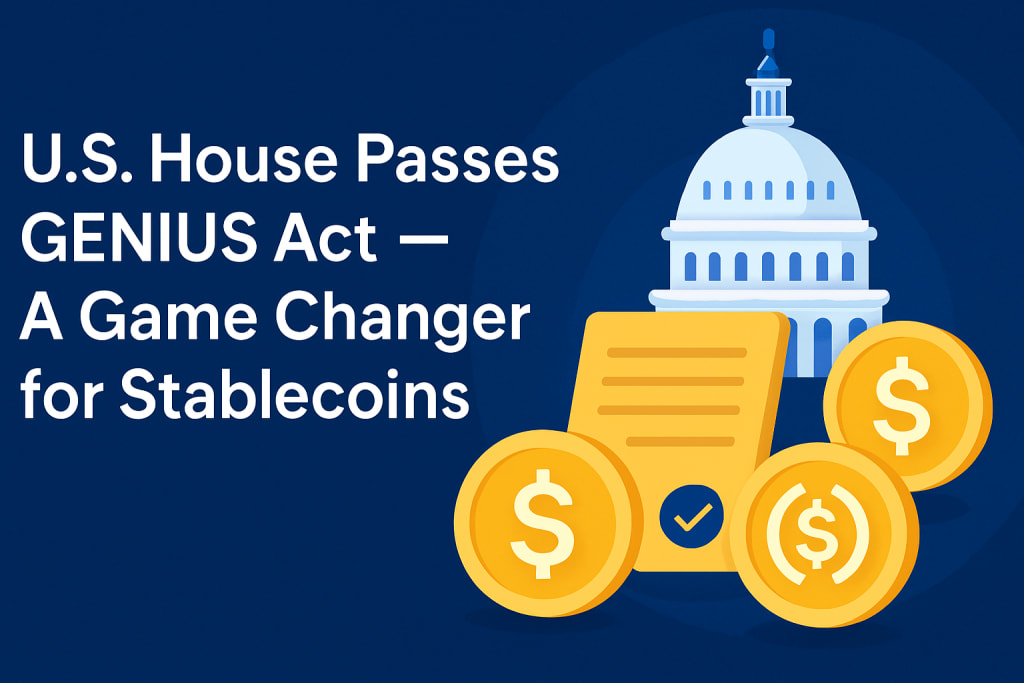
When the U.S. House of Representatives passed the groundbreaking GENIUS Act stablecoin regulation this week, it marked a pivotal shift in American financial policy. The legislation, officially known as the “Guaranteeing Enhanced Novel Infrastructure for Unchanneled Stablecoins” (GENIUS) Act, addresses the legal void surrounding stablecoin issuance, oversight, and consumer protection. For innovators, regulators, and crypto enthusiasts alike, this bill signals a bold new chapter.
1. Why the GENIUS Act matters
Filling a regulatory gap
Prior to the GENIUS Act, stablecoins were largely operating in a gray area—ruled by patchwork guidance from agencies like the SEC and OCC, but with little cohesive federal statute. Lawmakers repeatedly delayed action, wary of stifling innovation. This act provides a uniform legal framework, empowering regulators to oversee stablecoins much like banks oversee deposit-backed currencies.
Strengthening trust
Trust is the lifeblood of stablecoins. These tokens promise price stability by pegging value to real-world assets (e.g., USD, gold). Yet without clear regulation, issuers were often left on shaky ground when addressing reserves, audits, or redemption rights. Under the GENIUS Act, issuers must undergo stringent reserve accounting, periodic audits, and operate under federal chartering—mirroring traditional financial institutions. This elevates confidence for consumers, businesses, and large institutions.
Encouraging innovation
While consumer protection often conjures images of dams on innovation, the GENIUS Act carefully balances safeguards with flexibility. It’s designed to let cross-chain stablecoin projects flourish under consistent standards. Issuers can design tokens to operate seamlessly across multiple blockchain ecosystems, increasing competition and interoperability while ensuring regulatory compliance.
2. Major provisions of the GENIUS Act
A. Federal charter for stablecoin issuers
One of the headline features: a new federal licensing regime. Issuers must obtain authorization from the newly designated Office of Digital Asset Innovation (ODAI), which will be housed within the Treasury Department. Licensed issuers will face capital and reserve requirements analogous to banks, along with consumer disclosures and regular regulatory reporting.
B. Reserve requirements and audits
To redeem tokens at face value, issuers must back each digital token with an equivalent reserve. These reserves must be held in low-risk assets like cash or Treasuries. Auditors must verify reserve amounts quarterly, and findings are submitted to ODAI. This level of transparency aims to eliminate “fractional reserve” risk that has plagued unbacked stablecoins.
C. Consumer safeguards
Under this act, users holding stablecoins gain access to protections not previously guaranteed. For instance, if an issuer collapses, custodial arrangements must ensure that token holders can claim assets quickly. Plus, there are mandatory disclosures regarding redemption procedures, fees, and risks—empowering users with clarity.
D. Oversight and enforcement
ODAI will have authority to enforce compliance and carry out investigations. It can demand corrective measures, levy fines, or even revoke charters. Meanwhile, the SEC retains authority over fraud, and the CFTC retains jurisdiction over commodity-like tokens. The act aims to eliminate conflicting oversight by clearly mapping agency roles.
3. Implications for the crypto ecosystem
The passage of this legislation sends strong signals across the crypto landscape—from startups and legacy financial firms to developers of stablecoin development company services.
Startups and blockchain developers
With clear rules in place, blockchain developers can pursue stablecoin-based products without fearing sudden legal crackdowns. Projects involving lending, decentralized finance (DeFi), payments, or remittances can now plan for compliant stablecoins that operate across chains—especially with the act’s nod toward cross-chain stablecoin use cases.
Institutions and fintech
Banks, payment processors, and fintech giants have been waiting on the sidelines. With the GENIUS Act, they can collaborate with licensed issuers—or even become issuers themselves—without having to navigate uncertainty. This heralds the potential for mainstream adoption of stablecoin-based rails for real-time payments, treasury management, and global settlements.
Consumers and merchants
Once the act takes effect, stablecoins should become more reliable for everyday users. Whether remitting money internationally or paying at a store, token holders gain legal clarity—knowing issuers meet reserve standards and users’ holdings are protected. Merchants benefit too: accepting tokens backed by federal oversight reduces counterparty risk and simplifies accounting.
4. Challenges and road ahead
Implementation timeline
The bill must also pass the Senate and be signed by the President before it becomes law. Assuming swift movement, regulators will still need time to stand up ODAI, draft rulebooks, and onboard issuers—a process that could take 12–18 months.
Global coordination
While U.S. regulators establish this framework, stablecoins operate globally. For real interoperability—especially in finance and remittances—international alignment on reserve standards, cross-border auditing, and enforcement cooperation will be necessary.
Inclusion vs centralization
Some crypto advocates are concerned the act may favor large incumbents—banks and major fintechs—who can more easily meet compliance costs. Smaller issuers and independent stablecoin development company outfits may face barriers entering the market. Regulators will need to ensure oversight doesn’t stifle competition.
5. The big picture: Why it’s a game changer
Removing legal limbo
For years, stablecoins like Tether or USDC faced criticism over reserve opacity. The GENIUS Act’s clarity offers legitimacy and may accelerate broad uptake.
Boosting U.S. innovation
The U.S. lost some crypto leadership to more lenient jurisdictions. This bill could bring projects back home, reshaping the global digital asset landscape.
Repairing trust
Stablecoins haven’t seen major collapses—or yet—but trust has eroded from high-profile failures. By guaranteeing reserves and consumer protections, this legislation could build credibility in tokenized money.
Enabling real‑time finance
Imagine a future where payroll drops via stablecoin, retail settles instantly, and international remittances dodge banking lags—all under federal oversight. The GENIUS Act may pave this path.
6. What comes next — and how you can engage
- Stay informed: Track Senate movement—read hearings and committee reports for amendments.
- Share feedback: Industry, user‑rights, and consumer groups will receive public comment opportunities. Voice matters.
- Prepare for adoption: If you’re with a stablecoin development company, begin auditing reserves and building compliant systems. If you’re a business, start exploring partnerships with potential U.S.–chartered issuers.
Monitor international standards: Keep an eye on global frameworks like the Basel Committee or FATF for cross-border alignment.
Conclusion
The House’s approval of the GENIUS Act stablecoin regulation represents a watershed moment. It recognizes stablecoins as financial infrastructure, deserving of clear oversight—not left in a legal blind spot. With support for cross-chain stablecoin innovation and protection for consumers and businesses, this legislation could unlock years of innovation in digital finance. That said, its true impact hinges on methodical implementation, cost-effective access for smaller developers, and global coordination.
As the Senate takes up the act, now is the moment to engage, innovate, and prepare. This law could define how digital money functions in the real world—for decades to come.
About the Creator
Keep reading
More stories from Siddarth D and writers in The Chain and other communities.
How a Crypto Comparison Tool Empowers Smarter Investment Decisions
Cryptocurrency markets are exciting, volatile, and, for many, difficult to navigate. While blockchain technology has revolutionized the financial landscape, it has also introduced an overwhelming number of coins and tokens to keep up with. With more than 20,000 cryptocurrencies available today, making an informed decision requires much more than hype or intuition—it requires data. This is where a crypto comparison tool becomes indispensable for any serious investor.
By Siddarth D6 months ago in The Chain
Blockchain Security: Ultimate Guide for Secure Trading & Tech
Introduction Blockchain technology has reshaped how Australians trade digital assets, manage data, and build decentralised applications. From crypto trading platforms to DeFi protocols and enterprise solutions, blockchain promises transparency, immutability, and trust. However, despite popular belief, blockchain systems are not immune to security risks. High-profile hacks, flawed smart contracts, and compromised private keys have resulted in billions of dollars lost globally, making blockchain security a top priority for traders and developers alike .
By saif ullah5 days ago in The Chain
Australia Blockchain Market: Digital Trust, Decentralization & Enterprise Adoption
According to IMARC Group, the Australia blockchain market reached a value of USD 78.0 Million in 2024 and is projected to expand to USD 130.7 Million by 2033, growing at a compound annual growth rate (CAGR) of 5.9% during 2025–2033. This steady expansion reflects Australia’s measured but increasingly strategic adoption of blockchain technologies across financial services, government operations, supply chains and enterprise data systems. Rather than speculative use cases alone, Australia’s blockchain ecosystem is evolving around practical applications such as digital identity, payments infrastructure, smart contracts, asset tokenisation and secure data sharing. As trust, transparency and efficiency become critical in a digitised economy, blockchain is positioning itself as a foundational technology supporting long-term digital transformation.
By Shrestha Roy7 days ago in The Chain




Comments
There are no comments for this story
Be the first to respond and start the conversation.