
The Role of Cryptocurrency Coins in Digital Business Ecosystems
How Tokenized Value, Incentive Models, and Decentralized Economics Power Modern Business Networks
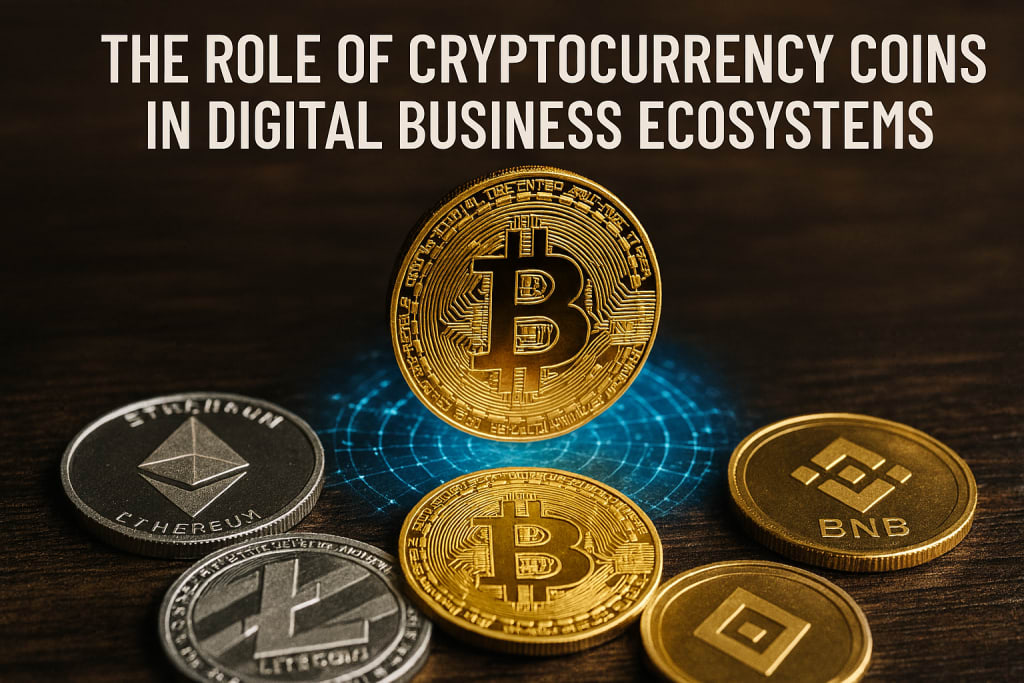
Digital business ecosystems are increasingly built on decentralized infrastructure, where trust minimization, programmability, and transparency are essential. Within this environment, the cryptocurrency coin functions as more than a speculative asset. It operates as an economic primitive that enables value exchange, incentivizes participation, and aligns network behavior. As enterprises experiment with blockchain-based models, understanding how cryptocurrency coins integrate into digital ecosystems has become strategically important.
Cryptocurrency Coins as Economic Infrastructure
At a foundational level, a cryptocurrency coin acts as native money within a blockchain network. It facilitates peer-to-peer settlement without reliance on centralized intermediaries. In digital business ecosystems, this property enables frictionless transactions across platforms, geographies, and organizational boundaries. Unlike traditional payment rails, settlement finality is enforced cryptographically, reducing reconciliation overhead and counterparty risk.
Beyond payments, cryptocurrency coins are used to price computational resources, storage, and bandwidth. Gas fees, staking requirements, and protocol-level rewards create self-regulating economies. These mechanisms ensure that network resources are allocated efficiently while discouraging malicious behavior through economic penalties.
Incentive Design and Network Participation
A critical role of the cryptocurrency coin is incentive alignment. Digital ecosystems thrive when independent actors—developers, validators, users, and service providers—are motivated to act in the network’s best interest. Tokenized incentive models reward participants for validating transactions, maintaining infrastructure, and contributing code.
Staking-based consensus models, for example, use cryptocurrency coins as collateral. Participants lock value into the protocol, gaining rewards for honest behavior while risking slashing for violations. This transforms security from a purely technical problem into an economic one, which scales more effectively as ecosystems grow.
Governance and Protocol Evolution
Modern digital business ecosystems are rarely static. Governance mechanisms built around cryptocurrency coins allow networks to evolve without centralized control. Token-weighted voting enables stakeholders to propose and approve upgrades, parameter changes, and funding allocations.
This governance layer is particularly relevant for decentralized applications operating in regulated or fast-changing markets. By embedding decision-making into the protocol, ecosystems can adapt while preserving transparency and auditability. The cryptocurrency coin, in this context, becomes a governance instrument rather than merely a medium of exchange.
Enterprise Integration and Interoperability
From an enterprise perspective, cryptocurrency coins enable interoperability between disparate systems. Businesses can integrate blockchain networks into existing digital stacks to facilitate cross-platform payments, automated settlement, and programmable incentives. Smart contracts denominated in a cryptocurrency coin allow enterprises to enforce business logic autonomously, reducing operational friction.
As enterprises increasingly collaborate with crypto coin developers, customized token models are being designed to support supply chain tracking, loyalty ecosystems, and decentralized finance integrations. These implementations emphasize utility and sustainability over short-term speculation, aligning blockchain usage with real business outcomes.
Risk Management and Economic Sustainability
Despite their advantages, cryptocurrency coins introduce economic and operational risks. Price volatility, liquidity fragmentation, and regulatory uncertainty can impact ecosystem stability. Mature digital business ecosystems address these challenges through mechanisms such as token supply controls, fee adjustment algorithms, and integration with stable settlement layers.
Risk modeling and on-chain analytics are now core components of ecosystem design. By monitoring velocity, concentration, and incentive efficiency, businesses can ensure that the cryptocurrency coin continues to support long-term network health rather than extractive behavior.
Conclusion
In digital business ecosystems, the cryptocurrency coin is a multifunctional asset that underpins transactions, incentives, governance, and interoperability. Its role extends far beyond digital cash, serving as the economic backbone of decentralized networks. As blockchain adoption matures, businesses that understand and design around these dynamics will be better positioned to build resilient, scalable, and transparent digital ecosystems.
Looking ahead, the strategic value of a well-designed cryptocurrency coin will depend on rigorous token economics, clear utility alignment, and measurable business impact. Digital ecosystems that treat coins as programmable economic tools, rather than marketing instruments, are more likely to achieve durability. For technical leaders, this requires continuous evaluation of incentive feedback loops, governance participation rates, and real-world value creation across stakeholders within evolving global digital market conditions.
About the Creator
Keep reading
More stories from Siddarth D and writers in The Chain and other communities.
Why Startups Are Still Launching New Cryptocurrency Coins in 2026
In 2026, startups across fintech, gaming, AI, logistics, and decentralized infrastructure are still launching a cryptocurrency coin despite regulatory scrutiny and market maturity. The motivation is no longer speculative hype but structural utility. Founders increasingly view a cryptocurrency coin as programmable financial infrastructure rather than a fundraising gimmick. Tokens now encode governance, automate incentives, and orchestrate multi-party ecosystems where traditional equity models fall short.
By Siddarth D5 days ago in The Chain
Who Wins Between Cryptocurrency and Traditional Banking?
Who Wins Between Cryptocurrency and Traditional Banking? Money has changed over time. Financial systems constantly adapt to new technology, whether it's by bartering goods or using gold coins, paper currency, or digital banking apps. One of the most important financial debates of the modern era is taking place right now: Cryptocurrency vs. Traditional Banking: Who actually wins?
By Farida Kabira day ago in The Chain
Mismatch Challenge Winners
Blending genres isn’t about stacking elements side by side. It’s about what happens when two sets of expectations refuse to cooperate. The strongest entries in the Mismatch Challenge understood that tension and leaned into it. Rather than smoothing the edges, these stories let their chosen genres complicate one another, creating friction that carried through voice, structure, and consequence.
By Vocal Curation Team2 days ago in Resources




Comments
There are no comments for this story
Be the first to respond and start the conversation.