
The Evolving World of Crypto Wallets: Beyond Storage to Sovereignty
How Wallets Became Gateways to Finance, Identity, and Sovereignty in the Decentralized Era


In crypto, the wallet is no longer just a tool—it’s an interface, a battleground, and a declaration of intent. As digital assets expand from speculation into decentralized finance, identity, and governance, wallets have matured from simple key managers into programmable, sovereign agents.
This article maps the evolving landscape of crypto wallets—from their technical underpinnings and user experience models to the political and regulatory frictions shaping their future.
Wallet Types: A Changing Taxonomy

1. Hot Wallets
Connected to the internet, these browser, mobile, and desktop wallets (e.g. MetaMask, Trust Wallet) offer speed and ease-of-use. But with convenience comes vulnerability: phishing, malware, and poor key hygiene remain common threats.
2. Cold Wallets
Offline and air-gapped (e.g. Ledger, Coldcard), cold wallets protect keys by isolating them from online access. Excellent for long-term storage, but less ideal for everyday DeFi.
3. Smart Contract Wallets
Wallets like Safe and Argent live on-chain, adding programmable features like multisig, social recovery, spending controls, and gas abstraction. These are the wallets of choice for DAOs and power users.
4. MPC Wallets
Multi-party computation wallets (e.g. ZenGo, Fireblocks) divide private key control among multiple parties or devices. No seed phrase needed—ideal for institutions or users who prefer a recovery model without single points of failure.
5. Custodial Wallets
Platforms like Coinbase or Binance control keys on your behalf. While easy and insured, they contradict crypto’s core principle: “not your keys, not your coins.”
6. Embedded Wallets
Invisible by design, wallets like Magic or Web3Auth use social logins, biometrics, or passkeys to abstract away key management. They power smooth onboarding—but often depend on centralized ID and cloud infrastructure.
Core Technologies & Trends
Keys, Recovery & Security
- Seed Phrases (12–24 words) remain standard, but face UX and security limitations.
- Alternatives like MPC, device-bound keys (Secure Enclave), and cloud-encrypted backups are gaining ground.
- Recovery Innovations include social recovery (Argent), Shamir secret sharing, and custodial shards.

Smart Wallet Features
- Account Abstraction (ERC-4337): Enables wallets to pay gas in any token, batch actions, add plugin modules, and serve as programmable agents.
- ZK Integration: Tools like zkLogin and ZKPs introduce selective disclosure, privacy-preserving credentials, and Sybil resistance.
Cross-Chain Interoperability
Wallets like Rabby, XDEFI, and Core streamline UX by aggregating multiple ecosystems (EVM, Bitcoin, Cosmos, Solana) into one interface. No more switching wallets per chain.
Legal, Ethical & Political Stakes
The Samourai Wallet Crackdown

In 2024, U.S. authorities arrested developers of Samourai Wallet—a privacy-preserving Bitcoin wallet. Their crime? Offering CoinJoin mixing and tools for anonymous spending.
The case signals a shift: wallets are no longer seen as neutral tools. Features like anonymity, decentralization, or censorship resistance may now be interpreted as “facilitating money laundering.”
Wallets as Political Statements
- Custodial Wallets are fully surveilled, often required by law to block or freeze users.
- Self-custody Tools are being scrutinized for offering too much privacy.
- Reputation Wallets (e.g. Worldcoin, Gitcoin Passport) introduce access-gated systems—raising ethical questions about who gets to participate in financial ecosystems.
Choosing a wallet is no longer just a UX decision—it’s a statement of sovereignty, privacy, and resistance.
Wallet Comparison Table

Choosing the Right Wallet

Step 1: Prioritize Your Values

Step 2: Use Case–Based Guidance

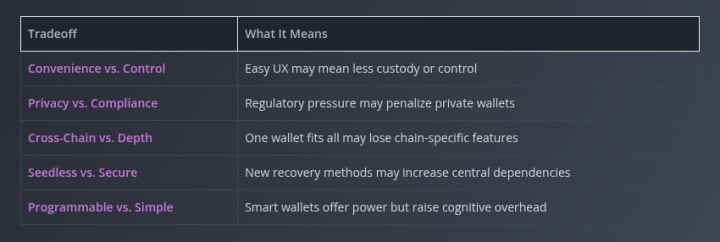
Step 3: Know the Tradeoffs
Pro Tips
- Use different wallets for different purposes: one for daily use, one cold for storage.
- Store seed phrases offline and redundantly—ideally with fire/water-resistant solutions.
- Avoid wallets that are not open source or lack export/recovery options.
- Keep jurisdictional awareness: privacy tech may be illegal or risky in some regions.
- Consider wallets that evolve with you—from beginner to advanced, over time.
What's Next for Wallets?
The future of wallets is not just about holding assets—it’s about managing identity, privacy, access, and autonomy. Expect to see:
- Passkey-based wallets (no seeds, biometric recovery)
- AI-native wallets (agentic, auto-signing, smart interactions)
- Onchain identity wallets (DID, zkKYC, verifiable credentials)
- Modular wallets-as-a-service powering onboarding invisibly
In the end, the best wallet is not just the safest or most convenient—it’s the one that reflects your values and your threat model. In a decentralized world, that’s the ultimate form of self-expression.
About the Creator
Time Money Code
Content creator exploring the intersection of time, money, and code. Sharing Python tools, automation hacks, and productivity systems to help you work smarter, earn more, and build efficiently.
https://timemoneycode.vercel.app
Keep reading
More stories from Time Money Code and writers in The Chain and other communities.
Crypto Wallets Under Fire: The Legal, Ethical, and Political Stakes of Self-Custody
As crypto wallets evolve from simple storage tools into gateways of financial freedom and digital identity, they are drawing new scrutiny from regulators, prosecutors, and political systems. Once considered neutral infrastructure, wallets are now being reimagined as instruments of power and potential criminality. The arrest of the Samourai Wallet developers in 2024 marked a turning point: open-source wallet developers are no longer insulated by the "code is speech" doctrine. The implications extend beyond privacy wallets to the very architecture of crypto itself.
By Time Money Code9 months ago in The Chain
Modern Machine Learning Techniques Redefining AI Systems
Let's be honest — most of us interact with AI every single day without really thinking about it. The moment your inbox filters out spam, your streaming app suggests the perfect show, or your bank flags a suspicious transaction before you even notice it — that's machine learning quietly doing its job. But what's actually happening under the hood? And why does it matter for you or your business?
By Technoloader4 days ago in The Chain


Comments
There are no comments for this story
Be the first to respond and start the conversation.