
Stablecoins for Cross-Border Payments: A New Era in Global Transactions
How Stablecoins Are Disrupting Traditional Finance and Making Global Transactions Faster, Cheaper, and More Inclusive
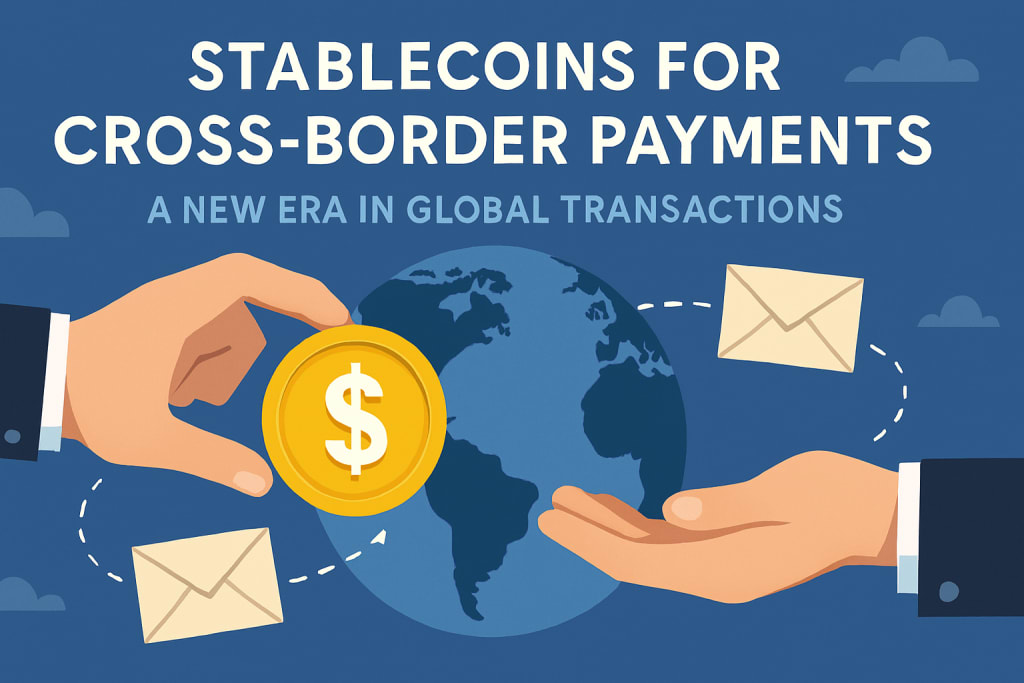
In the digital age, speed and simplicity are not just conveniences—they're necessities. The way we send and receive money across borders is being transformed, and at the forefront of this revolution are stablecoins for cross-border payments.
Gone are the days when international transactions took days and racked up fees along the way. With the advent of blockchain technology and stablecoins, we are beginning to witness the crumbling of traditional payment barriers.
Why Traditional Cross-Border Payments Are Broken
Before we dive into how stablecoins are changing the game, it's important to understand the flaws in the current system.
International wire transfers involve a network of intermediaries—banks, clearinghouses, and payment processors—all of whom take their share of fees and add latency. Delays of up to five business days are not uncommon. On top of that, the lack of transparency and traceability in these systems means users often don’t know where their money is during the process.
Add to this the currency conversion fees, regulatory inconsistencies, and the technological lag in underbanked regions, and you have a perfect storm of inefficiency.
Enter Stablecoins: The Digital Fix
Stablecoins are digital assets pegged to the value of a fiat currency, typically the US Dollar or Euro. Unlike volatile cryptocurrencies like Bitcoin or Ethereum, their value remains relatively stable, making them ideal for financial transactions.
When it comes to cross-border payments, stablecoins eliminate many of the obstacles found in traditional finance. They can be sent instantly across the globe, with minimal fees, and without the need for middlemen.
But what makes this particularly exciting is not just the speed or cost—it's the accessibility. Anyone with a smartphone and internet connection can send or receive stablecoins, regardless of their banking status.
The Rise of Use Cases in the Real World
Countries facing economic crises, such as Argentina or Venezuela, have seen a rise in stablecoin usage for both domestic and cross-border payments. When local currencies lose value rapidly due to inflation, stablecoins become a lifeline. Migrant workers, for instance, can send money home to their families in stablecoins and ensure that the value doesn’t erode before it’s withdrawn.
Freelancers and remote workers are also increasingly choosing to be paid in stablecoins. Not only does this bypass the friction of international banking systems, but it also provides them with more control over how and when they convert their earnings to local currency.
Major Players Driving the Adoption
While the concept of stablecoins has been around for years, recent innovations have made them more viable than ever. Projects like USDC and USDT dominate in terms of market cap, but newer entrants focusing on compliance, privacy, and decentralisation are gaining traction.
One of the more promising developments in this space is the rise of the decentralized stablecoin model. These coins are not backed by traditional banking reserves but rather use algorithmic models or crypto-collateral to maintain their peg. While some early versions struggled with volatility, newer models are significantly more robust and transparent.
Decentralised options offer users not only freedom from banking infrastructure but also control over their financial privacy. These alternatives are paving the way for more inclusive finance, especially in parts of the world where trust in government or financial institutions is low.
Regulatory Challenges and the Road Ahead
Of course, no innovation comes without hurdles. The global regulatory landscape for stablecoins is still evolving. Governments and central banks are scrambling to catch up, trying to classify and regulate these digital assets in ways that protect consumers without stifling innovation.
There is also a legitimate concern about financial crimes, including money laundering and terrorism financing. But technology is not to blame here—it's the misuse of it. And with the right oversight, stablecoins could become one of the safest forms of digital payment.
It’s also worth noting that Central Bank Digital Currencies (CBDCs) are being developed in response to the stablecoin boom. However, many argue that they may lack the openness and flexibility that make stablecoins so revolutionary.
Why This Matters for the Global Economy
We live in a world that’s becoming increasingly interconnected, and our financial systems need to reflect that. Remittances alone—money sent home by migrant workers—are a $600 billion industry annually. Imagine the economic uplift if fees dropped from 7% to under 1%, and funds reached families within seconds instead of days.
Stablecoins provide a secure, scalable, and inclusive solution to these inefficiencies. More than just a tech upgrade, they represent a shift in financial power—from institutions to individuals.
By empowering users directly, these digital currencies can foster more equitable access to money, especially in regions where banking systems are outdated, predatory, or non-existent.
Challenges Worth Solving
There are still technical and educational hurdles to overcome. Wallet usability, private key management, and network interoperability are ongoing issues that developers and crypto platforms need to refine.
Moreover, while blockchain transparency is a strong point, it also means a level of traceability that can conflict with personal privacy. Balancing transparency with user autonomy will be a delicate but crucial aspect of the next phase of development.
Education is perhaps the most underrated piece of the puzzle. As the ecosystem grows, users need to be informed and empowered to use stablecoins safely and effectively.
The Bigger Picture: Financial Sovereignty
At the heart of this movement is a broader idea: financial sovereignty. Stablecoins are not just a faster, cheaper way to send money—they are a step toward giving people full control over their financial lives.
This is where the concept of a decentralized stablecoin truly shines. It’s not just about removing intermediaries—it's about building systems that are governed by the communities that use them. In a world where trust in institutions is eroding, this model represents a powerful alternative.
Conclusion
The journey toward widespread adoption of stablecoins for cross-border payments is still in its early stages, but the momentum is undeniable. We are heading toward a future where sending money across the globe is as easy, fast, and cheap as sending an email.
What lies ahead is a new financial architecture—one that’s faster, fairer, and more accessible. Stablecoins are the building blocks of that system. And if used responsibly, they could reshape the way we think about money forever.
As we stand at the crossroads of traditional finance and decentralised innovation, one thing is clear: the future of cross-border payments isn’t just digital—it’s stable, transparent, and inclusive.
About the Creator
Keep reading
More stories from Siddarth D and writers in The Chain and other communities.
Cryptocurrency Token Development Company: Powering the Future of Digital Assets
In today’s fast-evolving digital landscape, cryptocurrencies have shifted from niche experiments to mainstream financial assets. At the heart of this transformation lies one critical innovation — cryptocurrency tokens. These digital representations of assets, utility, or value have become instrumental in fundraising, business models, decentralized ecosystems, and more. But behind every successful token is a strategic partner — a cryptocurrency token development company.
By Siddarth D7 months ago in The Chain
How Bitcoin Is Changing the Digital Payment Industry
The digital payment industry has undergone significant changes over the past two decades as technological innovation continues to reshape financial services. Traditional payment systems, which rely on banks, credit card networks, and payment processors, were once the primary method for conducting online transactions. However, the emergence of cryptocurrencies—particularly Bitcoin—has introduced a new model for digital payments that operates independently of traditional financial institutions.
By Backlinks Cart7 days ago in The Chain



Comments
There are no comments for this story
Be the first to respond and start the conversation.