
Cross‑Chain Stablecoin: Unlocking Seamless Value Transfer Across Blockchains
How Interoperable Stablecoins Are Transforming DeFi, Payments, and Multi-Chain Liquidity

The emergence of blockchain technology enabled the rise of decentralized finance, with stablecoins playing a central role in promoting predictable value exchange. But as multiple blockchain networks coexist—Ethereum, Binance Smart Chain, Solana, Avalanche, and more—users and developers face fragmentation. Enter the cross‑chain stablecoin, a solution that enables stablecoins to be transferred and used across disparate networks without friction.
Cross‑chain stablecoins not only preserve value pegged to fiat (US dollar, euro, rupee, etc.), but also empower users to access liquidity, lending, and payment ecosystems across all major chains. In this article, we explore what cross‑chain stablecoins are, how they work, their advantages, challenges, stablecoin use cases, and why businesses increasingly seek stablecoin development services. We’ll also touch on yield bearing stablecoins, which combine stability with passive income opportunities.
What Is a Cross‑Chain Stablecoin?
A cross‑chain stablecoin is a token backed by fiat—or algorithmically pegged—that can seamlessly move and operate across multiple blockchain platforms. Unlike traditional stablecoins confined to a single network (for instance, USDC on Ethereum), cross‑chain variants leverage bridges, liquidity protocols, and chain‑agnostic standards to exist and function on multiple chains.
At its core, such a stablecoin uses a combination of mint-and-burn mechanisms, collateral pools, or algorithmic reserves on each chain. For example, when you want to send stablecoins from Ethereum to Solana, a bridge locks or burns tokens on Ethereum and mints equivalent tokens on Solana, maintaining the peg and total supply across ecosystems. This architecture not only ensures price stability but also expands stablecoin use cases by enabling seamless value transfer across different blockchain environments—supporting everything from DeFi lending to cross-border payments.
This architecture empowers users to pay transaction fees in local tokens (ETH, SOL, BNB) while using the same stablecoin value. Additionally, developers can program DeFi contracts around a stable medium, confident that users can access liquidity regardless of their chain.
How Cross‑Chain Mechanisms Work
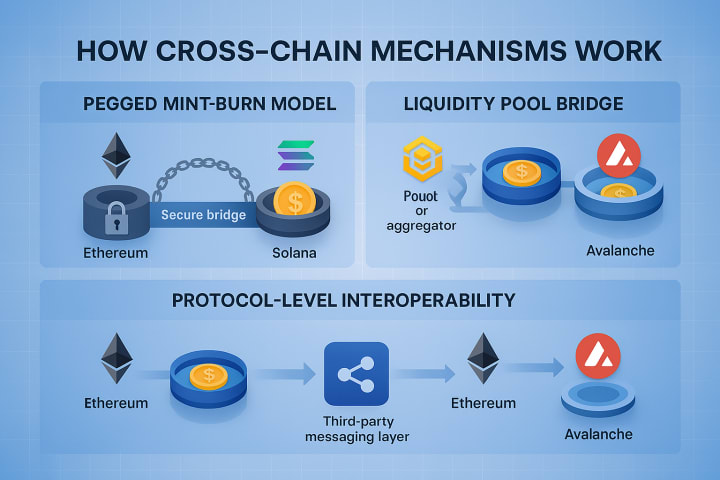
The most common patterns for bridging a stablecoin across chains include:
1. Pegged Mint‑Burn Model
In this model, the stablecoin issuer maintains collateral in a reserve or vault on each supported chain. When tokens are transferred from Chain A to Chain B, the protocol burns or locks the tokens on Chain A and issues (mints) an equivalent amount on Chain B. When transferring back, the same process reverses.
This approach preserves total supply while ensuring the peg is anchored by fiat reserves or crypto collateral held in audited custody.
2. Liquidity Pool Bridge
Here, decentralized exchanges or liquidity pools maintain stablecoin balances on multiple chains. A bridging operation swaps tokens across pools via routers or aggregators, rebalancing supply. Fees for bridging often go to LPs. While this model can introduce slippage or variable pricing, it enables permissionless movement.
3. Protocol‑Level Interoperability
Some modern cross‑chain protocols (like Wormhole, LayerZero, or Connext architecture) deliver messaging and token transfer services across chains. A stablecoin built atop such infrastructure inherits cross‑chain capabilities natively, without bespoke bridges on each pair.
Key Benefits of Cross‑Chain Stablecoins
Seamless Transfers: Move value across chains without multiple wrap/unwrap steps. One stablecoin, many networks.
- Unified Liquidity Access: Users tap into liquidity in any DeFi ecosystem, enhancing capital efficiency.
- Lower On‑Chain Friction: Holders don’t need separate stablecoins per chain—one asset meaning global utility.
- Diverse Use Cases: Cross‑chain support unlocks more people to use stablecoin use cases like cross-border remittance, DeFi yield farming, and payments in emerging markets.
- Modular Development: Businesses seeking stablecoin development company can launch token logic once and deploy it on multiple chains via interoperable modules, reducing duplication.
Integration with Yield Bearing Stablecoins
A powerful extension is combining cross‑chain capability with yield bearing stablecoins. These are stablecoins that earn interest passively—via lending, staking, or underlying yield strategies—while retaining their peg.
For instance, a cross‑chain stablecoin could accrue fees or interest while sitting in liquidity on multiple chains or participating in lending protocols. Users get stable, low-risk asset exposure with income generation across ecosystems.
This is especially attractive to corporate treasuries, DAOs, or crypto-native institutions looking to maintain stability, cross-chain stablecoin, and passive yield—all from a single token.
Major Use Cases for Cross‑Chain Stablecoins
Here are several stablecoin use cases uniquely enhanced by cross‑chain design:
1. Cross‑Border Payments and Remittances
By moving stablecoins across chains cheaply and quickly, cross‑border workers can send funds using low‑fee networks and recipients can cash out where it’s most convenient—regardless of which chain they hold.
2. DeFi Aggregation and Yield Strategies
Yield farmers can access lending pools or liquidity pools across Ethereum, BSC, Avalanche, and others—all using the same token. Their exposure is consistent, lowering fragmentation risk.
3. Gaming, NFTs, and Metaverse Commerce
Users in blockchain games or metaverse platforms may reside on different chains. A cross‑chain stablecoin allows smooth in‑game payments, storefront purchases, and asset issuance without switching tokens.
4. Corporate Treasury and Multichain Custody
Global businesses—and decentralized autonomous organizations—may operate on multiple chains. A cross‑chain stablecoin enables aggregated treasury functions and unified liquidity.
5. On‑Demand Chain Swaps
Wallets or aggregators can automatically route users through best‑value chain paths using a global stable asset. This improves UX and reduces manual bridging.
Technical and Regulatory Challenges
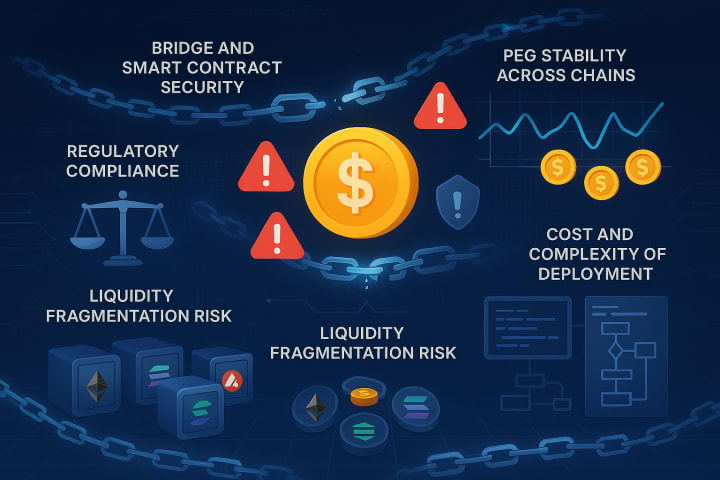
While cross‑chain stablecoins offer major advantages, they also come with complexities:
A. Bridge and Smart Contract Security
Each bridge or mint/burn contract is a potential point of failure. Hacks or bugs can undermine the peg if reserves are not properly secured or collateralized.
B. Peg Stability Across Chains
Maintaining the 1‑to‑1 peg across multiple environments, currencies, and market conditions requires robust collateral management and monitoring across networks.
C. Regulatory Compliance
Different jurisdictions may view stablecoins differently—some as securities, others as payment instruments. Issuers offering cross‑chain liquidity may need multi‑jurisdictional compliance, KYC/AML, and reserve audits.
D. Liquidity Fragmentation Risk
If liquidity is thin on one chain, bridging users out could lead to slippage or peg deviation. Maintaining healthy reserves or pools on all supported networks is essential.
E. Cost and Complexity of Deployment
Deploying smart contracts on multiple chains involves multiple audits, piece‑wise upgrades, and maintenance overhead. That’s why many businesses look for specialized stablecoin development services to handle cross‑chain deployment and governance.
Building a Cross‑Chain Stablecoin: Development Steps
For those looking to create or integrate with this technology, following is a high‑level process often offered by stablecoin development services teams:
- Design the peg model – Decide between fiat‑backed, crypto‑collateralized, or algorithmic collateral.
- Select cross‑chain protocol – Choose from mint/burn bridge, liquidity aggregation, or interoperability layer.
- Smart contract development and audits – Write token logic, bridge handlers, redemption logic; conduct multi‑chain audits.
- Reserve infrastructure – If fiat‑backed, set up custodial or on‑chain reserves per chain.
- Bridge deployment and testing – Deploy on testnets, simulate cross‑chain transfers, stress‑test.
- Governance and upgradeability – Include multisig or DAO control for mint/burn, collateral management, and emergency shutdown.
- UI and integrations – Build dashboard or wallet integration to move stablecoins across chains and tap into yield bearing stablecoins opportunities.
- Ongoing monitoring and compliance – Implement real‑time reserve monitoring and regulatory reporting.
Real‑World Examples
Several protocols offer or are migrating toward cross‑chain stablecoin models:
- USDC and USDT Bridging: Large stablecoins like USDC and USDT are bridged to multiple chains using wrapped versions, though not inherently cross‑chain native—they rely on custodial bridging.
- FRAX Cross‑Chain Pairing: FRAX supports cross‑chain deployments where mint/burn logic is built across multiple networks—though liquidity models vary.
- Native Multi‑Chain Stablecoins: Emerging projects like cUSD or certain experimental cross‑chain tokens are built on messaging-centric infrastructure (e.g. LayerZero or Wormhole) for native interoperability and flexibility.
These efforts illustrate the growing demand for bridging value with stable pricing across ecosystems—with stablecoins acting as the backbone.
Why Businesses Should Consider Cross‑Chain Stablecoins
- Unified Brand Asset: Issuers set a single token identity consistent across networks, boosting trust and simplifying marketing.
- Global Reach: Companies can issue and support their token in markets regardless of chain popularity.
- Ecosystem Agnostic: Enterprises need not build separate tokens or partnerships for each chain—they rely on interoperable deployment.
- Revenue through Yield: Incorporating yield bearing stablecoins allows businesses to offer passive yield to users or treasury holdings.
- Custom Integrations: Through professional stablecoin development services, businesses tailor collateral models, governance structures, compliance, and UI to fit their needs.
Future Outlook
Cross‑chain stablecoins represent a promising evolution in digital value transfer. As interoperability protocols mature, users will demand seamless asset mobility without sacrificing trust or yield. Regulatory clarity is needed to foster institutional adoption, but demand for chain‑agnostic money is only growing.
Developers and businesses focusing on DeFi, payments, financial infrastructure, or fintech innovation can gain a significant head start by embracing cross‑chain design early. Services that combine token engineering, collateral security, cross‑chain bridges, and compliance frameworks will be in high demand.
In the coming years, expect to see stablecoins that not only maintain peg but integrate real‑time interest, fractional reserve transparency, and fully cross‑chain payments—creating a bridge between stable value and open liquidity networks.
Conclusion
Cross‑chain stablecoins offer the ability to move fiat‑pegged value seamlessly across multiple blockchain networks—fueling liquidity, access, and efficiency. Coupled with yield bearing stablecoins, they deliver stability plus passive income. Whether you're building DeFi protocols, global payment apps, or corporate treasury infrastructure, partnering with expert stablecoin development services can accelerate deployment while managing risk. The range of stablecoin use cases, from remittance to gaming, reflects their growing role in the web3 economy. As users demand simpler and more efficient access to liquidity across chains, cross‑chain stablecoins are positioned to become indispensable.
About the Creator
Keep reading
More stories from Siddarth D and writers in The Chain and other communities.
Machine Learning in Trading: Revolutionizing Financial Markets
In recent years, machine learning in trading has emerged as a game‑changer in finance. Hedge funds, institutional investors, and even retail traders are increasingly turning to algorithms powered by data science to identify patterns, manage risk, and execute trades with precision. Unlike traditional rule‑based systems, machine learning models adapt, learn from new data, and refine themselves over time. In this post, we’ll explore how machine learning is transforming trading strategies—from predictive signal generation to portfolio optimization—and highlight real‑world applications, pitfalls, and best practices.
By Siddarth D6 months ago in The Chain
Crypto 30x: Can Bitcoin Still Deliver Exponential Returns?
Introduction When traders talk about crypto 30x, the conversation usually drifts toward obscure altcoins, meme tokens, or early-stage projects with questionable fundamentals. Bitcoin, by contrast, is often dismissed as “too big” or “already mature” to generate exponential returns. But history tells a more nuanced story. Bitcoin has delivered multiple 30x-style cycles over its lifetime — not overnight, but through long-term adoption, monetary shifts, and supply-driven scarcity.
By saif ullah4 days ago in The Chain
Crypto 2026 Conference: Ultimate Guide for Industry Events & Innovation
Introduction As the crypto and blockchain ecosystem continues to mature, 2026 is shaping up as a landmark year for industry conferences worldwide. From Miami and Denver to Dubai and Paris, developers, founders, regulators, and investors are preparing to converge on the biggest stages yet to share innovation, form partnerships, and set the agenda for the next chapter of digital finance. Whether you’re a blockchain builder, a crypto trader, or a Web3 startup founder, the strategic decisions you make at conferences this year could define your trajectory for the next decade.
By saif ullah5 days ago in The Chain


Comments
There are no comments for this story
Be the first to respond and start the conversation.