
What is hijab and its conditions
Society's attitude towards a closed woman


Despite the fact that the modern world is changing very rapidly, there are still traditions and customs that, once established in society, migrate from generation to generation, from century to century, and with each era of humanity become more and more stable. One of such traditions, as non-Muslims and some ignorant Muslims like to say, can be called the tradition of women wearing hijab. However, it is wrong to call wearing hijab a custom or a tradition. The religion of Islam is not associated with traditions or customs, no matter what areas of Islamic knowledge they relate to: questions of belief and the norms of Islamic law are based on faith and common sense, and on the interests of this and the next world.
What is hijab and its conditions
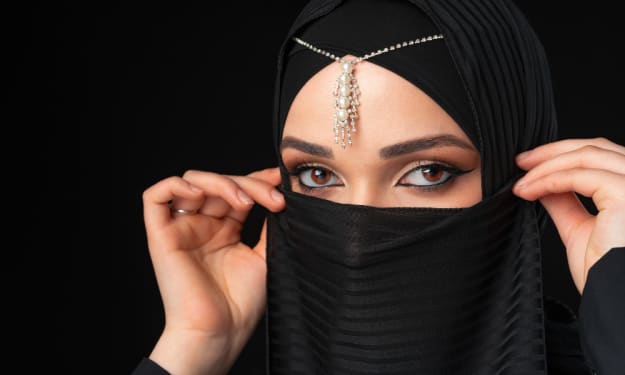
Hijab is a traditional Muslim women's clothing, in a broader sense - it is a woman's concealment of her body from prying male eyes, thus not attracting attention. A woman must cover her entire body, except for her hands and face, however, in some Muslim societies, leaving the hands and face is not enough to not attract the attention of men, especially in those regions where the traditional women's clothing is the niqab or abaya, in such regions a girl must follow local traditions by dressing in accordance with the local culture. Wearing hijab for Muslim women was imposed in the Koran as an obligation more than 1400 years ago.
The hijab has a number of mandatory conditions that it must meet when a girl goes outside her home:
- The hijab should cover the entire body except the hands and face;
- it should not be decorated, or too bright or unusual, attracting the attention of other men;
- it should not be transparent;
- tight-fitting clothing that emphasizes the girl's figure or individual parts of her body is not allowed;
- women's clothing and a woman's body should not smell of perfume;
- The hijab should not look like men's clothing.
Society's attitude towards a closed woman
There are many opinions on this matter in society, and one can often hear indignant statements about wearing a hijab, but such statements are most often heard from those who have nothing to do with Islam. You will rarely hear such statements from eastern girls and women in a hijab, since most of them not only do not think anything negative about wearing a hijab, but wear it with pleasure, considering it one of the most beautiful and elegant elements of their clothing.
Hijab and burqa are often confused by those who do not understand Muslim culture. It is funny to hear comments from such people about the appropriateness of wearing Muslim clothing.
Differences in Muslim women's clothing
A abaya is a type of outer garment worn by women in Muslim countries – it resembles a long-skirted robe with long false sleeves. The abaya is equipped with a hair net or chachvan, which is designed to cover the face.
The history of wearing the abaya goes back to medieval Persia, where this clothing was called faraji and was both men's and women's outerwear with long sleeves. Such clothing was worn in the sixteenth century, and should not be confused with the chador or abaya - in the feature film "White Sun of the Desert" during filming, the classic version of the abaya was used.
A chador is a veil worn by women. Translated from Persian, "chador" means "tent". This veil completely covers a woman's figure, from head to toe, and can be black, blue, or white. A woman's face and head are covered with muslin cloth.
Hijab is a universal name, and this term can refer to any clothing that is made in the form of a veil that covers a woman from head to toe. The word "hijab" itself is translated from Arabic as "veil". But in its most common understanding, this word means a woman's headscarf, and in European countries, when they talk about hijab, this is what they mean. In Sharia, the obligatory wearing of a veil by women who profess Islam is one of its main provisions.
What is the difference between hijab and niqab, burka and charshaf, what is a stole and amirka, what types of Muslim headscarves do women wear, about Islamic clothing of Muslim women .
What should be the clothing according to Sharia ? Is it possible to wear a fashionable hijab? What should be women's shoes and what parts can a woman reveal to a man?
Hijab can be different: long and short, but it should hide the shape of the woman's body and should not be tight. The Holy Book of Allah, the Quran, says that a woman should not show her beauty to anyone except her husband or close male relatives. The Quran mentions that it is forbidden to flaunt all female charms except those that are visible, and it is especially emphasized that the neckline on the chest should be covered. Among the relatives to whom a woman can show herself without a veil or scarf are listed the husband, father, father-in-law, sons, husband's sons, brothers, brothers' sons, sisters' sons, women, servants who are eunuchs, children who have not yet reached puberty.
Is hijab a tradition?
The position of some people who consider the norms of Sharia and Muslim morality to be “Islamic customs” is erroneous and dangerous. The purpose of imposing this label is to distort people’s minds with the malicious idea that the spiritual and moral values of Islam (which, in fact, contain the secret of happiness in two worlds and are the truth) do not originate from Allah the Most High, but are a series of customs and habits inherited from ancestors.
Undoubtedly, the result of instilling this “idea” is to alienate the greatest number of people from the ancient heritage of Islam and they want to impose it on the renewing modern society in the age of progress and development of civilization.
In reality, renaming the norms of Sharia is not accidental. Indeed, renaming the foundations of Islam with false labels is one of the ways to destroy it. All this is done in the following way - a certain number of values from Islam are taken and a label called "custom" is attached to them, and after a certain period of time, people form an opinion that the foundations and values of Islam are just customs. They will forget that the values of Islam are based on sound thinking and research and were primarily established by Allah Himself. All the values with which Islam came are aimed at achieving prosperity in two worlds. The orders and laws of people are devoid of perfection, they are prone to make mistakes, and therefore they often call the truth a lie. Whereas within the framework of the norms of Islam, calling the truth a lie is excluded, since the One Who legitimized these norms is the Creator of reason and thinking. This fact alone is an unshakable argument for believing in the truth of the foundations and values of Islam.
About the Creator
Kimberly Jose
Kimberly Jose is the author and editor of Black Camels, a leading magazine for the Muslim abaya clothing industry in Pakistan. Kimberly is an advocate for sustainable modest fashion.
Keep reading
More stories from Kimberly Jose and writers in Styled and other communities.
What is a Burqa?
A burqa is an Islamic garment. The "classic" (Central Asian) burqa is a long robe with false sleeves that covers the entire body, leaving only the face open. The face is usually covered with a chachvan, a thick net made of horsehair that can be raised and lowered.
By Kimberly Joseabout a year ago in Styled
A Smart Choice for Your Wedding Hair
A Great Wedding Hair Choice: Human Crochet Hair Extensions. For many Black women, picking wedding hair is very important. You want to look and feel amazing. Human crochet hair extensions are a strong option. They are not like full wigs you just put on. Instead, a stylist uses a small hook. They attach real human hair pieces to your own braided hair. This makes a style that is part of you. It looks very natural and fits you perfectly.
By manman zhai3 days ago in Styled


Comments
There are no comments for this story
Be the first to respond and start the conversation.