
Traditional Costume
Fashion of the Arab East Countries

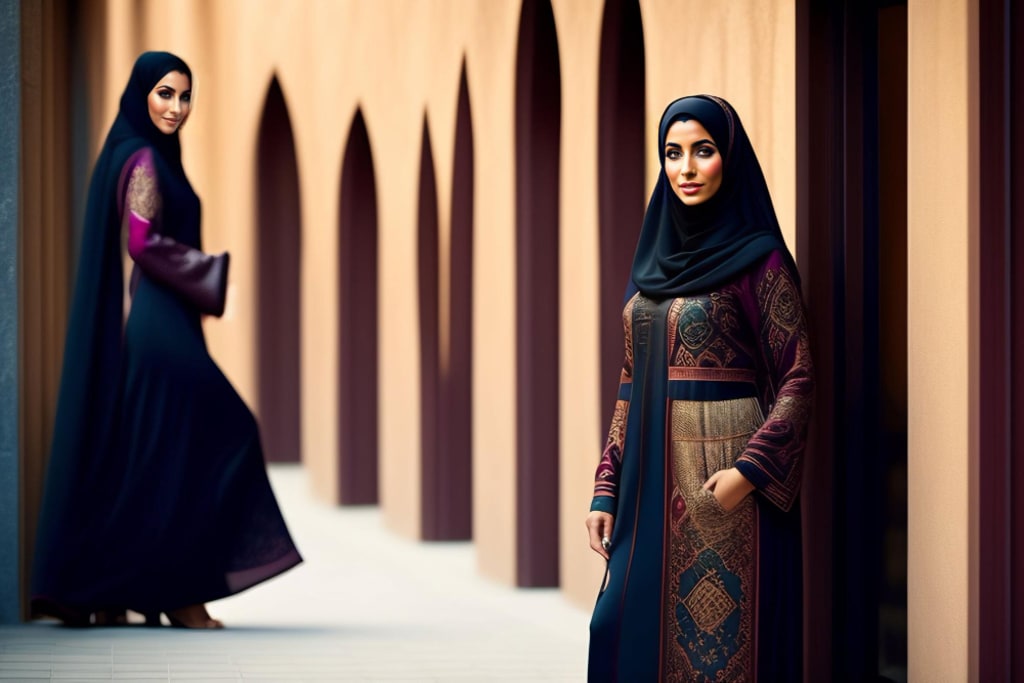
The costume of the Eastern countries is diverse, as are the traditions of the many peoples inhabiting the vast expanses of Asia. However, there are many common features in the costume of these peoples, connected, among other things, with their common history and common religion - Islam.
The Influence of the Arab Caliphate on Fashion
The traditional costume of the Arab countries was formed during the time of the Arab Caliphate, namely in the 7th-8th centuries. This time is considered the heyday of the Caliphate, the borders of which at that time began in the Indus River valley and ended at the shores of the Atlantic Ocean.
The Arab Caliphate lasted until the 13th century, but it left a significant cultural legacy and influenced the development of the peoples of all the territories that were part of it. And these are the territories of such modern countries as Syria, Palestine, Egypt, Sudan, Tunisia, Morocco, Spain, India, Turkey and, of course, the territory of the Arabian Peninsula, where the history of the Caliphate began.
In Islam, it is forbidden to depict a person, so information about traditional Arab costume can be gleaned from literature, from images of the inhabitants of the Muslim East created by Europeans, and also from traditional clothing that is still worn by the peoples of the East.
One of such sources on the history of Arab costume can be the tales of "A Thousand and One Nights". Thus, Scheherazade was described as the owner of a graceful figure, a white smooth face (it was "like the moon on the fourteenth night"), almond-shaped dark eyes under thick and long black eyebrows. It is believed that this was the ideal of female beauty during the Arab Caliphate. As for the costume, representatives of all classes of society (from peasant to caliph) wore clothes of the same style, which differed only in the quality of the fabric and the richness of the decor.
Men's suit and fashion of the Arab East
In ancient times, the men's clothing of the Arabian tribes consisted of a wide and long shirt with or without sleeves. And also a veil that protected the nomads' heads from the scorching rays of the sun. It was the long shirt and veil that formed the basis of the traditional Arab costume. Such a shirt consisted of two sewn panels and was always belted with a belt. An abbas cloak was worn over the shirt - a cloak made of sheep or camel wool. The veil was made from a quadrangular piece of fabric and was fastened to the head with a braid.
During the period of wars and expansion of the Caliphate's territories, innovations appeared in clothing, often borrowed from the conquered peoples. Thus, trousers were borrowed from the nomadic peoples of Asia, which became an obligatory element of the Arab costume. The trousers were white, made of cotton fabrics and ankle-length. At the waist, such trousers were fastened with a cord.
Soon, men began to wear a robe (or khaftan) over a white undershirt - clothing with long sleeves, decorated in the forearm area with inserts of contrasting fabric with inscriptions or patterns. Such a robe-caftan was always belted. The first such clothing most likely appeared in the times of Persia. In the Middle Ages, the fashion for wearing caftans came to Europe from the countries of the Arab East. Also, in the cold season, men could wear woolen clothing like a caftan with a lining - such clothing was called jubba. When it was cold, they also wore a woolen cloak, which was called aba or abaya. Such a cloak could be worn by both men and women.
The men's headdress was a turban. And also a keffiyeh - a veil or a men's headscarf.
Women's clothing of the Arab East
Traditional women's clothing in the Arab East was very similar to men's clothing. The main feature of women's and men's clothing in Muslim countries was the simplicity and freedom of clothing, as well as covering the entire body. Women also wore an undershirt, caftans, and harem pants, which were called shalvars. These pants were pulled down on the hips and gathered into many folds.
Women could also wear dresses. For example, in the Emirates, women wore a gandura dress - a traditional dress decorated with embroidery made of gold or colored and silver threads. With such a dress, they also wore pants called shirwal - pants with pleats. Another traditional women's dress is the abaya. Abaya is a long dress made of dark or black fabric. Gandura and abaya dresses are still worn by women in the East today.
Women in Arab countries have worn veils on their heads since ancient times. Thus, during the time of the Arab Caliphate, women covered their faces with an izar when going out. An izar is a veil, the upper end of which was pulled over the head at the back and secured with a cord on the forehead, while the rest of the fabric was secured with a clasp or held by hands in front and fell down the back and sides, almost completely covering the figure.
At the same time, in different parts of the former Arab Caliphate, the women's veil will eventually acquire local characteristics and different names. Thus, in the countries of the Middle East, the veil will be called a paranja, most likely from the Persian word ferenje, which means "opening", "window". Such a veil completely covered the figure and only a kind of "window" was left for the face - a window in the form of a thick mesh fabric.
In Arab countries (countries of the Arabian Peninsula), the veil is still most often called a hijab. Translated from Arabic, this word means a curtain. Hijab most often refers to a scarf that covers the head and neck, while the face remains open. Along with the hijab, women in the East can also wear a niqab - it covers the face, leaving only the eyes open.
Also in Muslim countries women can wear such a veil as a chador. The chador completely covers a woman from head to toe, but in some cases the face can remain open. The word chador itself, as well as the paranja, is of Persian origin. And in translation from Persian means a tent.
The Persian Influence on Islamic Fashion
Persia, like the Arab Caliphate, had a great influence on the formation of the traditional costume of the countries of the Muslim East.
It was from Persia that the Arabs borrowed such elements of clothing as the chador, paranja, turban, and caftan. The Persian kingdom existed from the 6th to the 4th centuries BC on the territory of modern Iran.
The Persian male costume consisted of leather pants and a leather caftan with a belt. The caftan and pants could also be made of wool. When the Persian king Cyrus conquered Media, he introduced the fashion for his courtiers to wear Median clothing, which also influenced the formation of the Arab costume. Median clothing was made of silk or fine wool, dyed purple and red. It was long and consisted of pants, a caftan-robe, and a cape.
Almost nothing is known about the Persian women's costume, since only male images have been preserved on the ancient Persian bas-reliefs that have survived to this day - images of hunters and warriors. However, the ancient Greeks painted Persian women. For example, on their vases. Thus, it can be assumed that in Persia women wore clothes made of expensive fabrics, long and wide, somewhat reminiscent of men's clothing. But at the same time they were distinguished by the richness of the decor.
About the Creator
Kimberly Jose
Kimberly Jose is the author and editor of Black Camels, a leading magazine for the Muslim abaya clothing industry in Pakistan. Kimberly is an advocate for sustainable modest fashion.
Keep reading
More stories from Kimberly Jose and writers in Styled and other communities.
What is hijab and its conditions
Despite the fact that the modern world is changing very rapidly, there are still traditions and customs that, once established in society, migrate from generation to generation, from century to century, and with each era of humanity become more and more stable. One of such traditions, as non-Muslims and some ignorant Muslims like to say, can be called the tradition of women wearing hijab. However, it is wrong to call wearing hijab a custom or a tradition. The religion of Islam is not associated with traditions or customs, no matter what areas of Islamic knowledge they relate to: questions of belief and the norms of Islamic law are based on faith and common sense, and on the interests of this and the next world.
By Kimberly Joseabout a year ago in Styled
FREE THE NIPPLE. BURN THE BRA. APOLOGISE TO OUR SPINES.
There are few things in modern life as quietly infuriating as the social expectation that women should strap themselves into uncomfortable, restrictive underwear every single day for the emotional comfort of strangers. Not safety. Not warmth. Not even practicality. Comfort. Specifically men’s comfort. Because somewhere along the way, we collectively decided that a woman’s nipple is a public threat, while a man’s nipple is background furniture.
By No One’s Daughter7 days ago in Styled



Comments
There are no comments for this story
Be the first to respond and start the conversation.