

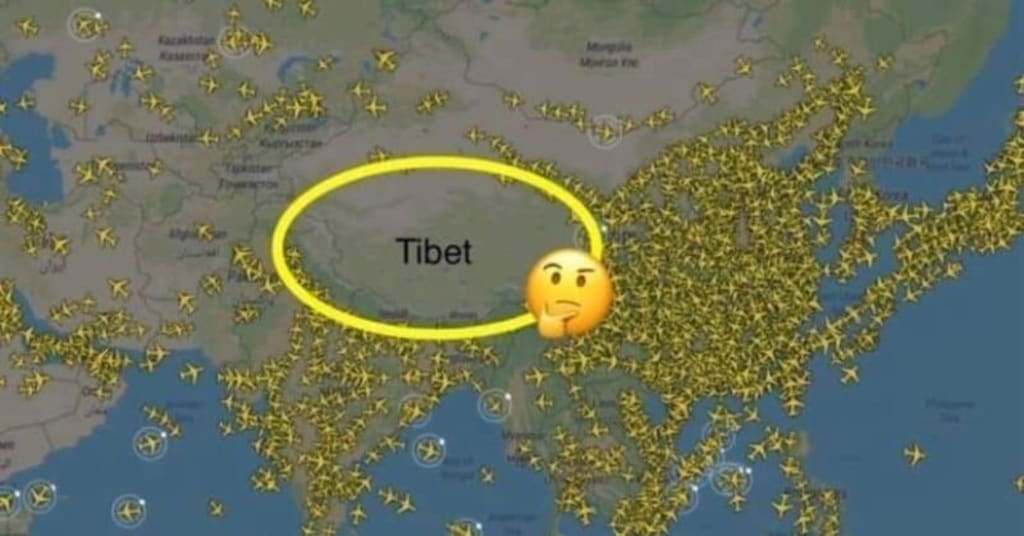
Air travel has revolutionized the way we traverse the globe, yet certain areas remain largely untouched by flight routes. The Tibetan Plateau, often referred to as the "Roof of the World," is one such region. Despite technological advancements in aviation, pilots and airlines tend to avoid flying over this expansive and challenging terrain. Why is that?
This article delves into the key factors that make Tibet a no-fly zone for many aircraft.
1. Extreme Altitude and Its Impact on Aircraft
Tibet sits at an average altitude of 4,500 meters (14,700 feet), with its peaks reaching over 8,000 meters. The high elevation poses significant challenges for commercial jets. At these altitudes, air pressure is lower, hindering engine performance and affecting aircraft operations. Additionally, in the event of an emergency, such as cabin depressurization, planes would need to descend rapidly to an altitude with sufficient oxygen levels. Over Tibet, such a descent might not be possible due to the towering mountains, limiting the pilots' ability to ensure passenger safety.
2. Harsh Weather Conditions
The Tibetan Plateau is notorious for its unpredictable and extreme weather patterns. Strong winds, violent turbulence, and sudden changes in weather can pose risks to aircraft flying over the region. The jet stream, a high-altitude, fast-moving wind current, is particularly strong over Tibet, making flying conditions turbulent. Severe thunderstorms and the potential for lightning strikes further complicate flight paths, making this region a hazardous one to navigate.
3. Limited Airport Infrastructure
Another critical factor in avoiding Tibetan airspace is the limited infrastructure in case of emergency landings. The region has very few airports capable of handling large commercial aircraft. In an emergency, pilots would need to rely on nearby airports, but Tibet's remoteness means there are limited options for diversion. Moreover, many of the airports in the area are located at high altitudes, presenting additional challenges such as reduced runway length and the need for precise landings in thin air.
4. Reduced Air Traffic Control (ATC) Coverage
The sparse population and the remoteness of the Tibetan Plateau mean there are fewer ATC centers and radar systems in place. This lack of comprehensive ATC coverage poses a safety risk, as constant communication between aircraft and control centers is essential for safe flight. In case of an emergency, the delay in communication can hinder immediate assistance.
How Tibet is Dealing with this Aviation Challenge
Tibet has faced significant aviation challenges due to its extreme altitude, harsh weather conditions, and limited infrastructure. However, efforts have been made to address these issues and improve air travel in the region. One way Tibet has been dealing with its unique aviation challenges includes through the Development of High-Altitude Airports. Tibet has been investing in the construction of high-altitude airports to enhance connectivity. For example, Lhasa Gonggar Airport, located at an altitude of 3,570 meters (11,710 feet), is one of the highest airports in the world and serves as a gateway to the region. The construction of Daocheng Yading Airport, which is the world’s highest civilian airport at 4,411 meters (14,472 feet), is another effort to improve access to the region. These airports are designed with longer runways and advanced technology to accommodate the challenges of high-altitude landings and takeoffs.
Another way is through Specialized Aircraft and Pilots. Airlines operating in Tibet use aircraft that are specially equipped to handle the region’s unique demands. Planes are often fitted with enhanced oxygen systems and reinforced engines to manage the thin air and extreme temperatures. Additionally, pilots who fly into Tibet receive specialized training to handle the difficult terrain and weather patterns, ensuring they are prepared for the challenges of flying in the region.
Upgraded Air Traffic Control Systems is also another embraced strategy. To improve safety and navigation over the Tibetan Plateau, efforts have been made to upgrade the region’s air traffic control (ATC) systems. This includes better radar coverage and enhanced communication systems, ensuring that aircraft are in constant contact with ground control. The expanded ATC coverage helps minimize the risks associated with the region’s remote and mountainous landscape.
Tibet has also been developing more adaptive flight routes. Airlines typically avoid direct flight paths over Tibet, but when necessary, they take routes that ensure proximity to safer areas for emergency landings. This minimizes the risks posed by the lack of emergency landing options in the plateau. Routes are carefully planned to avoid the most extreme weather and terrain while still ensuring efficient travel around the region.
There has also been the use of Weather Monitoring and Forecasting. Tibet’s unpredictable weather is a major challenge for aviation. To combat this, advanced weather monitoring systems have been installed at airports and across the region. These systems provide real-time updates and forecasts, allowing airlines to plan safer routes and avoid turbulent or dangerous conditions.
Tibet has also been applying Increased Investment in Infrastructure. The Chinese government has been heavily investing in improving Tibet’s overall infrastructure, including its aviation capabilities. This includes building better roads leading to airports and developing support infrastructure to handle increased air traffic. These investments are aimed at making Tibet more accessible while maintaining safety standards.
Emergency Response Improvements is also a move made by the country to counter altitude challenges in aviation. Recognizing the difficulty of emergency landings in Tibet’s mountainous terrain, the region has been working on improving its emergency response capabilities. This includes building more hospitals and emergency facilities near airports and improving search and rescue operations for remote areas. Helicopter services have also been expanded to support rescue missions in case of emergencies.
Closing
While planes can fly at high altitudes, the combination of Tibet's extreme geography, unpredictable weather, limited infrastructure, and sparse ATC coverage makes the region a challenging area for air travel. Safety is always the priority for airlines, and avoiding Tibetan airspace minimizes the risks associated with these factors.
About the Creator
Horace Was
Essay Writer, Aviation and Technology Expert
Keep reading
More stories from Horace Was and writers in Styled and other communities.
Airplane Path Mystery
Ever been on a long-haul flight and glanced at the inflight map? You might have noticed something strange: instead of flying in a straight line to your destination, the airplane takes a curved route. At first glance, this can seem inefficient. Why would the plane take a longer path? The answer lies in simple physics and mathematics, rooted in the shape of our planet and a few other key factors that affect flight planning.
By Horace Was2 years ago in Styled
Elegant Long Formal Dresses for a Sophisticated Look
Formal events often call for outfits that reflect elegance, confidence, and refined style. Whether you are attending a gala, a wedding reception, a prom, or a formal evening celebration, choosing the right attire plays a key role in creating a polished appearance. Among the most elegant options for such occasions are long formal dresses, which have long been associated with timeless sophistication.
By Style Sparksa day ago in Styled
Modern Eid Salwar Kameez Styles for Contemporary Celebrations
Eid has birthed so many symphonies of cultural backgrounds with classic merging into contemporary pieces to suit traditions, family get-together and festive mode fashion. While classic outfits are always in style, many people today like looks that seem both traditional and contemporary. Enter modern Eid salwar kameez design. They retain the allure of traditional dress but bring contemporary cuts, lightweight fabrics and fashionable touches that fit with today’s aesthetics.
By Amit Mandal2 days ago in Styled


Comments
There are no comments for this story
Be the first to respond and start the conversation.