
Airplane Path Mystery
Why Do Airplanes Fly in Curves Instead of Straight Lines?

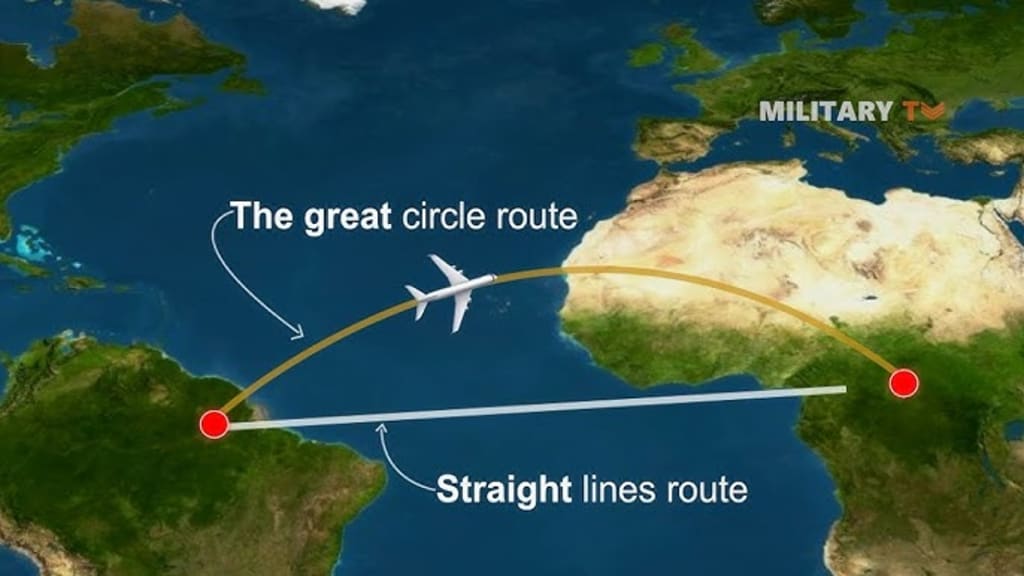
Ever been on a long-haul flight and glanced at the inflight map? You might have noticed something strange: instead of flying in a straight line to your destination, the airplane takes a curved route. At first glance, this can seem inefficient. Why would the plane take a longer path? The answer lies in simple physics and mathematics, rooted in the shape of our planet and a few other key factors that affect flight planning.
The Earth’s Spherical Shape and the Great Circle Route
To understand why planes don’t fly in straight lines, we first need to grasp the nature of the Earth. Our planet is a three-dimensional sphere, which means that the distance between two points can appear different depending on the perspective. On a flat, two-dimensional map, it might seem logical for planes to fly straight from one point to another, but in reality, the shortest distance between two locations on a sphere is not a straight line but rather a curve.
This is where the concept of the Great Circle Route comes into play. The Great Circle Route is the shortest path between two points on the surface of a sphere. It takes into account the curvature of the Earth and is especially noticeable on long international flights, such as those between the U.S. and Asia. When flying from New York to Tokyo, for example, planes will follow a route that arcs over Alaska and Siberia, which appears longer on a flat map but is actually the most direct and fuel-efficient path.
Why Do Curved Routes Appear Longer?
The reason curved routes look longer on a 2D map is that most maps flatten the Earth's spherical surface. Popular maps like the Mercator projection distort the size and shape of landmasses and flight paths, making areas near the poles appear much larger than they actually are. This distortion also affects how we perceive flight routes. What seems like an unnecessarily long arc is, in fact, the shortest path when traveling on a globe.
A good way to visualize this is through an experiment. Take two pieces of string of the same length. Place one string on a flat surface and stretch it between two points—this represents what we perceive as the shortest route on a 2D map. Now, place the other string around a ball (representing Earth) between the same two points. You'll see that the string that follows the curve of the ball covers a shorter distance. This is essentially what planes do when flying along the Great Circle Route.
The Impact of Jet Streams and Weather Conditions
In addition to the Earth’s curvature, weather conditions, particularly jet streams, play a crucial role in determining flight paths. Jet streams are fast-moving air currents in the upper atmosphere, with winds that can reach up to 200 miles per hour. These air currents can either assist or hinder an airplane's journey, depending on their direction.
When a plane flies with a tailwind from a jet stream, it can travel faster and burn less fuel, making the flight more efficient. Conversely, if a plane is flying into a headwind, the pilot may adjust the route to avoid the jet stream and save on fuel. For example, eastbound flights across the Atlantic often take advantage of the strong tailwinds provided by the jet stream, while westbound flights might adjust their paths to avoid the headwinds.
Weather patterns such as thunderstorms, turbulence, and wind conditions also influence flight paths. Pilots and air traffic controllers continuously monitor the weather and make real-time adjustments to routes for both safety and efficiency.
Airspace Restrictions and Traffic Management
Another reason airplanes may take curved paths involves airspace restrictions and traffic management. Commercial air travel operates within a complex network of airways, much like a system of highways in the sky. Aircraft must follow designated routes to avoid collisions and manage the flow of traffic, particularly in busy airspace near major airports or military zones.
Some areas of the world also have restricted or no-fly zones, whether for national security reasons or military operations. Planes must navigate around these areas, which can result in indirect or curved paths. This is particularly common when flying over politically sensitive regions or conflict zones.
Efficiency and Safety Above All
The primary goal of flight planning is to ensure efficiency, safety, and cost-effectiveness. By taking the Great Circle Route, pilots can reduce the distance traveled, minimize fuel consumption, and cut down on flight time, all while ensuring that the aircraft remains within safe airways and avoids hazardous weather conditions.
In fact, flight paths are meticulously planned before every departure. Air traffic controllers, airline dispatchers, and pilots work together to create a flight plan that balances the shortest route with considerations for fuel efficiency, safety, and comfort. Adjustments may even be made mid-flight as conditions change.
Why the Curved Path Makes Sense
When we put it all together, the curved routes planes take are based on a combination of physics, geometry, and natural atmospheric phenomena. The Great Circle Route follows the curvature of the Earth, ensuring the shortest distance between two points, while jet streams and weather patterns help optimize flight efficiency.
While it might look longer on a 2D map, the curved path is actually the most direct and efficient way to fly. So, the next time you're on a flight and see that familiar curve on the in-flight map, you'll know why it’s there. It's a reminder of how advanced aviation technology and science work together to make air travel faster, safer, and more efficient.
The Myth of the Flat Earth
Interestingly, the phenomenon of curved flight paths is often cited as evidence that the Earth is not flat. Despite the persistence of flat Earth theories, the use of Great Circle Routes in aviation provides strong, practical proof of the planet’s round shape. If the Earth were flat, straight-line routes would indeed be the shortest and most efficient. However, the curvature of the Earth is a fundamental reason for the curved paths we see on flight maps.
Final Thoughts
So, the next time you’re flying and notice that your plane is taking what appears to be a longer, curved path, remember that it’s actually the shortest, most efficient route. This curved flight path reflects the Earth’s round shape and accounts for several other factors like jet streams, weather, and air traffic management. What may seem like a detour is actually a well-calculated route to get you to your destination faster and more safely.
About the Creator
Horace Was
Essay Writer, Aviation and Technology Expert
Keep reading
More stories from Horace Was and writers in Styled and other communities.
Technician Perkes
Are you fascinated by aviation and looking for a career that offers both excitement and solid rewards? Aircraft technicians might be the perfect path for you. As the aviation industry continues to grow, the demand for skilled technicians is rising, and with it comes a range of enticing benefits and competitive earnings. Let’s explore why becoming an aircraft technician could be a smart career move and what you can expect in terms of rewards and earnings.
By Horace Was2 years ago in Styled
The Best Natural Skincare Secret for Glowing, Healthy Skin
Glowing skin is often associated with expensive beauty treatments and complicated skincare routines. However, the real secret to healthy skin is often much simpler. Natural skincare focuses on nourishing the skin with gentle ingredients, balanced hydration, and consistent habits that allow the skin to maintain its natural glow.
By Kelln Small3 days ago in Styled



Comments
There are no comments for this story
Be the first to respond and start the conversation.