
Open Source E-Commerce vs. Shopify: Which One is Right for You?
Open Source E-Commerce vs. Shopify
The choice between Open Source E-Commerce platforms and Shopify is a crucial decision for businesses looking to establish an online store.
Open Source solutions, like nopCommerce or Magento, provide unparalleled flexibility, allowing users to customize every aspect of their store while maintaining full ownership of their data.
On the other hand, Shopify offers a user-friendly, all-in-one platform with managed hosting and seamless integrations, making it ideal for those seeking simplicity and convenience.
This case study explores the strengths and limitations of both approaches, helping businesses determine which option aligns better with their goals, technical expertise, and budget.
Whether you prioritize control or ease of use, understanding these platforms can guide you to the right decision.
What is Open Source E-commerce?
Open-source e-commerce refers to software whose source code is freely available for anyone to view, modify, and distribute.
This allows businesses to tailor the platform to their specific needs and gives them full control over their store.
Examples of popular open-source e-commerce platforms include NopCommerce, Magento Open Source, PrestaShop, and Spree Commerce.
Unlike SaaS platforms like Shopify, open-source solutions often require more technical expertise to set up and maintain.
However, they provide flexibility and are typically more cost-effective in the long run due to the absence of recurring subscription fees.
Key Features and Benefits of Open Source E-commerce.
- Customization: Open-source platforms offer unparalleled flexibility, allowing users to customize the platform’s code to create a truly unique online store.
- Cost-Effective: Many open-source platforms are free to customers, with costs mostly associated with hosting, maintenance, and third-party integrations.
- Scalability: As your business grows, you can scale your open-source platform with ease, adding new features, integrations, and functionalities as needed.
- Community Support: Most open-source platforms have active communities that contribute to their development, offer support, and create plugins to extend the platform's functionality.
Types of Open Source E-commerce Platforms
NopCommerce
NopCommerce is one of the most robust and feature-rich open-source e-commerce platforms available. Built on the .NET framework, it’s known for its flexibility, ease of use, and scalability. NopCommerce supports a wide range of industries and business models, from small startups to large enterprises.
Why Choose NopCommerce?
- Scalability: NopCommerce can handle businesses of all sizes, offering advanced features that cater to both small businesses and enterprise-level operations.
- Customizability: With a powerful admin panel and vast plugin marketplace, NopCommerce allows for significant customization.
- Security: NopCommerce provides a secure platform with features like SSL support, multi-currency options, and built-in fraud protection.
Who Benefits Most From NopCommerce?
- Developers and Agencies: NopCommerce is ideal for developers who want to customize the platform and create bespoke solutions for clients.
- Growing Businesses: With its scalability, NopCommerce is perfect for businesses that anticipate growth and need a platform that can evolve with their needs.
- Enterprises: Larger organizations require an enterprise-level solution with full control over the platform.
Spree Commerce
Spree Commerce is a flexible and modern open-source e-commerce platform written in Ruby on Rails. It is known for its simplicity and modularity, but it requires more developer resources for customization.

Pros:
Lightweight and modular, ideal for custom projects.
Flexible and developer-friendly, written in Ruby on Rails.
Open-source with a strong focus on API integrations.
Cons:
Requires experienced developers for setup and customization.
Limited out-of-the-box features compared to other platforms.
Smaller community compared to NopCommerce or Magento.
Magento Open Source
Magento Open Source is a powerful open-source platform that offers a broad range of features, ideal for large businesses with complex needs. However, it requires substantial technical knowledge to implement and maintain, which may not be ideal for smaller businesses.
Pros:
Extremely powerful with a vast array of features.
Highly customizable, supporting complex e-commerce needs.
Supported by a strong community and third-party plugins.
Cons:
Steep learning curve and require significant technical expertise.
High costs associated with development and maintenance.
Resource-intensive and may need dedicated hosting infrastructure.
PrestaShop
PrestaShop is another popular open-source solution, known for its user-friendly interface and a vast selection of add-ons. It is particularly well-suited for small to medium-sized businesses that want to get started quickly without much development work.
Pros:
User-friendly with an intuitive interface for small to medium businesses.
The large number of modules and themes for customization.
Active community for support and regular updates.
Cons:
Limited scalability for larger businesses.
Some advanced features require paid add-ons.
Security features are less robust than those of other platforms like NopCommerce.
Big Commerce
BigCommerce offers both SaaS and open-source solutions. Its open-source option is ideal for businesses that need a more customizable solution but still require a user-friendly interface.
Pros:
Scalable: Handles high traffic and large catalogs effectively.
No Transaction Fees: Reduces long-term costs compared to Shopify.
Built-In Features: Includes advanced SEO tools and marketing integrations.
Cons:
API Limitations: API calls are restricted, which can affect integrations.
Add-On Costs: Some features may require additional purchases.
Less Community Support: Fewer developers compared to platforms like Magento or WooCommerce.
Shopify
Shopify is a leading SaaS e-commerce platform that allows businesses to set up and manage online stores quickly. Unlike open-source platforms, Shopify is a hosted solution, meaning Shopify takes care of hosting, security, and maintenance. Shopify is known for its ease of use, but it also comes with a subscription fee and limits in customization.

Key Features and Benefits of Shopify.
- Ease of Use: Shopify is known for its user-friendly interface, making it easy for anyone to set up and manage an online store without technical expertise.
- All-in-One Solution: Shopify handles everything from hosting to security, eliminating the need for businesses to worry about technical aspects.
- 24/7 Support: Shopify offers round-the-clock customer support, helping businesses resolve any issues quickly.
- App Marketplace: Shopify has an extensive app marketplace, allowing users to extend the functionality of their stores.
Who Shopify is Best Suited For.
- Small to Medium-Sized Businesses: Shopify is ideal for businesses that want to get up and running quickly without needing technical expertise.
- Non-technical Entrepreneurs: With its drag-and-drop interface, Shopify is great for business owners without a technical background.
- Business Owners Who Want Simplicity: Shopify provides a simple, streamlined solution for those who don’t need complex customizations or features.
Pricing and Scalability Considerations.
- Shopify Pricing: Shopify charges a monthly subscription fee that ranges from $39 to $399, depending on the plan. Additional costs can include transaction fees and costs for premium apps and themes.
- Open Source Platforms Pricing: Open-source solutions are free to use, but businesses will incur costs for hosting, maintenance, and potential development needs.
Features
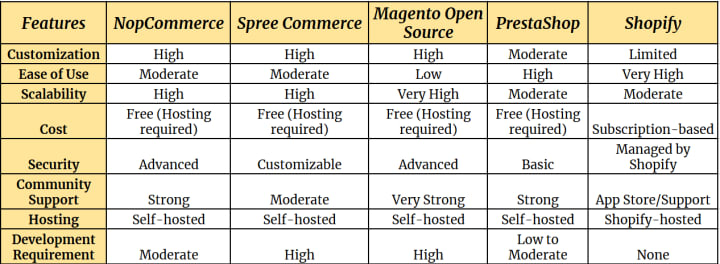
Conclusion
Both open-source e-commerce platforms and Shopify have their advantages. Shopify is an easy-to-use, all-in-one solution ideal for small to medium-sized businesses or entrepreneurs seeking simplicity.
However, it lacks the customization and flexibility offered by open-source platforms like NopCommerce.
For businesses that need more control, scalability, and the ability to tailor their store to specific needs, open-source platforms are a better option.
If we talk about platforms like NopCommerce that stands out as a flexible, cost-effective solution, especially for growing businesses and enterprises needing robust e-commerce capabilities.
Ultimately, the choice depends on your business needs—if you prioritize simplicity and convenience, Shopify is a good choice, but for full control, customization, and scalability, NopCommerce is the better option.
About the Creator
Keep reading
More stories from Jessica Harsora and writers in Styled and other communities.
Closed Source vs. Open Source: Why nopCommerce Might Be the Better Choice
The answer lies in one word: freedom. Because nopCommerce can combine unparalleled flexibility, total ownership, and cost-effectiveness qualities that set it apart from proprietary platforms & other open-source platforms.
By Jessica Harsoraabout a year ago in Styled
A Transparent Look at Vocal Challenges and Top Stories
Almost three years ago, we shared a resource article that served as a place for people to suggest new challenge prompts. We thought it would be a good idea to refresh that thread, and take the opportunity to answer a few common questions about top stories, how challenges are judged and how submissions are reviewed.
By Vocal Curation Team3 days ago in Resources



Comments
There are no comments for this story
Be the first to respond and start the conversation.