
Complete Guide to Arabic Clothing
Exciting journey through Arabic fashion

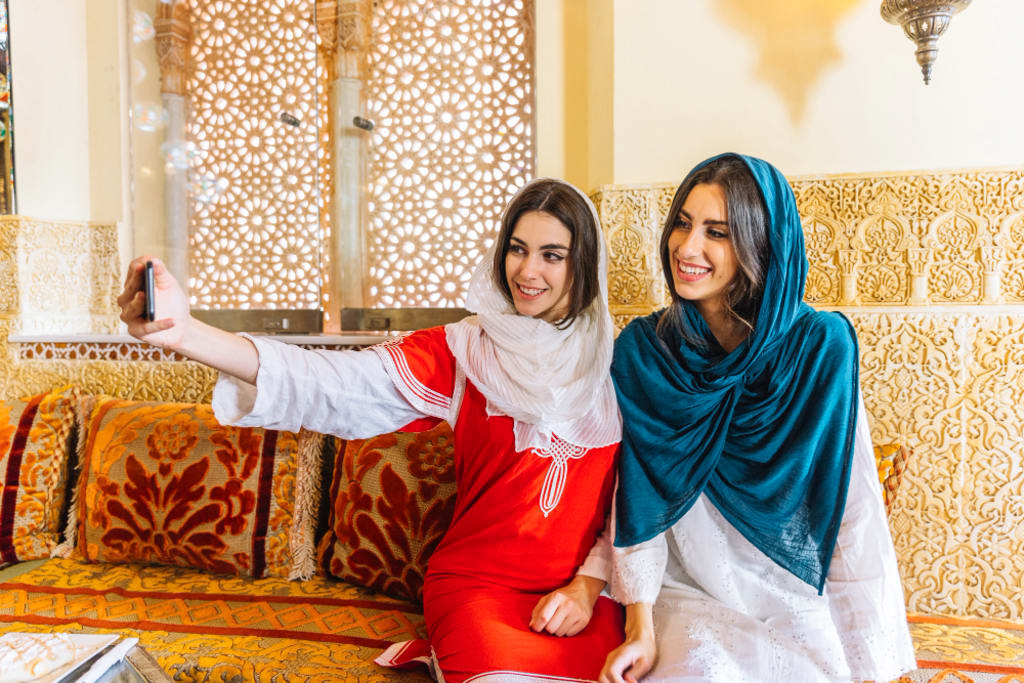
Before we embark on an exciting journey through Arabic fashion, let’s face some boring geographical facts. Many people assume that the Arabic language is spoken exclusively by Arabs. However, just as there are many English-speaking countries outside the UK, there are also Arabic-speaking nations outside the Arabian Peninsula.
Arabs live only in the Gulf area and that is where we are going to find out what they wear. It will not be easy to understand all the clothing choices of fashion lovers from these countries without a brief look at their history, religion and, perhaps, also the climate.
Most Middle Eastern women are seen wearing black robe-like dresses called Abaya . Although other Arabic-speaking countries have adopted the abaya as a religious garment, its history goes way before the birth of Islam. Covering women's bodies was more about their status, wealth, and privilege of not working in pre-Muslim society. Women who belonged to the upper class wore a large square-shaped cloth with openings for the hands and a wide gold trim around the neckline. A veil used to be a sign of luxury and separation from maids and slaves.
Abaya as we know it has slits in the front, sleeves, and is usually made of a light, flowing material. The most common color of a classic abaya is black. One might wonder why women would choose to wear black considering the hot and humid climate of the area. The answer lies in the practicality and functionality of such a choice: black is less transparent, so black fabric can be thinner than fabric of any other color, making the Abaya cool in the heat, but also keeping everything underneath hidden.
Nowadays, Abaya can be of any color with some slight changes in the cut and various decorations. It can be custom made by designers from the most expensive materials for the modern Arab elite, for people who love to complement their luxurious Abayas with expensive shoes, bags and jewelry from high fashion brands.
Talking about Arab fashion and not mentioning hijab would be very unfair as the Arabian Peninsula is its birthplace. Despite the common understanding of Hijab as a headscarf, it is actually not a garment at all. Hijab is a concept of a modest way of dressing for religious reasons. This concept exists in all monotheistic religions and in some polytheistic ones. However, hijab as a concept was spread outside this region by traders as a part of Islam long ago. Since then, Muslim ladies all over the world observe hijab in their own way.
The three most popular in the Gulf area are:
1. Shayla — a wide rectangular scarf that is wrapped around the head. Most often, Shayla is transparent and does not cover the hair or neck, and serves more as a traditional representation than a religious one.
2. Niqab — a face cloth that leaves only the eyes uncovered
3. Battoulah — a hard, metallic-looking face mask worn mostly by older women and also considered more as one of the local customs. Initially, women wore it to indicate their married status and according to other opinions, it served to prevent the nose and mouth from touching the sand and to fool enemies into thinking that the woman they had seen was a man.
For female festive gatherings and weddings, Gulf ladies wear Jalabiya , a colorful dress that is often lavishly embroidered with gold and adorned with tons of gold jewelry.
Men’s fashion is also worth mentioning ! Arab men from the Gulf area traditionally wear long white robes called thobe, also known as dishdasha or kandora, with white baggy trousers underneath and thick-soled leather sandals . The decorative details of the thobe will vary from country to country, as will the style and colour of the “ghutra” (a piece of cloth worn on the head with a black tube called an “egal” over it). Young men are often seen wearing a baseball cap instead of a ghutra, while expensive watches and sunglasses complement the kandoras of Gulf men of all ages.
Despite the introduction of colours in both male and female traditional attire, most locals still prefer the official colours. This contrast of all-black clothing for women and all-white attire for men makes local couples look elegant and classy. The Gulf countries in general are so harmonious in their contradiction, where progress and customs are equally appreciated and fused together. One can never remain indifferent to their world of hospitality and opulence!
About the Creator
Kimberly Jose
Kimberly Jose is the author and editor of Black Camels, a leading magazine for the Muslim abaya clothing industry in Pakistan. Kimberly is an advocate for sustainable modest fashion.
Keep reading
More stories from Kimberly Jose and writers in Styled and other communities.
Traditional Costume
The costume of the Eastern countries is diverse, as are the traditions of the many peoples inhabiting the vast expanses of Asia. However, there are many common features in the costume of these peoples, connected, among other things, with their common history and common religion - Islam.
By Kimberly Joseabout a year ago in Styled
A Smart Choice for Your Wedding Hair
A Great Wedding Hair Choice: Human Crochet Hair Extensions. For many Black women, picking wedding hair is very important. You want to look and feel amazing. Human crochet hair extensions are a strong option. They are not like full wigs you just put on. Instead, a stylist uses a small hook. They attach real human hair pieces to your own braided hair. This makes a style that is part of you. It looks very natural and fits you perfectly.
By manman zhai2 days ago in Styled



Comments
There are no comments for this story
Be the first to respond and start the conversation.