
A Fashion Of Sorts.
The creative process in review from corporate to creation for it's own sake.
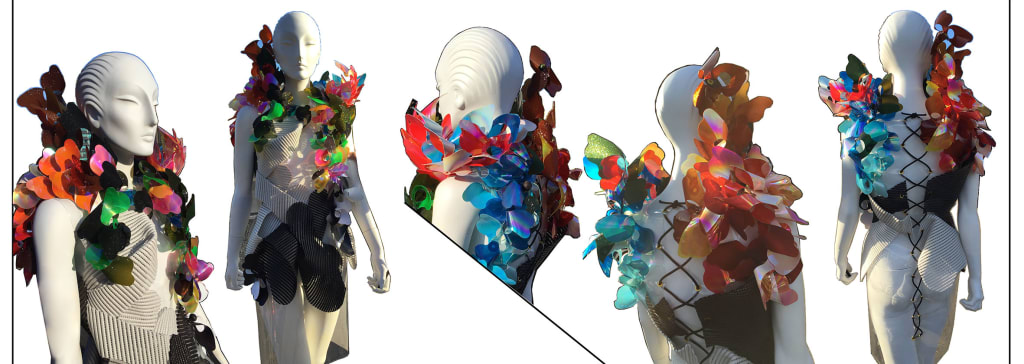
Creativity can come fast or slow much like the world of fashion. I worked for a few years for a high fashion house learning the ropes and assisting to design the ready to wear collections. Because we were removed from the world of fast fashion, time was in our favour. With only four seasonal collections a year to produce there was more emphasis given to fleshing out the context of our inspiration and developing a complex story with nuances from light and shade, to cut, colour and fabrication. I would spend hours researching the history of our chosen theme and looking for clues to ignite the creative process.
I always steered away from using images of other designers work, whilst it is important to know what's "in" fashion and what has come before you, every effort must be made to avoid (even inadvertently) being influenced by their work. Otherwise there is no originality, the best terms of achieving something unique is to take the inspiration from its source - or anything other than fashion itself. Whether that's an overarching theme or a minute detail like a pattern in nature.
Once the mood was set and I was embedded in the world I was exploring, the design flowed in different ways - once again fast and slow. In quick flashes I would see a print, stitch detail or even a whole runway that I would need to furiously scribe out before it fleeted away. Other times the process was arduous, working in a commercial setting there is a need to show evidence of your creative workings, hundreds of sketches that tried to tease out an idea but lacked the inspiration of the flashes that came unscheduled. These illustrations were not wasted however, useful tools where a section here or there can be used to fill in the missing links of a design, to clean up loose ends and polish an idea to its full extant.
Sometimes, it was not intellectual but more organic. I found this often when actually draping or through cut and play. Taking scraps of fabric and pinning them to a form, seeing what the fabric would allow me to do and then cutting into it, to force it beyond its movement into something new. This is where I learned to execute my ideas from thought and paper into something three dimensional - where you could walk around it and embrace your sense of touch and scale. If you stopped here though the piece is only conceptual, pinned together without functionality. As an artist with a background in painting and illustration this would be enough for me, a single concept more like an art installation for enjoyments sake.
Though the designer in me knows fashion is an applied art, this means steps must be taken to make it accessible for real world use. Function aside, there are a number of designers whom successfully bridge both worlds, the late Alexander McQueen for one. He took the runway and turned it into his exhibition - creating a world if only for a short moment where the concepts from the cutting room floor can be shared in context with the commercial garments. Through styling and story telling they can be successful as art for consumption.
After a few years working in the same fashion it is easy to loose your inspiration. I wanted to do something purely for me, something that would not require an external audit. I found myself wondering through hardware stores and discount stores for unusual objects to see what "flashes" they would inspire. I found in a popular Japanese Discount store a child's toy pinwheel, the colours went from vibrant rainbows to burnt tones and sparkling blacks. I bought nearly two hundred of them not knowing what was to become or where I was to begin. I new I also needed a fabric like base for the structure but I wanted to still keep away from traditional materials, so I made my own brief : "to make a garment entirely from found objects and materials inside the discount store and use 90% of the components to avoid waste".
I deconstructed the pinwheel to understand their shapes, each was a single turbine connected by a wooden dowel for the pin and a bamboo staff. I had also picked up some PVC slip mats like the ones you might find in the bottom of the shower for my base. I traced out the turbine and scaled it up - every pattern was to be a turbine reiterating the design from the pinwheel by playing with scale and mass. Then the fun began, I spent three straight days twisting and forming the turbines into one another. They were brittle and some colours less flexible than others. I used a surgeons tool - a clamp that would help hold there shapes in place until their forms were set to my will.
I kept building and finding new paths and connections between the turbines, they were transforming from turbines into petals forming a beautiful bouquet towered around the body. I could barely sleep for excitement as I did not want to stop the flow. Finally, I was done - but what had I created? It was functional enough in that it could be worn - but too delicate to survive wear. I had created my installation - all that was to be done was to photograph it and leave it to deconstruct with time.
The process was one of creativity for its' own sake - for mine own sake. I needed this to see if I could still push myself and still create without the need to produce for external gain. Unlike my normal process I started without context, but that is not to say there was none. Having finished my work I had a chance to step back and analyse the "why". I had traveled to Japan in recent years and was struck by two non-binary styles that have emerged from it's culture; namely Normcore and Harajuku. Normcore is a neutralised aesthetic, block colours and clean designs that approach life with utility and function, in other words basic staples that make up your wardrobe. In contrast Harajuku style is a mix of unique subset cultures that as a whole are anything but normal. It is a celebration of individual takes, of colour and contrast and even incorporates traditional dress in new and innovative ways.
In Australia there has been an influx of global brands that represent the Normcore style, yet there is a lack of the alternative Harajuku representation. I wanted to evoke the spirit of these young innovators using only items found in the Japanese discount store with creativity as the foundation. The final silhouette tends towards futurism whilst it’s colour palette and up cycled materials are hallmarks of the movement.
This self appointed exercise has inspired me to keep creating, to keep being an artist without it having to mean anything to anyone - though if it inspires others I'll pocket that for a rainy day.
About the Creator
Keep reading
More stories from writers in Styled and other communities.
Lordhair vs Lavivid: A Wearer's Take
I didn't plan on comparing brands. I just wanted to share my own experience and thoughts. The Situation By the time I started wearing a hair system, I’d already spent too much energy reading forums, watching videos, and second‑guessing myself. Every option sounded perfect until it wasn’t.
By Ryan Collins2 days ago in Styled


Comments
There are no comments for this story
Be the first to respond and start the conversation.