
Why Do Humans Resort to War?
Can the Future Be More Peaceful?


Wars have been part of human history since ancient times, with tribes and empires engaging in conflicts for survival, territorial expansion, and self-defense. However, war has never been the only option; some leaders and societies have chosen peace instead of conflict, avoiding the destruction that war brings. But why do some people choose war while others seek peace?
1. Self-Defense and Fear of Threats
One of the primary reasons nations and groups go to war is self-defense. When a country feels threatened by an external force, it may resort to war as a means of protecting its land and people. For example, during World War II, European nations had no choice but to resist Nazi expansion once Hitler began invading other countries.
In modern times, this principle can be seen in the Israeli-Palestinian conflict, where both sides believe they are defending their rights and territories. Palestinians fight for liberation from Israeli occupation, while Israel claims to need military action for national security, perpetuating the cycle of violence.
2. Economic Greed and Expansionism
Not all wars are defensive; some are driven by economic greed. During the 19th and 20th centuries, European powers colonized many African and Asian countries to exploit their natural resources, such as gold, oil, and diamonds.
Even in modern times, economic interests continue to influence conflicts. The U.S. invasion of Iraq in 2003, for example, was officially justified by the search for weapons of mass destruction, but many believe that controlling Iraq’s oil reserves was a major motivation for the war.
3. Ethnic and Religious Conflicts
Ethnic and religious tensions have historically been major causes of war. In many cases, religion or ethnicity is used as a political tool to justify violence. The Yugoslav Wars in the 1990s are a clear example, where ethnic tensions between Serbs, Croats, and Bosnians led to one of the most devastating conflicts in Europe after World War II.
While religion has often been used to justify wars, there have also been religious leaders who promoted peace instead of violence. Mahatma Gandhi, for example, used nonviolent resistance to lead India to independence from British rule.
4. Revenge and the Cycle of Violence
Many wars start as a response to past grievances, creating a cycle of violence that lasts for generations. A clear example of this is the Israeli-Palestinian conflict, where each new generation grows up in an environment of conflict, making it difficult to break the cycle.
However, some nations have managed to move past revenge and embrace peace. In South Africa, after decades of apartheid, Nelson Mandela chose reconciliation instead of violence, preventing a potentially devastating civil war.
5. When Do People Choose Peace?
Despite the prevalence of war, there have been moments in history where nations have chosen peace over conflict.
The Egypt-Israel Peace Treaty (1979): After multiple wars, Egyptian President Anwar Sadat and Israeli Prime Minister Menachem Begin, with U.S. mediation, signed a peace treaty. Despite controversy, the treaty ended decades of military conflict between the two countries.
India’s Independence from Britain: Instead of resorting to armed struggle, Gandhi led a nonviolent resistance movement, which resulted in India’s independence without a full-scale war.
The Reunification of Germany (1990): After decades of division between East and West Germany during the Cold War, the country was peacefully reunited without military conflict.
6. Can the Future Be More Peaceful?
Although wars continue, efforts to resolve conflicts peacefully are increasing. International organizations like the United Nations work to mediate disputes and prevent wars, and global public opinion is more aware of the devastating consequences of armed conflict.
However, achieving lasting peace requires fundamental changes in how leaders and politicians approach conflicts, as well as educating societies about the importance of dialogue over violence. Wars may have been part of human history, but they are not inevitable—better solutions always exist.
About the Creator
Keep reading
More stories from wail Djerou and writers in Serve and other communities.
The hijab: A Symbol of Tradition, Religion, and Politics Through History
The Historical Context of the Veil: From Social Tradition to Political Use In 1953, President Gamal Abdel Nasser met with Hassan al-Hudaybi, the Supreme Guide of the Muslim Brotherhood, who demanded that all Egyptian women wear the veil as a condition for implementing Islamic law. However, ironically, al-Hudaybi’s wife and daughter did not wear the veil, raising questions about whether it was a religious obligation or a political tool to expand the group’s influence. This event reflects how the veil has undergone historical transformations, from a social symbol to a religious and political tool. This article reviews the origins and evolution of the veil.
By wail Djerouabout a year ago in Art
Israel Attacking On Iran
Israel has carried out major air and missile strikes on Iranian targets. Explosions were reported in Tehran and other areas. Israeli leaders say they attacked to stop Iran’s military and missile capabilities before Iran could launch its own large attack.
By shaoor afridi6 days ago in Serve
Non Stop War Between Pakistan And Afghanistan
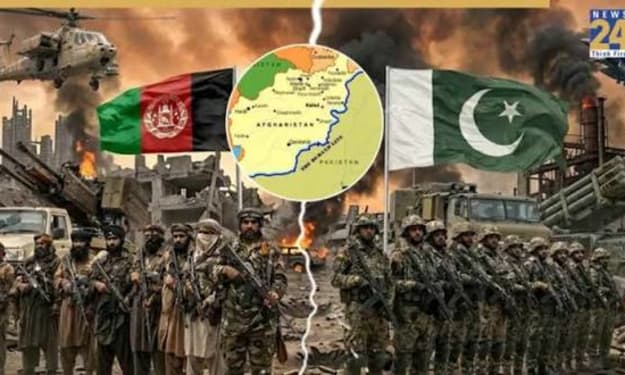
The situation between Pakistan and Afghanistan has suddenly gotten much worse. In late February 2026, Pakistan said it is now in what it calls an “open war” with Afghanistan. Pakistan’s military carried out airstrikes on several major Afghan cities, including the capital Kabul and places like Kandahar and Paktia. This has caused fighting to grow significantly between the two neighbors. �
By shaoor afridi6 days ago in Serve



Comments (1)
War. What is it good for? Absolutely nothing! Great work!