
United States Air Taxi Market Size and Forecast 2025–2033
How eVTOL Innovation and Urban Mobility Shifts Are Lifting America’s Next Aviation Frontier

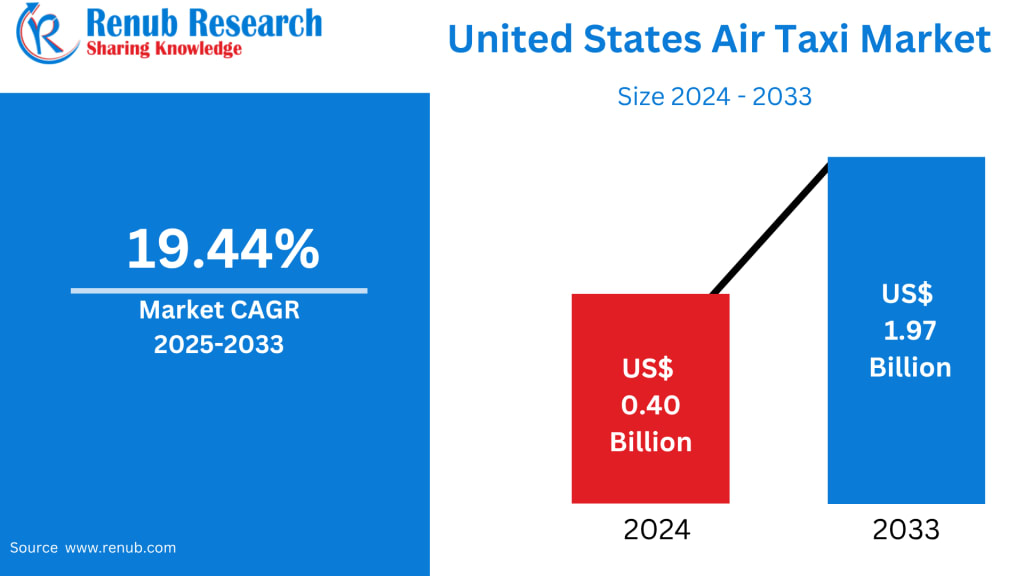
The United States Air Taxi Market is entering a transformative decade—one that could redefine how millions of Americans move within and between major cities. According to Renub Research, the United States Air Taxi Market is expected to reach US$ 1.97 billion by 2033, rising from US$ 0.4 billion in 2024, with a remarkable CAGR of 19.44% during 2025–2033. This surge is being powered by breakthrough technological advancements in electric vertical takeoff and landing (eVTOL) aircraft, mounting urban congestion challenges, sustainability initiatives, and extensive financial commitments from mobility and aerospace leaders.
The next eight years are expected to mark a major shift from concept to commercialization—ushering in a future where boarding an air taxi could soon be as routine as booking a rideshare. With supportive government policies, FAA collaboration, and rapid private-sector innovation, the U.S. is quickly cementing itself as a global hub for urban air mobility.
United States Air Taxi Industry Overview
Air taxis are compact electric or hybrid-electric aircraft designed for short-distance, on-demand travel within or between cities. Most modern designs use eVTOL capabilities, allowing vertical takeoff and landing without runways—a crucial advantage in dense metro regions.
In many ways, air taxis are the aviation equivalent of ride-hailing services. They promise point-to-point connectivity, bypassing surface traffic and reducing travel times dramatically. These aircraft can operate from vertiports, heliports, or even existing small airports, offering a flexible, eco-friendly mobility solution.
Key advantages include:
✔ Zero or low emissions
✔ Reduced noise compared to helicopters
✔ Automated or semi-autonomous flight systems
✔ Lower operating costs through electrification
✔ Scalable urban integration
As technology matures, air taxis are evolving from experimental prototypes to reliable, commercial-ready mobility platforms. Rapid innovations in electric propulsion, battery density, digital airspace management, and lightweight materials are accelerating market readiness. Meanwhile, the transportation needs of urban populations—facing some of the world’s worst congestion—are creating a robust demand environment for aerial alternatives.
Key Growth Drivers for the United States Air Taxi Market
1. Urban Congestion: A Growing Transportation Crisis
America’s largest metropolitan areas—New York, Los Angeles, Chicago, San Francisco—are grappling with extreme traffic congestion, costing billions in lost productivity annually. Traditional surface infrastructure can no longer keep pace with population growth and vehicle density.
Air taxis offer a revolutionary mobility upgrade:
Bypassing traffic entirely
Providing predictable, faster travel times
Offering relief during peak congestion
Opening new mobility corridors through underutilized airspace
Cities evaluating smart transportation systems are increasingly viewing air mobility as a necessary component of long-term urban planning. As investment in vertiports and supporting systems grows, the foundation for large-scale deployment is becoming more robust.
2. Technological Advancements in eVTOL and Autonomy
Technology is the backbone of the American air taxi revolution.
Major innovations include:
Electric propulsion systems that offer quieter, cleaner flight
Autonomous navigation technologies enabling semi- or fully autonomous operations
Advanced battery systems supporting longer ranges and shorter charging times
Digital airspace management systems using AI, 5G, and intelligent traffic networks
Lightweight composites enhancing safety and fuel efficiency
eVTOL capability is particularly transformative. With vertical takeoff and landing, air taxis can operate in compact urban environments without the need for runways. This dramatically expands operational possibilities within cities.
As more companies receive FAA design approvals and begin road-mapping commercial rollout strategies, the technology gap narrows, bringing the air taxi market closer to full-scale operation.
3. Sustainability and Environmental Alignment
The U.S. is intensifying its focus on clean transportation and climate-conscious mobility. Air taxis—particularly electric models—fit these priorities:
Zero direct emissions during operation
Reduced noise pollution compared to helicopters
Energy-efficient propulsion systems
Compatibility with renewable energy charging infrastructure
For cities aligning with carbon-neutral targets, air taxis represent a sustainable alternative to traditional ground vehicles, especially for short-distance trips in dense corridors. Corporate sustainability commitments and growing eco-friendly consumer preferences further reinforce adoption.
Key Challenges in the United States Air Taxi Market
Despite promising growth, the market faces several structural and regulatory challenges.
1. Regulatory and Certification Complexity
The FAA is working to develop frameworks for eVTOL certification, vertiport operations, pilot training, and airspace integration. However, the process remains complex and time-consuming.
Key bottlenecks include:
Developing new certification pathways for never-before-seen aircraft designs
Lack of standardized regulations across states
Evolving airworthiness criteria for electric propulsion
Safety validation for autonomous flight systems
Extended certification timelines could delay commercialization and increase costs for manufacturers.
2. Airspace Management and Integration
Introducing air taxis into already busy urban airspaces is a considerable challenge. The U.S. requires advanced traffic management systems capable of supporting simultaneous operations of:
Drones
Helicopters
Commercial aircraft
Private aircraft
Emergency services
eVTOL air taxis
Successful integration depends on real-time communication networks, automated routing technology, and collaborative regulatory frameworks. These systems are still in development, and scaling them to major metro areas will require large investments.
Regional Outlook of Key U.S. Air Taxi States
California: The Innovation Epicenter
California leads the U.S. air taxi landscape thanks to its:
Dense metro centers in Los Angeles, San Francisco, and San Diego
Severe congestion
Strong aerospace R&D presence
Major eVTOL manufacturing hubs
Sustainability-driven policies
The state is aggressively investing in vertiports and digital airspace infrastructure. Venture capital funding also flows heavily into California-based urban air mobility startups, positioning the state as an early adopter.
Texas: High Growth Potential Across Expansive Cities
Texas cities like Dallas-Fort Worth, Austin, and Houston are well-positioned for air taxi adoption due to:
Large geographic footprints
Rising commuter populations
Strong aerospace ecosystem
Business-friendly regulatory environment
The state has ample space for establishing vertiports and is considered ideal for regional eVTOL routes connecting multiple neighboring cities.
New York: A Prime Market for Premium Mobility
New York’s dense urban layout and high-income population make it one of the strongest commercial markets for air taxis. The ability to bypass surface congestion—particularly in Manhattan—makes air taxis appealing for:
Business commuters
Financial professionals
Tourists
Airport transfers
State-level sustainability goals and smart city initiatives are accelerating investment in urban air mobility infrastructure.
Florida: Ideal for Tourism and Inter-City Routes
Florida’s major tourism hubs and sprawling metro regions create strong demand for air taxis. Miami, Orlando, and Tampa are exploring on-demand eVTOL operations for:
Tourist mobility
Congested urban travel
Regional connectivity
Airport-city transfers
Florida’s strong aviation sector and regulatory support reinforce its position as a rapidly emerging air taxi market.
Recent Developments in the U.S. Air Taxi Market
October 2024: Joby Aviation secured FAA approval for its eVTOL aircraft design—one of the most significant milestones toward commercial air taxi operations in the United States.
February 2024: Joby Aviation announced FAA acceptance of its certification plan for its propulsion system, marking another crucial step toward type certification and commercial readiness.
These developments signal industry-wide progress and reinforce confidence in near-future commercialization.
United States Air Taxi Market Segmentation
By Propulsion Type
Parallel Hybrid
Electric
Turboshaft
Turboelectric
By Aircraft Type
Multicopter
Quadcopter
Others
By Passenger Capacity
One
Two
Four
More than Six
By State (29 Breakups)
Includes major markets such as:
California, Texas, New York, Florida, Illinois, Pennsylvania, Ohio, Georgia, New Jersey, Washington, North Carolina, Massachusetts, and more.
Key Players Covered (5-Viewpoint Analysis)
The U.S. air taxi market includes major innovators such as:
Honeywell International Inc.
Ab Corporate Aviation
Skyway Air Taxi
Airbus SE
Kitty Hawk Corporation
Fly Aeolus
Neva Aerospace Ltd.
Hyundai Motor Company
Joby Aviation
Talkeetna Air Taxi Inc.
Each company is evaluated based on company overview, key personnel, recent developments, strategies, SWOT analysis, and sales performance.
Final Thoughts
The United States Air Taxi Market is entering a defining phase of aviation history—transitioning from conceptual prototypes to real-world deployment. Backed by strong technological progress, sustainability commitments, supportive regulations, and growing consumer interest, the market is poised for explosive growth over the next decade.
If current momentum continues, air taxis could become a commonplace mobility option by the early 2030s, reshaping urban transportation and unlocking a new frontier for regional aerial mobility.
With a forecasted market value of US$ 1.97 billion by 2033, the U.S. is not just participating in the global shift toward air mobility—it is leading it.
About the Creator
Sushant. Renub Research
I’m Sushanta Halder, Digital Marketing Manager at Renub Research with 15+ years in SEO, content, PPC & lead generation. Passionate about data-driven growth strategies.
Keep reading
More stories from Sushant. Renub Research and writers in Serve and other communities.
Europe Air Taxi Market Size and Forecast 2025–2033
The Europe Air Taxi Market is on the brink of transforming the future of transportation, driven by technological breakthroughs, urban congestion, sustainability mandates, and rising investment in electric vertical takeoff and landing (eVTOL) systems. According to Renub Research, the Europe Air Taxi Market is expected to reach US$ 1.68 billion by 2033, up from US$ 0.38 billion in 2024, growing at a CAGR of 17.88% during 2025–2033.
By Sushant. Renub Researchabout a month ago in Serve
Stolen Bike, Not Valor
Koa was riding his new electric bike through the city park not too far from the US Embassy where he served in an Asian country. The ride was a part of his daily evening workout. He didn't really like the idea of an electric bike because he thought it was lazy. Besides, Koa had another good mountain bike he'd bought here used and it gave him a much better workout. But this one was his girlfriend's gift for his 29th birthday that she had taken the trouble to ship to him across the ocean. Koa felt obliged to ride it out at least occasionally, but promised himself not to use the battery. He even took it off the bike, to avoid the temptation.
By Lana V Lynx21 days ago in Serve
Why America Failed in Afghanistan
The withdrawal of the United States from Afghanistan in August 2021 marked the end of a 20-year war and raised a difficult but necessary question: why did America fail in Afghanistan despite unmatched military power, resources, and global influence? The answer is not simple. The failure was not the result of a single mistake but rather a combination of strategic miscalculations, political contradictions, cultural misunderstandings, and unrealistic goals that accumulated over two decades.
By shaoor afridi3 days ago in Serve
Standing While Falling
Quotation from Friedrich Nietzsche "He who wrestles long with monsters should beware lest he himself become a monster. And if you gaze long into an abyss, the abyss also gazes into you. Man is not destroyed by suffering, but by the meaning he makes of it."
By LUCCIAN LAYTH5 days ago in Critique


Comments
There are no comments for this story
Be the first to respond and start the conversation.