
Three Wars and a Funeral: A Life Shaped by Foreign Boots on Afghan Soil
From Kalashnikovs to Silence—An Afghan man’s testimony through the Soviet invasion, civil war, and America’s longest war.

They say a man only lives one life. I’ve lived three—each born from war, each ending in silence.
My name doesn’t matter, not anymore. What matters is what I saw, what I buried, and what I’ve come to understand. I was born in Kunar province in the winter of 1967, in a village that had more goats than people. My earliest memories were of snowfall, my father’s prayers, and the laughter of my brothers echoing in the narrow valleys. We had no electricity, no paved roads, but we had peace. Briefly.
Then the Soviets came.
Part I: The Red Storm (1979–1989)
I was 12 when the tanks rolled in. I was 14 when I first touched a gun. My father was an imam, but he didn’t stop me. None of the elders did. In those days, fighting was prayer. We were defending our homeland, our faith. The Soviets bombed indiscriminately—schools, houses, mosques, wedding tents. We buried our cousins in shallow graves. I learned to dismantle an AK-47 before I learned to read Dari properly.
The Americans supported us then. CIA agents gave us weapons, sometimes training, sometimes promises. We didn’t know their names. We called them “ghosts in ties.” They wanted us to bleed for them—and we did, willingly.
By 1989, the Soviets were gone. We danced in the dust of their retreating columns. We thought the war was over. We were wrong.
Part II: Brothers at War (1990s Civil War)
What happens when an enemy disappears but the guns remain?
Afghanistan became a chessboard again—this time without players to hold the pieces. Mujahideen groups fought over Kabul like children fighting over broken toys. Once brothers-in-arms, now we hunted each other. I was 25, hardened, married, and disillusioned.
I lost my wife in a rocket strike in 1994. She was baking bread. She died holding our infant daughter. There was no foreign enemy to blame—only us.
That year, I left the gun and returned to my village, my beard grown long, my voice tired. I swore off fighting. I tried to teach children the Quran, to fix roofs, to plant wheat. But Afghanistan does not let men retire.
Part III: The Americans Return (2001–2021)
I still remember the sound of the jets on September 11th, 2001—though they were across the ocean. The Americans came back, this time as invaders. My sons were teenagers, and I told them to stay out of it. But they couldn’t. One joined the Taliban. One joined the local police. Both believed they were defending their people.
Neither came home.
The Americans brought money, roads, schools—but also drones, prisons, and collaborators. Some in our village grew rich overnight. Others disappeared overnight. The war was everywhere and nowhere. You never knew if the man shaking your hand in the morning would sell your name for dollars by nightfall.
In 2010, a drone strike hit a wedding in our district. My niece lost both legs. The Americans said it was a mistake. We heard that phrase a lot—"collateral damage," “misidentification,” “tragic error.” You can’t bury mistakes with honor.
Part IV: The Silence After the Fall (2021–Today)
When Kabul fell in 2021, it wasn’t a shock. It was an exhale. Twenty years, and it all collapsed in twenty days.
Some celebrated. Some wept. I did neither. I sat on my roof and listened—to the wind, to the silence. My war was over, not because peace had come, but because I had nothing left to give.
Today, I am 58. My back is bent, my hands are rough, and my memories are full. I tend goats again. I teach boys the alphabet. I help bury the dead.
What I’ve Learned (and What Americans Should Know)
If you are an American reading this, I ask you for nothing. I only ask you to understand.
We Afghans are not born warriors. We are not extremists. We are not chess pieces. We are farmers, teachers, sons, and daughters. But for 40 years, we were trapped in other nations’ strategies—in your Cold War, in your War on Terror.
You cheered when we fought the Soviets. Then you left us to tear each other apart. You returned to fight the men you once funded. And now, you are gone again.
But we remain. Always, we remain.
I don’t hate Americans. I met some who were kind, who built schools, who treated us like humans. But I also saw arrogance, broken promises, and careless killing.
You ask: Was it worth it?
I ask you: Worth what? The sons I buried? The schools turned to rubble? The orchards burned because someone in Virginia (the Drone Operators) thought a suspect was hiding there?
You talk of freedom. So do we. But our definitions are different. Yours comes with bombs. Ours comes with prayer, family, quiet.
I don’t blame you. Not entirely. But I beg you: Learn. If not for us, then for the next country your bombs find.
The Final War
My grandson plays in the same hills where I once fired rockets. He knows nothing of Soviets or Americans. He asks me why I limp, and I tell him, “I tripped on history.”
Maybe one day, we’ll bury the last gun. Maybe one day, our land will be known not for war but for its poets, its pomegranates, its mountains.
Until then, we wait—not for saviors, not for invaders—but for the kind of peace that doesn’t wear boots.
About the Creator
Keep reading
More stories from Inzamam Ul Haq and writers in Serve and other communities.
A Life Between Giants: My Story as an Afghan Fighter
1. A War Before I Could Read I was six when the Soviets rolled into Afghanistan in 1979. I didn’t know what communism was, nor did I care. What I understood was the thunder of tanks that shook our village, the flames that devoured our school, and the day my older brother left with a rifle and never came back.
By Inzamam Ul Haq7 months ago in Serve
War Between Pakistan And Afghanistan
Tension Escalates Sharply at the Pakistan-Afghanistan Border What’s happening now? Tensions between Pakistan and Afghanistan have suddenly escalated into heavy fighting along their shared border, known as the Durand Line. Both sides are accusing each other of attacks, and military clashes have intensified in recent days. 
By shaoor afridia day ago in Serve
Non Stop War Between Pakistan And Afghanistan
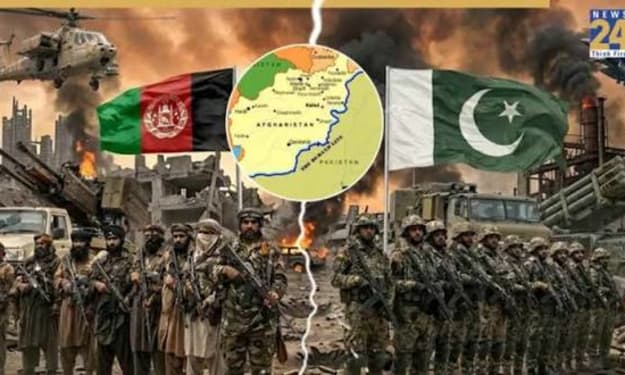
The situation between Pakistan and Afghanistan has suddenly gotten much worse. In late February 2026, Pakistan said it is now in what it calls an “open war” with Afghanistan. Pakistan’s military carried out airstrikes on several major Afghan cities, including the capital Kabul and places like Kandahar and Paktia. This has caused fighting to grow significantly between the two neighbors. �
By shaoor afridiabout 12 hours ago in Serve


Comments
There are no comments for this story
Be the first to respond and start the conversation.