
In War, Good Graces
A WWI Trench Warfare Short Story
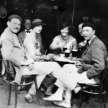

Silently, we looked out on the field from the depth of our trench, fellow comrades leaning against the bunker, glazed eyes peering through peepholes in mortar, folds in sandbags, mouths exhaling hot stale breath that misted in our faces in the cold morning air. We were a stack of sardines pressed against the interminable, cemented walls and heavy, sand-filled burlap sacks comprising the barricade, green steel helmets and bayonet-tipped rifles flitting the air. All of us, hundreds were collect, ready in courage, yet unspeakably horrified we might not be coming back.
In our uniformity drew we a last grave, coppery breath in that dreadful calm, awaiting the storm. The barracks’ were emptied, mess-hall and officer rooms in candlelit shadow, quarters deadly quiet, lonely haunts for the departed, and us all waiting. I’d watched dense rolls of fog fall over the cemetery beyond, sift, plume spectral about the beaten soil, swirling in ethereal wisps like a consolidating congregation of lost souls.
That’s when the whistle blew.
Sharp and shrill, the senior officer going into battle harped long, loud on the metallic device. Simple as that, we stormed rickety wooden ladders over the top, rushing battlefield headlong in swells of sounded fury.
Unto the fray we charged through smoke, dust, ash, hopping over explosives in the minefield of barbed wire, pikes, stakes. Each stride farther taking us closer to the very crosshairs heart of that chthonic hinterland, where amidst chaos eruptions and artillery grew presently louder, reverberated thunderously, were felt ever stronger until they seemed to become all that was left in our man-made reality.
Going along, deep past the last glean of fog-lights into the dark, most of the men in vanguard were fell by unseen bullets. In the twilight, that was still pitch-black, all felt far from the dawn; all one saw were clouds of debris, dust, smoke through gunfire. At front of the enlivened, death-defying surge, I came to find myself. As we went on, all rage, fear, mortality, few allies still dotted the map ahead, most soon joining the vanquished in ditches.
A bit of shrapnel took one of ours in the leg, not far in the lead. He buckled down, an entourage of medics kneeling aside lending aid. Another diverted in the misty rain and explosives wind, entering into must-survive combat with an enemy fighter waiting in stealth. Through the fog, a lone Dutch soldier went well beyond ranks, dozen feet in front – he ended in the blast of a grenade launched from a German Schiessbecher. And so I was past them all, running ever deeper, grinding teeth, squeezing fists, charging into this consumptive hell, head bowed, back ducked and eyes tight shut, until I were taken in a gust of light and power.
***
Later, I revived in the pits, ailing a concussion from the brunt of the blast. I wondered how many lives of men it took with it.
Disoriented, in a sea of mud I clawed with nails, grunting in attempt to roll over. The ground had become like a tar-pit, flypaper for humans without the sweet fragrance, and reeking of another. Eventually, I managed to nudge myself along and sat up tenting each elbow, then dug in at the fingertips to raise up.
Both boots were soaked, clammy, the socks clinging to my feet like pasted paper-machete. I’d had trenchfoot twice before, hoping I would not develop it now. Worst of all were the lice, mites that left the skin constantly irritated, begging to be itched. The necessity for scratching was eternal, save when the anxiety became worst of all in the start of battle or through the thick of it, then the sensation dulled until you thought about it or the fighting stalemated, so anxiety lessened a little.
I looked out and watched the deadened field. Clearing before my vision, mists sifted away, trailed into greater fogs. Dirt and dust were dense clouds in the air, taking a while to settle after it had fallen silent. At a distance white tendrils of smoke and soot blotted components of the theatre, hovered up phantomic in thee amalgamated matters of disembarked spirits gone on the wind, floating ethereal masses.
Out of this flight I spotted nearby a neighbouring German soldier, stuck in the muck, seeming jarred in the same as myself, trying to brace himself upward. I tore off the buckling leathern sheath of the holster, wrenched out the revolver and pointed it immediate at the Nazi, sitting faced the opposite direction. He turned, noticing me in the nick of time.
Thus I gripped index finger on the trigger, determined, squeezed. No shot transpired; I jangled it, beat adamantly at stock and forestock, though nothing changed. I stared across the scape, direct into his bloodshot eyes, whilst the Nazi began patting down the ground, finding his own pistol and when he had, taking aim, made to fire. But no bullet emerged through the barrel. The cartridges in both guns were murked from the filth.
Our gazes, met and lasted, soon fell away, and I laid back into the mud, gasping out a sigh. Today was the closest I had ever been to dying, twice, post-breakfast in the early AM and after napping in the afternoon. Briefly I rested there, looking at patches of sky twixt the veiled ether; I could see faint yet sweeping blue, furrowed puffs of white.
After this close call and creeping docility mine mind screeched back into alertness – I jostled up where I lay. Not far off upon the shallow, low ridge of an embankment, dirt-carved, trodden smooth by the champ of soldiers’ boots, the German soldier shot up in response. With a calm composure he turned his head, gazing over sensing I’d resurfaced.
‘So, we cannot kill each other,’ he called to me. ‘Maybe we can help another to get back. D0 you see my jacket?’
‘No,’ I scoffed.
‘Could you look?’
I wondered if he was delirious.
‘Find your own damned jacket,’ I replied, grimacing.
‘I can’t,’ he answered back, hushed. ‘Look.’
He shuffled wide about on his bottom, moving slowly. As he came round, I saw him applying pressure on the thigh of his right leg. This German boy, who was no man, peered to me innocently, a painted expression which qualified he understood the graveness of the situation.
‘Please help me,’ he implored. ‘I need a doctor.’
‘Alright,’ I told him. ‘If we can find a way out of here.’
‘Don’t you know the whereabouts of your trench?’
‘No. Do you?’
‘Zero,’ he admitted. ‘What happened to you?’
‘A grenade from one of your blasters. ‘You?’
‘The same, I think. We must’ve been close.’
‘Sure.’
‘What’s your name?’
‘Sephrenus,’ I admitted. ‘Cassleman.’
‘I’m Wilhelm, Brecht,’ replied the boy. ‘I recognize your surname – Kassel?’
‘My grandparents were immigrants. It is bastardized.’
‘So you’re Deutsche.’
‘I’m Canadian.’
He listened politely, then looked at the leg, squeezing it and grimacing – I could tell his attention had been there the whole time. I got the feeling we trusted each other adequately, went a bit closer and kneeled at his side in the muck. The wound looked bad, torn down the quadricep muscle, bright red and spreading the interior of the thigh. I reckoned he needed immediate medical service if he were to live.
‘You can take me prisoner,’ professed Wilhelm – it seemed silly, in war a childlike barter of sorts. ‘Just get me somewhere with medicine.’
‘Alright.’ I tried to muster professional confidence. ‘You said you’d lost your coat. Is it around here?’
‘I don’t know.’ He continued labouring over the leg, speaking English well although with a thick accent. ‘It blew off me in the explosion.’
‘Do you really need it?’
‘Well, it’ll get cold. And there’re pills for pain.’
‘Alright. I’ll give it a look.’
‘Thank you, Sephrenus.’
‘You can call me Seph. It’s easier.’
I scanned the vicinity of the embankment and in the confines of the ditches. They were incredibly shallow so I searched rather fast. A few metres of embankment near to the right large mounds of tossed Earth covered the ground. Siphoning away debris, underneath one of these I found a tattered Nazi corduroy coat moistened in the dirt.
‘It’s all torn,’ I said, crouching down close. ‘Sorry.’
‘The pills,’ he said, ‘check the pocket in the chest.’
I put two fingers into the breast pocket, then checked the hand pockets for good measure. There wasn’t anything in any of them.
‘Nothing. Sorry.’
He fell back, a little aghast, apparently more put out there weren’t any pills than in concern for the severity of physical condition.
‘C’mon,’ I said gently. ‘We ought to be moving on.’
‘I can’t walk at all.’
‘I’ll help you.’
I moved closer, upon a first contact; Wilhelm appeared slightly uncertain of it. I looked at the wound and then to him.
‘It’ll get infected. I need to clean it.’
From a tin canteen, I poured out some water, then used cloths from a sanitary pack to rub it clean. Next I tore the seams of the coat’s sleeves, ripped apart their fabric then lashed and tied them tight over the gash. Lastly, I looped the corduroy base of the jacket, securing it loosely over the threads for an additive protective layer against bacteria.
‘Let’s go,’ I said.
Wincing, Wilhelm propped up an arm, I clasped him around the forearm, then lifted. He rose slow, hobbling with his weight on the good leg. Once he steadied we went fast from there, only ever inching along, always doubled over. We headed due north along the plain, going this way so that we wouldn’t wander too closely to either lines.
We were much slowed toward dusk. The needle in my compass was erratic, affected by the magnetic zones of the battlefield. And so we ended up merely wandering. In entirety our progress had been tedious; Wilhelm could not more than limp, careful not to put too much weight on the bad leg, mostly dragging it behind like someone with awful gout or a clubfoot.
Somewhere passing we realized we could hear noises, excited whispers, that certainly were surely not imagined, as we scaled beneath great mounds, traversing within throughout the deepest foxholes centering the field. From then we paced only increments, always beneath the sides of embankments, or below the jutting lips of ditches with the Earth blasted apart by detonations. Going some time now I had been helping Wilhelm along, lending support and man-carrying with our arms over each other’s shoulders, his top-weight pressing down the crest of my spine.
Bitter, gruff and indignant voices grew suddenly louder, of accents undoubtedly British. Soon their words became discernible.
‘Listen,’ one said, ‘over there, down below. D’you hear it?’
‘Yeah, think do. What s’ppose?’
‘Dunno. Les check.’
The two of them sounded a pair of burly, rougher men – sometimes particulars of that sort tended not to be so kind to prisoners, nor especially favourable to the aspect of taking them. I chose to remain silent, though think Wilhelm half expected me to call out, and waited to see if it were us that they had heard. Since dusk we had been moving at a slow rate and kept in the steepest, deeper ditches, and I imagined rather quiet.
After a long moment's waiting in disquiet the sound of their movement began to trail away. Next few nothing showed up, so we both figured it was probably safest to clear out sooner than later. Hunched, we kept along the side, and eventually I assisted Wilhelm to shimmy up the inverted slope.
For all that was good in the world we paused before climbing over the ridge. In the dim, grey light, the shadows of the two military figures crept a hilltop barely yonder. They moved in a way summoning to mind the feral scurrying of rats and went farther in that rodent manner down the base of a ditch; stopping, they calculated and watched an unwitting soldier who cowered in the cleft of an old abandoned pillbox. Through the side of the pillbox was a rugged patch of mossy dirt, partially collapsed in bullet-holes; he mustn’t have noticed this particular vulnerability.
Wilhelm had yet to catch up where this exhibition unfolded. Patiently I awaited, eagerly hoping to death the half-hidden man wasn’t a Nazi.
The Britons snuck up to the pillbox, wrenched the hider out by his feet, falling upon him. I heard the shouts and implores for mercy clearly; the soldier was definitely and unmistakably German.
‘Don’t look,’ I said to Wilhelm, once he made it up beside me.
Wilhelm peaked down over the ridge, and in doing so looked anyways. Quickly his face grew chalk-full of grief, disgust. It weren’t an easy thing to look at, nor could ever such be. Wilhelm turned away, when the time came that he couldn’t watch any longer, and I did too, for I couldn’t bear it.
The cold, shrill gale beat o’er these deserts of No Man’s Land, called out desperately, somberly, in some way obscure, hoping for us all to hear it, amidst this horrific and sorrowful desolation of our making.
***
It was cold at night in the wet mud and autumn weather. The Nazi’s carcass lay below us, stiff, still. There were red fingerprints around his throat; they’d beaten and throttled him. We’d seen most of it, hence due this probably both felt we deserved to be shot in cowardice. It should have been a war-crime under the Geneva Convention to witness such atrocity.
‘Check his pockets,’ Wilhelm told me.
Kneeling, I reached into the man’s breast, pulling out a small tin that rattled with what couldn’t have been more than a couple mint-sized objects. Wilhelm, though perceivably not satisfied in this setting, nodded and held his hand out for me to pass him the aluminum drugbox.
Softly, Wilhelm shut the man’s eyes, then untangled a sterling-silver crucifix hung on the corpse’s neck, removed it, tucking it into his palm, closed the fingers around. Here we couldn’t stay long. Kindly, I deflected the youth’s attention, beckoning him on, we had to go.
***
We came upon another carcass of man that night in the dark. It were husked of a Lieutenant Frederic, whose life’s charge had been mine unit; he must’ve died in the morn assault. His face had gnarls which were heat boils, half the flesh melted or torn off. His dog-tags and boots were gone. For Wilhelm, I gently sidled the lieutenant out of his coat.
Also, Frederic’s helm had tumbled off his head in death, rolling into a puddle of soggy mud; I reached in and procured it as well.
‘You may want these.’
‘Danke.’
The two of us then walked some metres away, and down we laid in a shallow ditch concealed with divots from each opposing side.
‘There is to be an offensive tonight,’ confessed Wilhelm, offering me one of two miniscule pills from the tin. ‘Take it. You'll feel much better. This will just become business.’
The stars were out, bright and aplenty, moon high and pale-violet far away near red Mars. There wasn’t anything that could make the night and night’s sky unbeautiful. The way of such things, their marvel, was perpetual, not affected like other things humans could destroy.
I knew Wilhelm had been correct, as the drug kicked in. Raw emotion became immaterial, not of the essence. Everything was more vivid, sharp and clarified and focus intensified and senses honed to a frenzied degree.
We rested there, afraid to fall asleep, though there wasn’t a chance of that anymore. In our distinctive lull, amid its poignant clarity, we gazed the stars, sky, listening to sounds of night stir in the grassless, lifeless plain.
‘In Flanders fields the poppies blow, Between the crosses, row on row, That mark our place; and in the sky The larks, still bravely singing, fly Scarce heard amid the guns below …’
‘What was that?’ Wilhelm asked me.
‘Poem a Canadian named John McCrae wrote.’
‘Did he die?’
‘Yeah. In the Great War. He wrote it about Ypres.’
‘It is good verse.’
‘It is.’
‘How old are you?’
‘Nineteen. You?’
‘Seventeen.’
‘You look younger than that.’
‘Oh.’
Pause.
‘Do you have a girlfriend?’
‘Yeah. Back home. We went to school together. You?’
‘No. Too young.’
I looked at him as he smiled and we laughed softly.
‘Yeah. Guess so, Willy.’
***
All through night we watched the orchestra of explosions, gunfire, listened to the typical symphony choruses calling in the dark that we had been numbed to for so long now. The Nazis bombarded heavily throughout the whole of it; their barrage of lightning-blitzkrieg a gunmetal lightshow of blue, yellow and orange flashes, vibrance akin the Northern Lights in both brightness and beauty. Phantom detonations, artillery and firefighting glared through the dusty smoke, resonance booming like the storm’s thunder, always followed by the next electrification of disaster.
We watched, transfixed, until this lightning struck us.
***
Fighting resumed at dawn, continuing late into the afternoon. In the night a shell had fallen close by where we laid and blasted us into an exploded crater ten feet deep. Wilhelm had not much strength left; I think his leg already was rotting on him. He had bad fever, as well. Most of the day I spent trying to wake him, recurringly fearful he died, except for a weak pulse continually reassuring me otherwise.
I stood in the crater, spreading my arms to their full length, measuring the gap. There was about a half foot one side I couldn’t reach; towards the top the opening became narrower. My hair was filthy, matted, face stained with mud, blood. Vile sloshed up the ankles, disturbingly uncomfortable.
I clutched my young German companion by the collars of Frederic’s jacket, shook him then brushing him lightly across the face a few times. He came to, eyes lolling, focus weak, doing his very best to heed me there.
‘We’ve gotta get out of here,’ I expressed. ‘It won't be easy.’
‘Okay,’ he said.
I rushed him onto his feet under the armpits. He wobbled, taking a minute to steady, gaining grip. He anchored himself up on his good leg, the other crooked, and hanging onto a protruding root with trembling hands.
‘What do we do now?’
‘Back to back,’ I said.
‘There’s no way I can make that climb.’
‘You can,’ I told him, defiantly. ‘We’re at least going to try.’
We locked in arms and shoulders, then pressed our backs hard up against each other’s. Wilhelm exerted a lesser force than thine, buoyant eyes finicking in anguish; yet I felt the will in his resolve.
‘One foot at a time, then the other person goes. Slow and steady. We can do this, Will.’
Given that the crater was fresh Earth in the walls seemed relatively dry, dense with rocky material – much to our benefit. We removed large placements of rock then smoothed out pebbles and dirt, carving footholds we could ably use the first dozen or so steps. Once we each completed a few stepping stones we began the climb without a word.
The beginning went easy, although slow with the hesitancy it took Wilhelm to plant the foot of his bad leg, when he needed to. A few times he caused us to wobble, though there didn’t seem a great threat of teetering over. Each time, he managed secure it, and in the speed, persistency of motion, I never was unconfident of his strength to subsist.
Nearer the top, where there weren’t any footholds, it became difficult. We were pressed closer together, and had to excise greater effort. Wilhelm wobbled, teetered, shaking consistently. A metre from the top we utilized our inverse force to adrenalize us up. I felt Wilhelm’s determination, refusal to give up, pushing on hard and heartily, a final step. On mine, I knew then that he couldn’t take another, I launched us sideways so our shoulders clipped the edge of the crater’s precipice, but then we were slipping, about to fall back in. We each dug our heels at the edge, clenching tight, pushing with all the force we could muster, rolling a fraction onto the surface. On our final reserve, having nothing left but fumes, we tumbled far as gravity would take us, separating, energies and wills imploding on the ragged soils.
Any alternative out of our hands, we took rest on the ground. Afterward, recollecting ourselves in the groggy delirium of sleepless, drug-induced trauma, when finding ourselves able to climb back onto our feet we inspected the smoke, dust and soot clouding the theatre, and the silhouettes of apparent passersby, seeming deformed as if they were mirages; we’d no idea how far, or close, nor who they were, moving way they did. Passing in unison, demented skulls extended craniums Ancient Nazcas, others in Pickelhaube helms of Kaiser’s Imperial Army.
‘Demons,’ I announced.
‘No,’ interjected Wilhelm, solemn, deprived. ‘Soldiers.’
We stood, loitered afoot, spectating the grotesquerie menagerie. Soon thereof as if in the grips of an overwhelming hallucination awoken one lone monstrosity came at us aggressively fast, prevailing out of the fog.
A bayonet pierced my shoulder, pinning me unto Earth with fierce might; I looked up under an enraged face, beastly contorted, snarling.
‘No!’ shouted Wilhelm.
He knocked the soldier clear off me; weakly I jolted up, the blade now clear of my flesh, making to stand. As I twisted around penetration of a second blade drove into my left heel, cold, sharp.
I writhed, flipping onto my gut, twisting, seeing the small hatchet lodged above my foot. Wilhelm protested again, pushed the older soldier a length away from the spot of ruinous ground. It was all I could do to pay attention, listen, watch the means that would decide mine impending fate.
‘Get back to the base now, traitor boy,’ commanded the older man. ‘Take this scum, too. Report to the authority of your station immediately. There’re special places reserved in detention for mutinous cowards.’
Surprisingly, the soldier turned and ran off into battle. My friend looked down over me.
‘He pointed that way,’ I said to him. ‘Go.’
‘I won’t leave you.’
‘You will, now. You have to.’
Wilhelm’s eyes were still beady and glossed from the affects of the pill. He crouched down, reaching his forearm out to clasp mine; frailly I reciprocated, afterwards shaking hands and nodding at each other firmly, makeshift brothers-in-arms.
‘Get going. I’ll to try to make it back on my own. Go.’
‘Thank you, Seph. I will search for you one day when this is done. Please, survive.’
Into the fray he disappeared, sprinting off until the mists of dust, soot, smoke and fog consumed his grey-fledged silhouette. When he’d gone I did my best to regain both feet; I couldn’t, though could crawl along decently well, a leg poised up. Rather heavily I had been bleeding.
Deep beyond the distant opaque clouds I heard a shot ring out, understanding then that none of it had been worth it. Providentially, I knew somehow Wilhelm had been fell, recipient of the blast. Possibly mistaken for an ally raiding the enemy trench. Or killed by a stray of ours. I remembered he was wearing Frederic’s jacket and helmet.
My journey was not yet over – I had to be going. It was the only thing then left for me to do. Thus I fled from there fast as I could, headlong back into the madness and delusions of dying men.
The End
About the Creator
James B. William R. Lawrence
Young writer, filmmaker and university grad from central Canada. Minor success to date w/ publication, festival circuits. Intent is to share works pertaining inner wisdom of my soul as well as long and short form works of creative fiction.
Keep reading
More stories from James B. William R. Lawrence and writers in Serve and other communities.
Debutante Darlings, Harlots and Debonair Charlatans
Big Les threw the best parties. At the turn of the twenties the great, vain fun of the heirs of Long Island were just these such events thrown by the poorly closeted bootlegger. Mansion, garden and ocean strolls. Sultry evenings in the summer limelight under the stars and all the money whore males drinking mock cocktails. Those who were bold enough, connected even sometimes snuck in real champagne or sparkling wine. The fanciest pimps depraved enough even brought with them their best girls.
By James B. William R. Lawrence5 years ago in Criminal
Ayatollah Ali Khamenei Is Dead Or Live?
Israeli and U.S. Officials’ Claims Israeli Prime Minister Benjamin Netanyahu has publicly stated there are “many signs” that Iran’s Supreme Leader Ayatollah Ali Khamenei is dead after a joint U.S.–Israel military offensive targeted Iranian leadership compounds, including sites linked to him in Tehran. �
By shaoor afridi6 days ago in Serve
Putinsnappy” Dead or Alive?
1. Who Is “Putinsnappy”? First, it’s important to explain the name “Putinsnappy.” Searches show that @MrPutinSnappy is a social media or parody account name (likely on platforms like X/Twitter) that presents commentary about world politics and Russia. It is not an official account of the Russian president, nor does it have any authoritative standing. �
By shaoor afridi4 days ago in Serve

Comments
There are no comments for this story
Be the first to respond and start the conversation.