
How One Woman Fixed WW2’s Biggest Problem!
How One Woman Fixed WW2’s Biggest Problem!

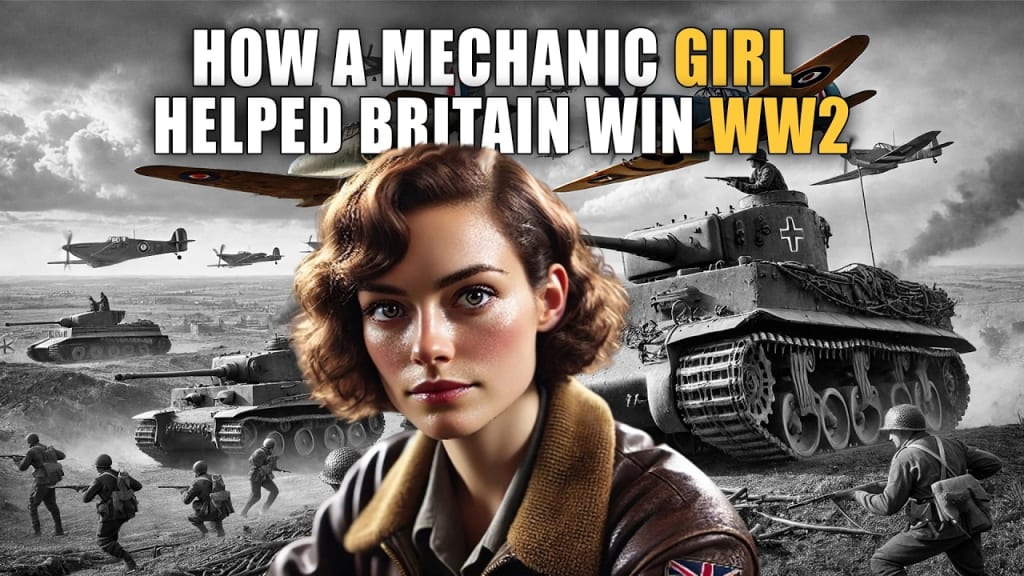
The Fighter Plane That Nearly Failed Britain in WWII
During World War II, Britain had a fighter aircraft that became a national symbol — the Supermarine Spitfire. Known for its speed and agility, it was a favorite among pilots and a source of hope for the British people.
But behind its glory was a serious technical problem:
The engine often failed — especially during mid-air combat.
The Hidden Flaw in the Spitfire
The issue appeared when the plane would dive downward during a dogfight with German fighters. The Rolls-Royce Merlin engine used in the Spitfire would lose power, or even shut down completely.
On the other side, the German Luftwaffe’s Messerschmitt Bf 109 had no such problem. That made German pilots more dominant in the air.
Although Britain won the Battle of Britain, this engine issue was a major weakness in the war. Unless it was fixed, Britain could not hope for clear victory in World War II.
The Battle of Britain Was Just the Beginning
By the time this flaw was discovered, Britain had already produced over 20,000 Spitfires — all with the same engine. Other British planes like the Hawker Hurricane and Boulton Paul Defiant also used the same Merlin engine.
This meant that a major portion of the Royal Air Force was flying planes with a critical defect during intense aerial battles.
Why the Engine Failed
When the Spitfire would suddenly dive down, gravity would force the fuel in the carburetor away from the engine’s fuel outlet.
This fuel starvation caused the engine to sputter or shut down, leaving the pilot vulnerable during combat.
Advanced maneuvers like quick dives and climbs were common during dogfights. Losing engine power even for a second could mean death.
Top Engineers Tried and Failed
Britain assigned some of the best engineers from Rolls-Royce and the Royal Aircraft Establishment to solve the issue.
Engineers like Cyril Lovesey and A.D. Fisher worked on it, but all their high-tech solutions failed — and some even created new problems.
It seemed impossible to fix. Until a young woman engineer stepped in with a simple but genius solution.
Meet Beatrice "Tilly" Shilling — The Woman Who Changed WWII
Beatrice Shilling, known as "Tilly", was not just an engineer — she was also a motorcycle racer who had rebuilt and raced her own 490cc Norton bike at the famous Brooklands racetrack.
She had been passionate about machines since childhood and had overcome the social barriers of her time to study engineering at Victoria University of Manchester, where she was the first woman to study in her department.
Her Simple Invention Saved Lives
In 1939, she was promoted to Technical Officer at the Royal Aircraft Establishment and was given responsibility for carburetor development.
When the top engineers failed, Shilling requested permission to try her own solution. Despite being underestimated due to her gender, she succeeded — and quickly.
Her solution?
A brass restrictor plate with a small hole that regulated fuel flow during dives.
It didn’t fix the problem 100%, but it stopped the engine from stalling during critical combat moments.
Miss Shilling’s Orifice — A War Hero’s Invention
This small device became famously known as "Miss Shilling’s Orifice".
It could be installed easily in the field, without much time or effort.
Shilling herself traveled across airbases, riding her motorcycle, installing the device in Spitfires and Hurricanes across the country.
Later, she even helped design a new carburetor that permanently fixed the issue.
Recognition and Legacy
Thanks to Shilling’s brilliance, many RAF pilots credited her for saving their lives.
She was awarded the Order of the British Empire (OBE) for her contribution to the war.
Even after WWII, she didn’t stop. She worked on rocket technology, guided weapons, and jet propulsion systems through the 1950s.
In 1955, she became the Senior Principal Scientific Officer at the Royal Aircraft Establishment.
A Trailblazer for Women in Engineering
Tilly Shilling wasn’t just a brilliant mechanic or scientist — she was a pioneer for women in engineering.
Today, many believe that if it weren’t for her contribution, World War II might have ended differently.
Her story proves that sometimes, a small fix from an unexpected person can change the course of history.
Final Thoughts
We hope you enjoyed this incredible story.
Don’t forget to like, share, and comment if this inspired you.
We'll see you again with another powerful story.
About the Creator
Keep reading
More stories from Jehanzeb Khan and writers in Serve and other communities.
War Between Pakistan And Afghanistan
Tension Escalates Sharply at the Pakistan-Afghanistan Border What’s happening now? Tensions between Pakistan and Afghanistan have suddenly escalated into heavy fighting along their shared border, known as the Durand Line. Both sides are accusing each other of attacks, and military clashes have intensified in recent days. 
By shaoor afridi2 days ago in Serve




Comments
There are no comments for this story
Be the first to respond and start the conversation.