
Global Air Taxi Market Size and Forecast 2025–2033
Urban Air Mobility Takes Flight as eVTOL Technology Redefines the Future of Transport

Introduction: A New Era of Urban Mobility
The global transportation industry is on the brink of a historic shift, and air taxis are at the heart of this transformation. Once considered science fiction, air taxis are now moving rapidly toward commercial reality, driven by advances in electric vertical takeoff and landing (eVTOL) technology, increasing urban congestion, and strong government and private investment.
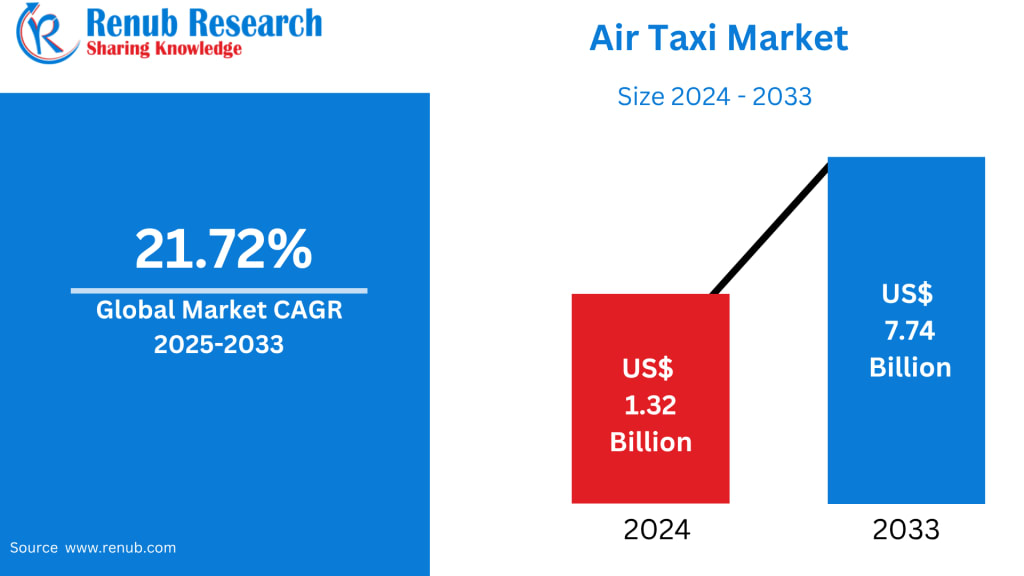
According to Renub Research, the Global Air Taxi Market was valued at USD 1.32 billion in 2024 and is projected to reach USD 7.74 billion by 2033, expanding at a remarkable CAGR of 21.72% during the forecast period (2025–2033). The combination of cleaner propulsion, faster urban travel, and smarter air traffic systems is positioning air taxis as the next frontier of mobility.
Global Air Taxi Market Outlook
Air taxis are compact, on-demand aircraft designed for short-range, point-to-point transportation. Most are powered by electric or hybrid propulsion and use eVTOL technology, allowing them to operate without traditional runways—making them ideal for densely populated urban environments.
These aircraft are intended for:
Intra-city commuting
Inter-city connections
Airport transfers
Emergency and medical services
Business and premium travel
As part of the broader Urban Air Mobility (UAM) ecosystem, air taxis aim to reduce congestion, lower emissions, and cut travel times dramatically. A journey that takes two hours by road could be reduced to just 15–20 minutes by air.
Countries including the United States, Germany, China, the UAE, and Saudi Arabia are investing heavily in infrastructure, regulation, and pilot projects. With improvements in battery energy density, autonomous flight systems, and regulatory clarity, air taxis are steadily transitioning from concept to commercial deployment.
Key Drivers of Growth in the Global Air Taxi Market
1. Rapid Technological Progress in eVTOL and Electric Propulsion
The evolution of eVTOL aircraft is the foundation of the air taxi industry. Advances in lightweight materials, high-performance batteries, and power electronics have made quiet, efficient, and emission-free flight possible.
Major aerospace companies, startups, and automakers are actively testing prototypes, many of which have already completed successful flight trials. Falling battery costs and the development of charging infrastructure are further improving the business case for electric air taxis.
In June 2025, UK-based Vertical Aerospace strengthened its partnership with Bristow Group to accelerate commercial air taxi services, highlighting growing confidence in the technology.
2. Urban Congestion and Demand for Time-Saving Transport
Traffic congestion is worsening in megacities worldwide, costing billions in lost productivity each year. Air taxis offer a direct solution by using underutilized low-altitude airspace to bypass ground traffic.
Business travelers, medical services, tourists, and high-income commuters are early adopters, but long-term potential lies in scalable, affordable networks that serve mass urban mobility. As cities continue to grow vertically and horizontally, demand for fast aerial transport will only increase.
3. Strong Investment and Regulatory Support
The air taxi market is benefiting from unprecedented levels of funding from:
Venture capital firms
Aerospace giants
Automotive manufacturers
Government innovation programs
Regulators such as the FAA (USA) and EASA (Europe) are actively developing certification pathways, pilot training frameworks, and airspace rules for urban air mobility.
In October 2024, Toyota Motor Corporation invested an additional USD 500 million in Joby Aviation, strengthening its commitment to electric air taxi manufacturing and certification. This followed earlier investments and underscored growing confidence in the sector’s long-term viability.
Challenges Facing the Global Air Taxi Market
Infrastructure and Airspace Integration
Launching air taxi networks requires significant infrastructure investment, including:
Vertiports with charging stations
Maintenance and repair hubs
Passenger terminals
Integrated air traffic management systems
Urban real estate constraints and complex airspace integration remain major hurdles. Coordinating low-altitude air traffic alongside drones and traditional aircraft demands advanced digital traffic management systems.
High Costs and Affordability Barriers
Air taxis currently cost USD 1–5 million per unit, making early services expensive and premium-focused. While economies of scale will eventually reduce costs, widespread affordability remains a challenge.
Without cost reductions in manufacturing, certification, and operations, air taxi services may remain limited to high-income users in the near term.
Market Segmentation Insights
Global Electric Air Taxi Market
Electric air taxis dominate the growth landscape due to:
Zero tailpipe emissions
Low noise levels
Reduced operating costs
Most models carry 2–6 passengers and are optimized for urban and regional connectivity. Companies like Joby Aviation, Lilium, Archer, and EHang are already in advanced certification phases.
As battery technology improves, electric air taxis are expected to become the backbone of future urban mobility systems.
Global Turboshaft Air Taxi Market
Turboshaft air taxis, derived from helicopter technology, offer greater range and reliability but face challenges due to noise and emissions. These aircraft are more suitable for:
Long-range routes
Offshore operations
Hybrid-electric configurations
Environmental regulations and rising fuel costs limit their long-term growth in urban markets.
Global Multicopter Air Taxi Market
Multicopters use multiple small rotors, providing high stability and redundancy. Their compact size makes them ideal for rooftop vertiports, though range and payload remain limited.
With strong backing from the drone industry, multicopters are seen as a key stepping stone toward autonomous urban air mobility.
Passenger Capacity Analysis
More Than Six Passengers
These air taxis are designed for regional commuting, airport shuttles, and island hopping. Hybrid-electric propulsion is common, but infrastructure and certification requirements are more complex.
Four Passenger Air Taxis
This segment is expected to be the early commercial winner, balancing cost, range, and certification feasibility. Companies such as Volocopter and EHang are heavily focused on this category.
Regional Market Highlights
United States Air Taxi Market
The U.S. leads global innovation with strong regulatory engagement and a robust startup ecosystem. Cities like Los Angeles, Miami, and New York are early adopters due to congestion and existing aviation infrastructure.
In May 2025, Archer Aviation was selected as the Official Air Taxi Provider for the LA28 Olympic and Paralympic Games, marking a major milestone for commercial deployment and global visibility.
Germany Air Taxi Market
Germany is Europe’s innovation hub for air taxis, led by Lilium and Volocopter. With strong government backing and EASA collaboration, Germany plans to deploy air taxis nationally by 2032, following a phased rollout starting in 2026.
China Air Taxi Market
China is rapidly scaling air taxi adoption, supported by government-led smart city initiatives. EHang and AutoFlight are advancing autonomous eVTOL deployment, with new assembly facilities under development.
In April 2025, AutoFlight announced a new assembly and testing hub in Wuhan, accelerating China’s role in global air mobility leadership.
Saudi Arabia Air Taxi Market
Under Vision 2030, Saudi Arabia is integrating air taxis into tourism and urban development projects such as NEOM and The Line. The kingdom is investing in vertiports, regulations, and pilot programs.
In May 2025, the Ministry of Transport partnered with FlyNow Arabia to launch the country’s first air taxi app, with pilot services planned at KAUST.
Market Segmentation Overview
By Propulsion Type
Electric
Parallel Hybrid
Turboshaft
Turboelectric
By Aircraft Type
Multicopter
Quadcopter
Others
By Passenger Capacity
One
Two
Four
More than Six
By Region
North America
Europe
Asia Pacific
Latin America
Middle East & Africa
Key Players in the Global Air Taxi Market
Honeywell International Inc.
Airbus SE
Joby Aviation
Hyundai Motor Company
Kitty Hawk Corporation
Skyway Air Taxi
Talkeetna Air Taxi Inc.
Fly Aeolus
Neva Aerospace Ltd.
Ab Corporate Aviation
Each company is evaluated across five dimensions:
Overview
Key Personnel
Recent Developments
SWOT Analysis
Revenue Performance
Final Thoughts
The global air taxi industry is transitioning from experimental prototypes to real-world transportation networks. While infrastructure, regulation, and cost challenges remain, the momentum behind electric flight and urban air mobility is undeniable.
With a projected market size of USD 7.74 billion by 2033, air taxis are set to redefine how cities move, connect, and grow. As technology matures and governments embrace the future of aerial mobility, air taxis will no longer be a luxury—they will become an essential layer of modern transportation.
About the Creator
Keep reading
More stories from Aaina Oberoi and writers in Serve and other communities.
India Car Rental Market Size and Forecast 2025–2033
The India Car Rental Market is on an unprecedented growth trajectory, shaped by rising travel activity, changing mobility preferences, expanding digital adoption, and the increasing demand for flexible transportation solutions. According to Renub Research, the India Car Rental Market is expected to reach US$ 8.19 billion by 2033, up from US$ 2.67 billion in 2024, registering an impressive CAGR of 13.26% between 2025 and 2033. This exceptional expansion reflects a structural shift in how Indians—across metros, business hubs, and tourist destinations—choose to commute.
By Aaina Oberoi2 months ago in Serve
Stolen Bike, Not Valor
Koa was riding his new electric bike through the city park not too far from the US Embassy where he served in an Asian country. The ride was a part of his daily evening workout. He didn't really like the idea of an electric bike because he thought it was lazy. Besides, Koa had another good mountain bike he'd bought here used and it gave him a much better workout. But this one was his girlfriend's gift for his 29th birthday that she had taken the trouble to ship to him across the ocean. Koa felt obliged to ride it out at least occasionally, but promised himself not to use the battery. He even took it off the bike, to avoid the temptation.
By Lana V Lynxabout a month ago in Serve
How, Too
Many people wonder how, too. You are not alone, and I am an expert. I will teach you how, too! First, you need to remit a small application fee and fill out an application describing the nature of your financial situation and how often payments will be made, as this will have great bearing on how well I teach you how, too.
By Harper Lewis5 days ago in Fiction




Comments
There are no comments for this story
Be the first to respond and start the conversation.