
You’re Not Burned Out — You’re Living in a Broken System
Why your exhaustion isn’t a personal failure, but a logical response to a world that demands everything and guarantees nothing.
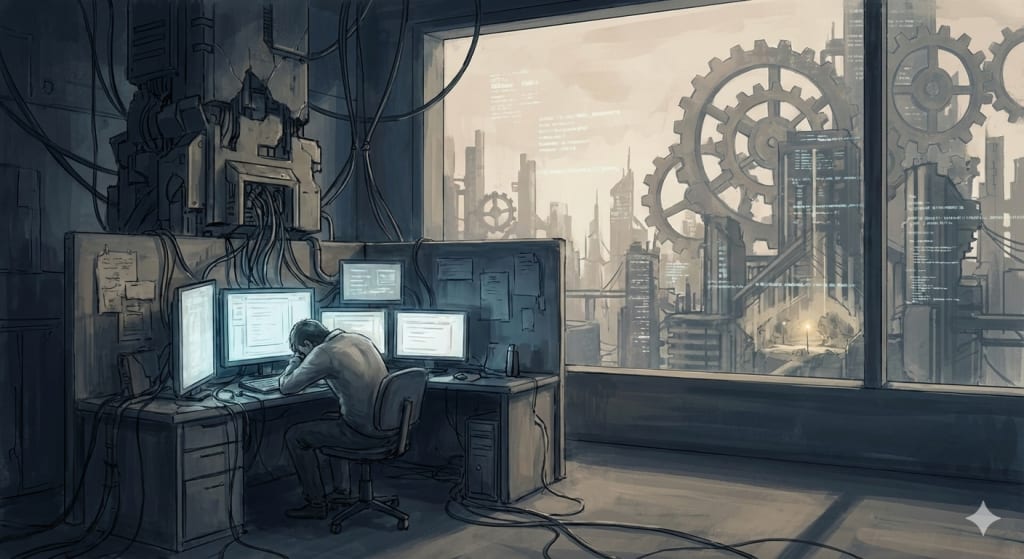
The Morning Weight
It starts before you even open your eyes. It’s that heavy, sinking feeling in your chest—a mixture of dread and exhaustion that no amount of caffeine can wash away. You look at your alarm clock, and for a fleeting second, you calculate how many hours of sleep you would get if you called in sick. But you don’t. You get up. You shower. You open your laptop or commute to an office, and you begin the cycle all over again.
We call this "burnout."
We treat it like a personal defect. We talk about it as if it were a glitch in our own internal operating system—a sign that we need better time management, more green juice, or a stricter meditation routine. We buy planners. We download mindfulness apps. We read books on "grit" and "resilience." We internalize the idea that if we are tired, it is because we are not doing enough.
But I am here to tell you something that the wellness industry and corporate HR departments won't: You are not broken. You are functioning perfectly. Your exhaustion is not a symptom of personal weakness; it is the only logical response to an economic and social environment that has become fundamentally uninhabitable for the human spirit.
You aren't burned out. You are being exploited.
The Gaslighting of "Resilience"
In the modern lexicon of corporate culture, few words are as weaponized as "resilience."
On the surface, it sounds empowering. It suggests strength, adaptability, and toughness. But in practice, "resilience" has become code for "your ability to endure structural abuse without complaining."
When a company lays off 20% of its workforce to boost quarterly profits but expects the remaining employees to cover the workload for the same pay, they call for "resilience." When the cost of rent doubles while wages remain stagnant, we are told to be "resilient."
This is a form of systemic gaslighting. By shifting the focus to your internal fortitude, the system absolves itself of responsibility. It tells you that the problem isn't the crushing workload or the impossible economic climate; the problem is your mindset. If you just had a more "positive attitude," you wouldn't feel this way.
This narrative is dangerous. It turns structural failures into personal anxieties. It keeps us busy trying to "fix" ourselves so that we don't have the energy to demand that the system fix itself.
The Death of the "Off" Switch
Let’s look at the mechanics of modern life. For most of human history, labor had a physical limit. When the sun went down, or the harvest was done, work stopped.
Today, we carry our factories in our pockets. The smartphone has dissolved the boundary between "labor" and "life." We are living in the era of the "Always-On" employee. An email at 9:00 PM demands mental energy. A Slack notification on a Sunday morning triggers a cortisol spike. Even when we are technically "off the clock," our brains are in a state of low-grade hyper-vigilance, waiting for the next ping.
This is not natural. The human brain was not designed to process global tragedies, work demands, and social comparison algorithms simultaneously, 24 hours a day.
We are suffering from "Notification Fatigue." It’s a state where the nervous system never truly enters a "rest and digest" mode. We are constantly in "fight or flight." And yet, we wonder why we are tired? We wonder why we have brain fog? We aren't resting; we are just charging our batteries enough to survive another day of drainage.
Productivity Dysmorphia
Perhaps the most insidious aspect of this broken system is what I call "Productivity Dysmorphia."
It is the nagging feeling that no matter how much you do, it is never enough. You could work a 10-hour day, clean the house, and pay the bills, and still lay your head on the pillow feeling like you were "lazy."
Why? Because the goalposts have moved.
In the 1970s, a single income could often support a family, buy a home, and save for retirement. Today, the "American Dream" requires two incomes, a side hustle, and a gig-economy job just to tread water. We are working harder than our parents did, yet we own less.
This economic reality creates a deep, subconscious panic. We hustle not because we are ambitious, but because we are terrified. We know that the safety net has been shredded. One medical emergency, one layoff, one bad month could ruin us. So we run on the hamster wheel, faster and faster, hoping that if we just work hard enough, we will finally feel safe. But safety never comes, only more exhaustion.
The Loss of the "Third Space"
Sociologist Ray Oldenburg coined the term "Third Places"—spaces that are neither home (the first place) nor work (the second place). These are cafes, parks, community centers, and libraries where people gather to connect without an agenda.
Look around. Where are they?
They have been monetized, digitized, or destroyed. To exist in public now costs money. If you want to see a friend, you have to "schedule" it three weeks in advance because everyone is drowning in work.
Instead of community, we have consumption. When we feel the void of loneliness, we are encouraged to buy something to fill it. We doom-scroll on social media, mistaking "connection" for "communication." We watch the curated lives of others and feel a pang of inadequacy, driving us back to work so we can afford the lifestyle we think we need to be happy.
Isolation is a key component of burnout. Humans are pack animals. We regulate our nervous systems through co-regulation with others. Without deep, non-transactional community, we remain in a state of stress. We are the most connected generation in history, yet we are dying of loneliness.
Your Burnout is a Protest
So, where do we go from here?
The first step is to stop apologizing for your tiredness. Stop trying to "hack" your way out of burnout with a new planner or a vitamin regimen.
Your burnout is not a disease; it is a signal. It is your body and soul engaging in a sit-in strike. It is your humanity screaming that it refuses to be reduced to a unit of economic production.
Accepting this doesn’t solve the rent crisis or fix the wage gap, but it does something vital: It liberates you from shame.
When you realize that the game is rigged, you can stop beating yourself up for losing. You can start setting boundaries—not because you are "weak," but because you are protecting your greatest asset: your life force. You can start prioritizing "unproductive" joy. You can choose to rest not to "recharge for work," but simply because you are a living being who deserves rest.
We need to stop asking, "How can I be more resilient?" and start asking, "Why have we built a world that requires this much resilience just to survive?"
You aren't crazy. You aren't lazy. And you certainly aren't alone. You are just a human being trying to bloom in a garden that has been paved over with concrete. Don't let them convince you that the wilting is your fault.
About the Creator
Top tipple tricks
Been thinking a lot about drinking, lately. Not least because of a recent episode of over-indulgence and the inevitable after effects. Some readers may recall the earlier articles I wrote about beating the booze. Here I set out an experiment in techniques for cutting down on my alcohol intake. The experiment was successful, the techniques worked, and I have armed myself with an arsenal of weapons in the war against the demon drink. I have yet to fire the first round however. It's all a question of timing (perhaps procrastination).
By Raymond G. Taylor4 days ago in Psyche
The Mind Behind Your Money: Why Wealth Starts in Your Head
"You can earn more, save more, and invest wisely—but if your mind doesn’t understand money, it will always slip through your fingers. The real wealth isn’t in your bank account—it’s in the way you think about money."
By Zakir Ullah7 days ago in Psyche



Comments
There are no comments for this story
Be the first to respond and start the conversation.