
You Are Not Who You Think You Are — The Psychology of the Hidden Self"
Your brain lies to you every single day — and you believe it.
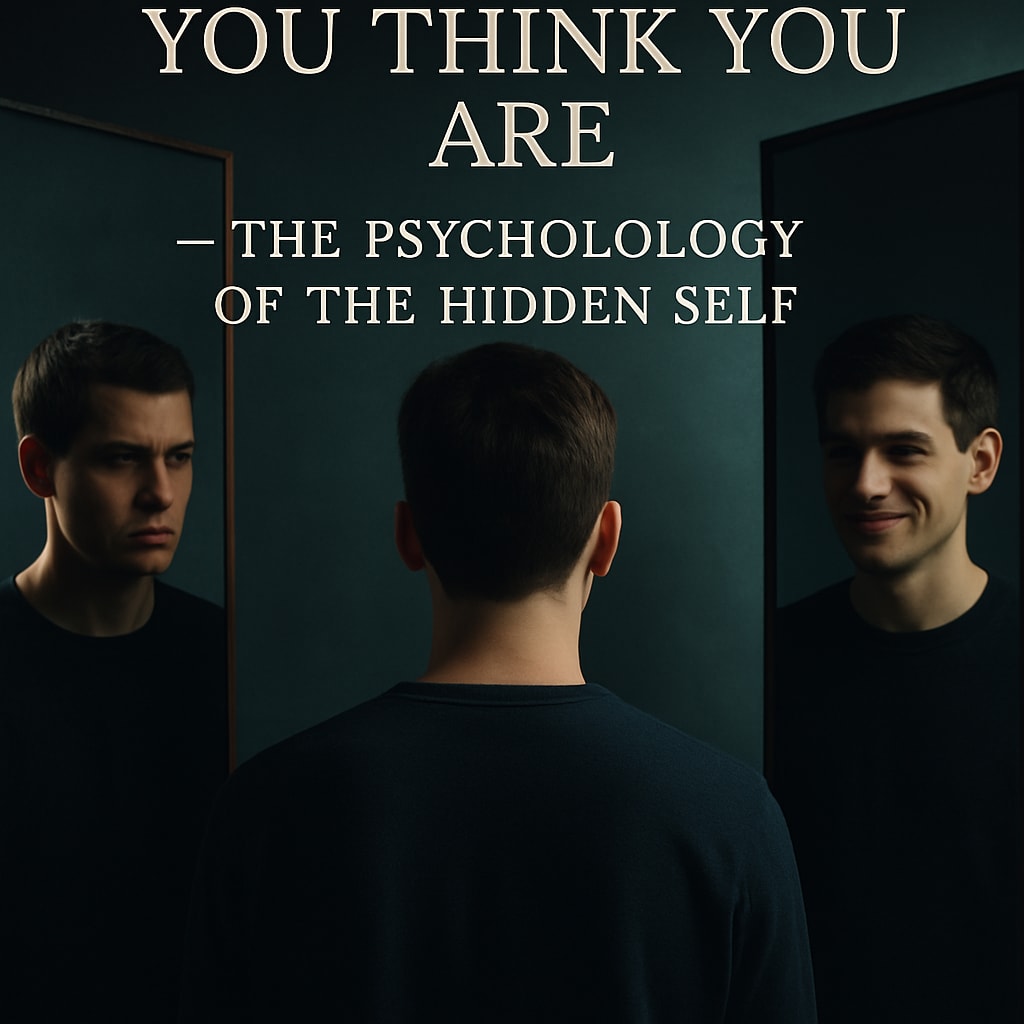
Title: You Are Not Who You Think You Are — The Psychology of the Hidden Self
Subtitle: Explore the illusions your brain creates and meet the self you’ve never truly known.
---
Who Are You Really?
Most people would answer that question with their name, job title, or a few personality traits:
"I’m Ali, a student."
"I’m confident, kind, and curious."
But here’s the unsettling truth:
> You are not who you think you are. You are who your brain wants you to believe you are.
In psychology, this is often called the "illusion of self" — a protective story your brain weaves around your identity to make life feel safe and logical.
But the truth? The real you is deeper, more complicated, and often hidden even from yourself.
---
🧠 The Self Is a Story — Not a Fact
We like to believe we’re logical, consistent, and fully in control of our decisions. But psychology disagrees.
Experts like Dan Gilbert (Harvard psychologist) and Antonio Damasio have shown that what we call the "self" is just a narrative structure — a story our brain invents to explain the chaos of our emotions, memories, and choices.
Let’s break it down:
When you make a mistake, your brain defends you: “That’s not like you.”
When you win, it praises you: “That’s who you truly are.”
When you change, it rewrites history: “You’ve always been this way.”
The catch?
> None of it is completely true. But it feels true — and that’s what matters to the brain.
Because the brain doesn’t care about absolute truth. It cares about coherence — the feeling that your story makes sense.
---
🪞 Your Brain Filters Reality — Not to Show Truth, But to Protect You
Ever heard of cognitive biases? They’re like secret filters on your brain’s camera lens:
Confirmation Bias: You notice what confirms your beliefs.
Negativity Bias: You remember failures more vividly than wins.
False Consensus Effect: You assume most people think like you.
These filters distort reality — but not randomly. They exist to protect your emotional balance, your ego, and your ability to survive socially.
> The brain's job is not to be right. Its job is to keep you safe.
---
🧩 The Split Inside You: "Public You" vs "Shadow You"
Carl Jung, the Swiss psychoanalyst, described the concept of the Shadow Self:
> The parts of your personality that you hide, reject, or deny.
The anger you suppress
The envy you pretend not to feel
The desires you think are wrong
This Shadow isn’t evil. It’s human. But when you ignore it, it grows more powerful — quietly controlling your behavior from the background.
Ever exploded with emotion and thought: "That’s not like me"? That was you — the hidden you, finally demanding to be seen.
To grow, you must face this side. Not to fight it — but to understand it.
---
🎭 The Masks You Wear
Every day, we put on different versions of ourselves:
The serious student at school
The obedient child at home
The chill, fun friend outside
These aren’t lies. But they aren’t the full truth either.
We shift ourselves based on:
Who’s around
What we fear
What we want
What we remember
What we’ve been through
> The real you is not one version. It’s all of them. And none of them, permanently.
You are fluid. You are evolving. You are a story still being written.
---
🧠 The Most Dangerous Lie: “I Know Myself”
Self-awareness sounds like a superpower. But it can also trap you.
> "I’m not good at confrontation." "I’ve never been creative." "I always mess up under pressure."
These are not truths. They are beliefs — reinforced over time by repetition and emotion.
And here’s the twist: The brain resists change. Because change feels like danger.
If you’ve always been "the helper," saying no feels cruel.
If you’ve always been "the quiet one," speaking up feels fake.
So the brain whispers:
> "This isn’t you." "You’ll lose people." "You’ll fail."
But in reality?
> You can become anyone. You are not limited by the identity you built — or were given.
---
🔑 How to Meet Your Real Self
Here are 5 science-backed ways to dig past the illusion:
1. Watch Your Thoughts — Don’t Obey Them Blindly Not every voice in your head is true or helpful.
2. Notice Your Reactions — They’re Clues What makes you angry, jealous, or afraid reveals hidden parts of you.
3. Write Without Editing — The Shadow Speaks Freely on Paper Journaling (especially stream-of-consciousness) helps surface unconscious patterns.
4. Talk to Your Shadow — Ask Hard Questions What version of yourself do you avoid being?
5. Accept Change as Growth, Not Betrayal You’re not being fake when you evolve — you’re being free.
---
🌌 Final Thought
You are not just your name, your habits, or your past. You are a story in motion.
> The more you explore your hidden self, the more whole you become.
Because the truth is not just what’s on the surface. It’s what you’ve been afraid to admit… even to yourself.
About the Creator
Keep reading
More stories from Abubakar Khan and writers in Psyche and other communities.
I Tried to Be the Good Guy — But It Nearly Destroyed Me”
I Kept Trying to Be Good — And Every Time, It Broke Me They told me, “Be kind.” So I was. I held the door open for strangers. I listened when people vented. I stayed patient even when I was boiling inside. I smiled when I wanted to cry. I let people interrupt me and still gave them the floor. I never raised my voice. Not once.
By Abubakar Khan6 months ago in Humans
Not All Fear Is Real
The first breath of dawn is a quiet thing, as though the world itself is holding its breath, waiting to exhale. But for Nadia, the morning air felt like a sharp slap against her skin, cold and biting. Her fingers trembled as she clutched the edge of her jacket, the wind tugging at her hair. She stood on the edge of the cliff, her gaze cast over the valley below, the dark outline of the forest stretching far into the horizon. The shadows of night still clung to the trees, but the first threads of daylight were beginning to seep through, spilling gold onto the earth.
By Jhon smith3 days ago in Psyche
How to Succeed at the Benson Directory®
Congratulations and welcome to the Benson Directory® employee #22391! As our newest call handler, you will have the privilege of speaking with dozens of unique and interesting people on a daily basis as well as the opportunity to earn bonuses for high performance. Contained within this handbook you will find a set of ease to follow instructions designed to help you settle in to your new role and begin paving the way to success.
By S. A. Crawford4 days ago in Fiction



Comments
There are no comments for this story
Be the first to respond and start the conversation.