
Why Your Focus Feels Unstable
It's not laziness. It's Slip, the noise inside your cognitive drive system.

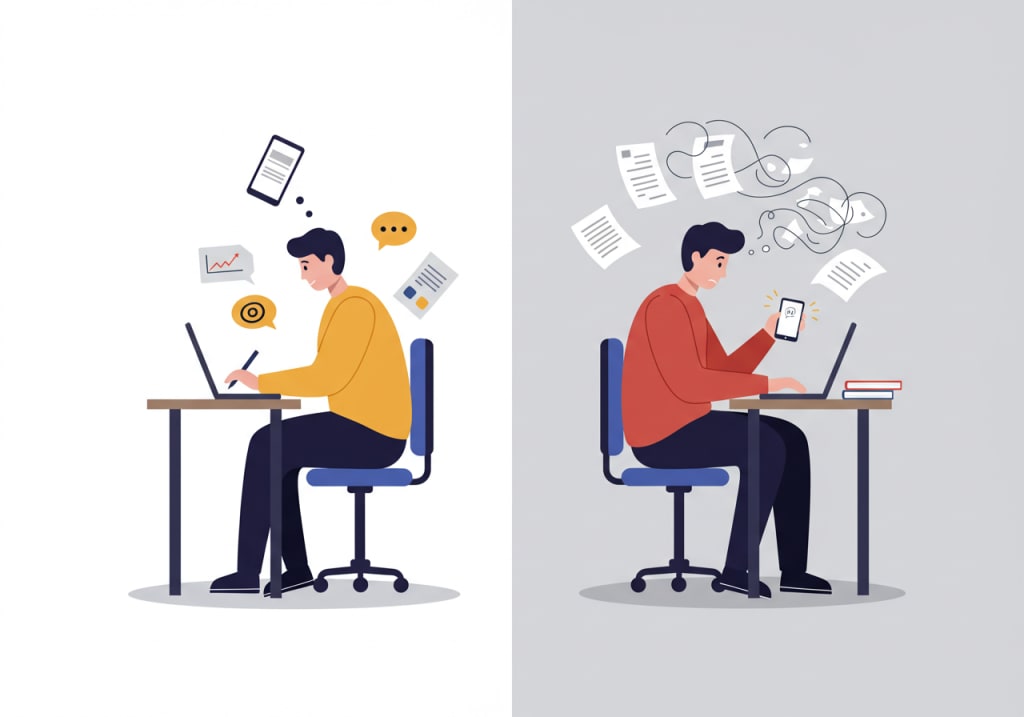
One of the most discouraging things about personal effort isn't failure. It's an inconsistency. You're focused and steady one day, then suddenly foggy and restless the next. From the outside, it looks like you lost discipline. From the inside, it feels like you've fallen off track.
But you didn't fall off. Your system drifted.
And in the field of Cognitive Drive Architecture (CDA), that drift has a name: Slip.
What Is CDA?
Cognitive Drive Architecture (CDA) is a proposed field in cognitive psychology. Its focus is effort, not as a vague trait like "motivation" or "willpower," but as a structural system that can be mapped, measured, and explained.
Where traditional psychology has theories of motivation, attention, or executive function, CDA offers something different: an architecture. It treats drive the way engineers treat engines: defined by variables, thresholds, and feedback loops.
In other words, CDA doesn't just describe what effort looks like. It explains the structural conditions that make effort possible, unstable, or impossible.
What Is Lagunian Dynamics?
At the core of CDA is Lagunian Dynamics, the theoretical engine that defines six variables of Drive:
- Primode: ignition switch; whether you can start.
- CAP: Cognitive Activation Potential, your mental voltage.
- Flexion: the fit between your system and the task.
- Anchory: attention tether, what holds you steady.
- Grain: friction, resistance, transition costs.
- Slip: the wobble, drift, or noise in the system.
These variables aren't personality traits. They're structural roles. When they align, Drive ignites and holds. When they misalign, effort collapses, regardless of how motivated you feel.
What Exactly Is Slip?
Slip is one of those six variables, and it's the one most often mistaken for personal weakness.
Slip is the drift in your system. It's the wobble in your focus, the random turbulence in mood and attention that make your effort line uneven.
- One day, you're sharp.
- The next day, you're jumpy or foggy.
- Nothing big changed, but you can't hold the same rhythm.
That's Slip.
In ADHD studies, Slip shows up as unstable effort patterns and reaction time variability. In everyday life, it feels like an inconsistency.
But Slip isn't laziness or loss of discipline. It's noise. Every dynamic system produces noise. Every engine vibrates when it runs. Your mind does too.
Why We Misread Drift as Failure
The culture of productivity trains us to expect consistency: grind, discipline, and routine. When Slip appears, we see it as failure.
But Slip isn't failure. It's built into the system. It's not something to feel ashamed of; it's something to track and work with.
How to Track Slip
Pilots know planes drift. They don't panic. They measure the drift and correct course.
You can do the same. Slip becomes less scary once you log it.
Try simple daily notes on mood, energy, or focus. Or watch for when your effort "shakes," when you bounce between tabs, snap at people for no reason, or zone out mid-task. Over time, you'll notice patterns. Maybe Slip spikes after long monotony, late at night, or whenever you've skipped recovery.
Once Slip is visible, it becomes data, not self-judgment.
Tools for Stabilizing Drift
You can't erase Slip. But you can keep it within range:
- Variability Logs: one-line check-ins on mood/focus.
- Anchory Supports: attention stabilizers like noise-canceling, timers, or playlists.
- Burst Pacing: shorter, timed bursts of work that match your natural rhythm.
- Novelty Injectors: new environments or micro-challenges to smooth out wobble.
- Recovery Routines: good sleep, exercise, and downtime to lower Slip's amplitude.
These aren't hacks. They're stabilizers. They make drift manageable instead of destructive.
Rethinking Consistency
Consistency doesn't mean zero Slip. It means being able to work inside the drift.
When you understand Slip as turbulence, you stop treating it like collapse. Shame fades. You become more adaptive. And paradoxically, that makes you more consistent than before.
The Bigger Picture
Slip is one piece of the architecture. CDA has other models that extend the framework:
- Cognitive Thermostat Theory (CTT): a control-theory model of ignition. It explains when the action starts.
- Latent Task Architecture (LTA): a model of task interference. It explains how unresolved tasks create drag and instability.
Both build on Lagunian Dynamics. Together, they position CDA not just as another motivational theory, but as a field in cognitive psychology dedicated to the structure of effort itself.
Final Thought
You didn't fall off. You drifted.
That drift is Slip, the turbulence of your drive system. It isn't proof you're broken. It's a sign you're human.
The real test isn't avoiding drift. It's learning to recognize it, track it, and correct for it. Once you do, Slip stops being a source of shame and starts being a source of insight.
About the Creator
Keep reading
More stories from Nikesh Lagun and writers in Psyche and other communities.
Breaking the ADHD Effort Paradox (Why Motivation Alone Isn’t Enough)
Have you ever been excited to start a task, fully aware of its importance, yet somehow found yourself stuck at the edge of action? It’s a paradox that many people with ADHD know all too well. Despite the best intentions and a strong sense of motivation, the action remains elusive. This struggle is not a flaw of character or willpower. Instead, it’s a complex failure of the cognitive system, a deeper issue that goes beyond typical motivational theories. The reason for this inaction is rooted in how our minds regulate effort, and in the case of ADHD, this regulation can break down in unique ways.
By Nikesh Lagun5 months ago in Psyche
The Silent Pattern That Is Draining Your Life Without You Noticing
The Silent Pattern That Is Draining Your Life Without You Noticing Not all psychological struggles announce themselves loudly. Some don’t come as panic attacks, breakdowns, or visible crises. Some arrive quietly. They blend into your routine. They feel like “just life.” And that is exactly why they are so dangerous. This article is about one of those patterns. When Functioning Becomes a Disguise You wake up. You do what needs to be done. You fulfill responsibilities. From the outside, you look fine. But internally, something feels… depleted. Not sadness. Not anxiety. Just a constant low-level exhaustion — mental, emotional, existential. This is not laziness. And it is not weakness. It is a psychological pattern built around over-functioning. The Over-Functioning Trap Over-functioning happens when your sense of worth becomes tied to: Being useful Being reliable Being the “strong one” Holding everything together At first, it feels like maturity. Later, it becomes identity. Eventually, it becomes a prison. You stop asking: “What do I need?” “What do I feel?” “What do I want?” Because survival has trained you to focus only on: “What must be done next?” Why This Pattern Forms This pattern often develops early: In emotionally unpredictable environments In households where your needs were secondary When being “low-maintenance” kept the peace When responsibility arrived before safety So you adapted. You learned to function without support. You learned to silence discomfort. You learned to keep moving — no matter the cost. And it worked. Until it didn’t. The Cost No One Talks About The cost is subtle but heavy: Chronic emotional numbness Difficulty resting without guilt Feeling disconnected even during success A sense that life is happening around you, not within you You may achieve things. You may be admired. But fulfillment feels strangely absent. That absence is not a flaw in you. It is a signal. Awareness Is the First Disruption This pattern survives on invisibility. Once you see it, it weakens. Start noticing: When productivity replaces self-worth When rest feels unsafe When you only feel valuable while giving You don’t need to “fix” yourself overnight. You need to listen — without judgment. Healing here is not dramatic. It is quiet. Consistent. And deeply human. A Final Thought You were not meant to merely function. You were meant to experience life. If this article resonated, it’s not because something is wrong with you. It’s because something true was finally named. And naming is always the beginning.
By Med Abdeljabbar6 days ago in Psyche



Comments
There are no comments for this story
Be the first to respond and start the conversation.