
WHERE DO HUMANS COME FROM?
The world we inhabit today often feels ordinary and familiar. We tend to take for granted the conveniences and comforts that surround us, from readily available food to secure shelter. It's easy to assume that this is simply the natural state of human existence. However, the reality is quite different. The human journey is one of continuous adaptation and transformation, a story that spans millions of years and countless generations.
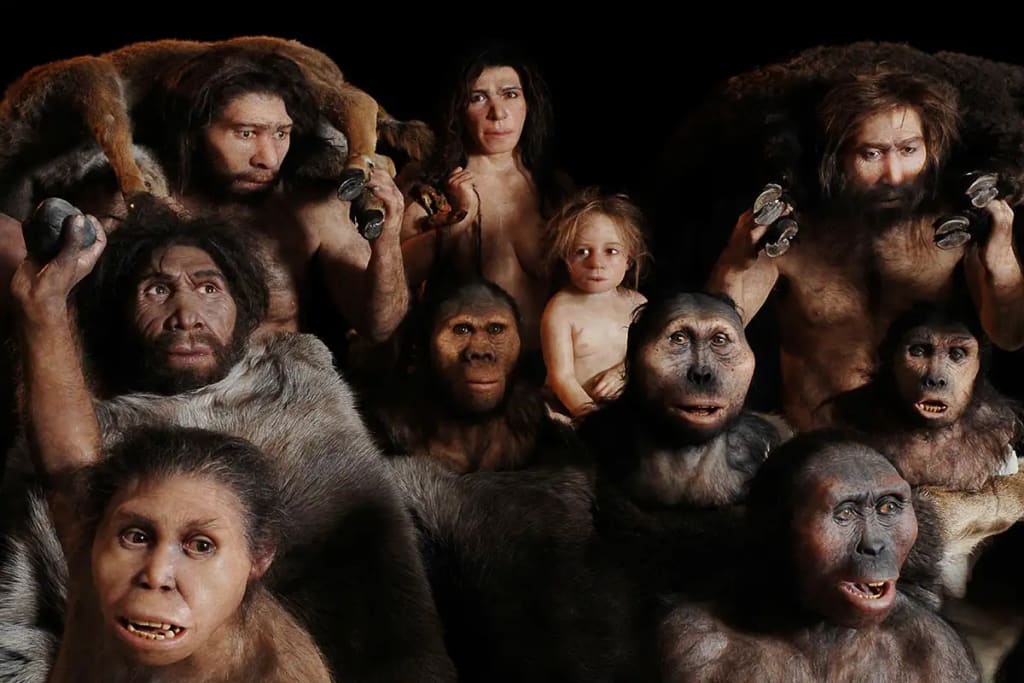
Our story begins approximately 6 million years ago when the hominini tribe diverged, marking the end of our shared lineage with the apes. The emergence of the genus Homo, the first humans, occurred around 2.8 million years ago. But it's important to note that we were not the sole human species at that time. When Homo sapiens sapiens, our species, came into existence around 200,000 years ago, we coexisted with at least six other human species, each with its unique characteristics and abilities.
These human species were our cousins, possessing comparable intelligence and capabilities. The coexistence of multiple human species was akin to living alongside aliens, a fact that adds a sense of intrigue to our ancient history. Some of these species, such as Homo erectus, thrived for 2 million years, a duration ten times longer than our species has existed. However, these ancient human relatives vanished around 10,000 years ago, leaving behind questions about their demise. While some interbreeding likely occurred, it was not enough to constitute a merger between species.
Around 2.8 million years ago, early humans began using tools but made limited progress for almost 2 million years. Then, they harnessed fire, a pivotal development in our history. Fire-enabled cooking renders food more nutritious and contributes to the expansion of our brains. It provided light, warmth, and protection against predators, even aiding in hunting. Torched landscapes offered pre-roasted food sources.
From 300,000 years ago, most human species lived in small hunter-gatherer communities. These early humans had fire, wooden, and stone tools, and practiced burial rituals, fostering their unique cultures. Crucially, they communicated with one another, albeit through a less complex form of language than we use today. If we could travel back in time, how far back could we go, snatch a few babies, and raise them in our present world without anyone noticing their differences? This remains a topic of debate, with estimates suggesting a limit around 70,000 years ago for behaviorally modern humans.
Around 50,000 years ago, a significant leap in innovation occurred. Tools and weapons became more advanced, and cultures grew more complex. Humans possessed a versatile brain and an advanced language that enabled effective information exchange. This closer cooperation distinguished us from other creatures, allowing flexible collaboration within large groups. The ability to expand knowledge rapidly, preserve it over generations, and build upon it is what sets us apart.
Human life remained relatively unchanged for the next 40,000 years, but around 12,000 years ago, agriculture emerged independently in multiple locations. This revolution transformed everything. Before agriculture, survival as hunters and gatherers demanded broad skill sets from everyone. With agriculture, individuals could rely on others' skills for survival, allowing specialization. This shift was the dawn of civilization.
Agriculture provided a reliable food source, enabling food stockpiling for the first time, particularly with grains. This led to community living, defense structures, and increased organization. As we became more organized, efficiency surged, leading to the formation of villages, cities, kingdoms, and empires. Connections among humans proliferated, facilitating knowledge exchange and propelling progress.
Around 500 years ago, the Scientific Revolution began, transforming our understanding of mathematics, physics, astronomy, biology, and chemistry. This laid the foundation for the modern world. The subsequent Industrial Revolution further accelerated progress, and today, we live in the most prosperous age in human history.
The invention of the computer and the development of the Internet reshaped our world. Our knowledge and the way we acquire and store it expanded exponentially. Despite our impressive progress, our rule over this planet remains fragile.
The human journey, spanning 125,000 generations, has led us to this point. We have transformed our planet, our environment, and our knowledge. The future remains uncertain, as we continue to build upon this complex, ever-evolving foundation.
The world we live in today is a testament to human adaptability and innovation. As we navigate our daily lives, it's worth remembering the extraordinary nature of our existence. Perhaps, in the grand scheme of things, the small inconveniences we encounter are not worth the frustration. Our story is one of remarkable change, and the possibilities for the future are limitless.
About the Creator
Gia Hưng Phùng
My whole life, I have always been a curious person, asking myself some of the biggest questions in life that may still remain unsolved like where do humans come from, are gods real, or what is the meaning of life,etc
Keep reading
More stories from writers in Psyche and other communities.
Let Grief Be Loud.
When I first started writing about grief, I thought it would be too hard, but it turns out to be the easiest thing I’ve ever done. It has been so easy reaching into my soul and spilling my feelings. Whether people read the poems or I’m posting without results, writing about grief and putting it out into the world has been so healing. Though I’ll never heal, I’m thankful for that, because it means I’ll always have something to write about.
By April Kirby.5 days ago in Psyche
🅼🅸🅳🅽🅸🅶🅷🆃 🆂🅽🅰🅲🅺🆂
"It's 10 in Tuscon! We all know what that means... It's Time for Midnight Snacks with your man, Gerald Gee! Ready to spend the night together? Me too! I'm full of snacks and can't wait to regurgitate them all back into your hungry ears. Crack a brew! Pop some corn! Anything to get ready for one hell of a show where the talk maybe cheap but the words cut deep...
By Lamar Wiggins4 days ago in Fiction


Comments (1)
Test