
What Are Nightmares Telling Us?
On the obscure language of the human psyche
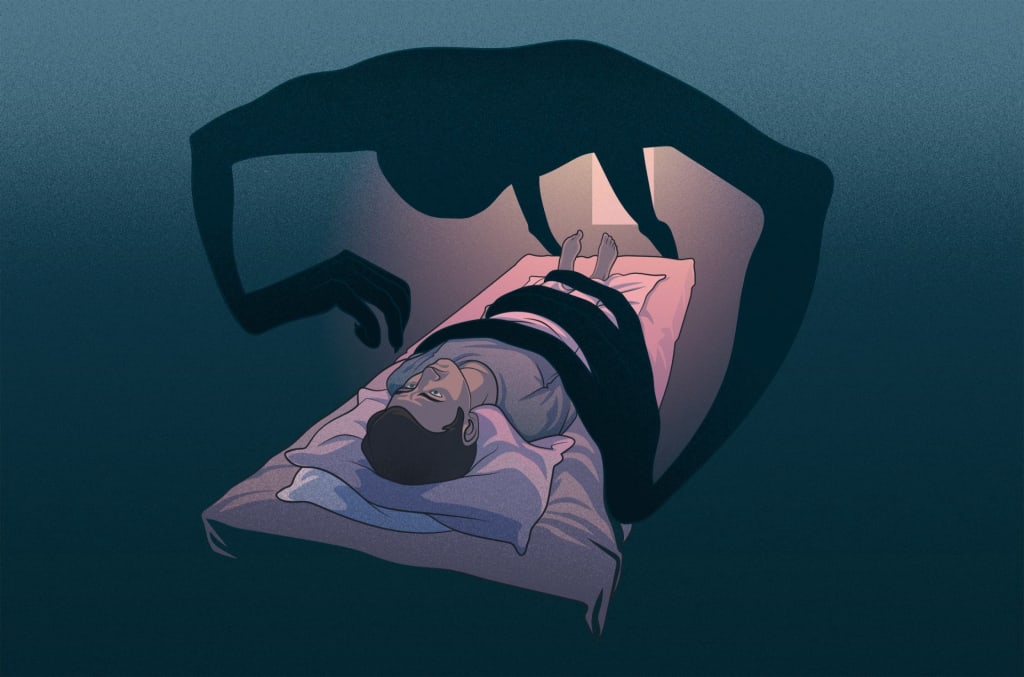
In 2008, I was lying in bed and drifting off to sleep. My then-boyfriend was in the other room. Lying on my stomach, my head turned to the right, I was idly glancing at the wardrobe.
Shortly, I sank into a deep sleep — and was yanked right out of it when I felt someone’s weight on my back.
I knew it wasn’t my boyfriend or even a human being. It was something much heavier — pressing down on me so hard that I felt like my ribcage will shatter. I couldn’t move, I couldn’t speak, my entire body was immobilized, even my eyes. They were open but fixed on the wardrobe and I couldn’t even look up or down.
And then I heard: “He is very sick.”
It wasn’t a voice. I heard it in my head, the way thoughts form in the mind. Just like in a dream, when you need a single word or a single image to understand something in its entirety. In this petrified state, I sunk back into sleep.
When I woke up the next morning, I immediately told my boyfriend. I had been in perpetual worry about his health already. He was a chain smoker who had recently been hospitalized for a lung problem, he drank heavily, and he had a pill addiction. He would often complain of stomach pains, liver pains, being on the brink of fainting. From its very start, our relationship had fallen into a co-dependent dynamic, with him feeding off of my anxiety and constant dread about his wellbeing.
Now, he said, “You’re silly. I’m not seeing a doctor just because you had a nightmare.”
“But it was so real!” I said. “What would it hurt if you just go for a check-up?”
He didn’t go.
He also didn’t drop dead like I feared he would.
He went on as always. Until, several months later, I got sick. I started getting paralyzing migraines and he hated it. He accused me of pretending, exaggerating, “making it all up.” He berated me constantly for being in pain. My breaking point finally arrived one evening when he blasted the volume of the TV after I asked him to turn it down because I was having a head-splitting headache.
That was the moment I finally saw him clearly and left him.
I had finally accepted what the words “He’s very sick” meant in that paralyzing night in 2008.
They weren’t a message for him. They were a message for me.
What are nightmares?
This was my only experience of sleep paralysis — an episode where you either dream of a malevolent presence or hallucinate it while you’re awake. Regardless of whether you’re asleep or awake, it feels the same: you feel paralyzed but fully conscious, and — in most cases — you see or feel something menacing.
In its essence, sleep paralysis is not very different from a nightmare. You experience something frightening and it feels very real. The difference is, with sleep paralysis it continues to feel real even after you wake up. You can’t be quite sure whether you dreamt it or experienced it.
And this is the point.
Dreams, nightmares, sleep paralysis — they always point to something very real.
Where do they come from?
In our modern culture, we tend to disregard dreams as meaningless. But this is a very recent development in the long history of human beings. Pagan and shamanic cultures, by contrast, based personal and tribal decisions on dreams. Dreams were their guides.
Carl Jung fell out with his mentor, Sigmund Freud, over this exact topic. Freud saw dreams as mere “compensation” to what the conscious ego is thinking or doing, similar to a mechanic knee-jerk reaction.
But Jung saw them as messengers from our deep, intuitive, unconscious mind — the part of our psyche that stores all our memories, thoughts, feelings, secrets, the bulk of which never do reach our consciousness.
What was revolutionary in Jung’s position — but not new to shamanic cultures — was that the unconscious mind is not mechanical. It is an active participant in life that knows much more about us than we ever consciously will.
It communicates to us with hunches, cravings, emotions, and dreams. But most modern humans don’t pay attention.
When the message is urgent
There are two kinds of nightmares.
The ones that we get after experiencing something traumatic. The event plays out in our dreams over and over again, until our psyche has processed it.
And the ones we get “randomly.” Except they are not random.
They happen when you have ignored your intuition, your authentic feelings, and usually a lot of non-frightening dreams.
They are the unconscious mind’s way to make you pay attention.
Have you ever wondered how nightmares can be so frightening? If you view them from the lens of horror storytelling, they are pure perfection. They can utilize mere whispers, vague figures, simple words in a way that surpasses the scariest book or movie ever made.
It’s because they “know” you. The unconscious mind knows exactly how to push your buttons because it knows everything else about you.
Nightmares are among the most powerful tools it uses when you’re ignoring something important it’s trying to tell you.
And if you keep ignoring it, you will start having the same nightmare again and again.
And if you keep ignoring this too, it will find other ways to amp up the noise.
In my case from 2008, it gave me a sleep paralysis experience. I ignored that too, so finally, it paralyzed me further with psychosomatic migraines that brought to the surface the reality I was refusing to see.
The unconscious mind is the most powerful and accurate guide you can have. All you need to do is listen to it.
What to do about nightmares?
To answer this question about nightmares, first we need to face the biggest criticism against dreams in general.
Why are they so strange? Why are they using a language so impossible to decipher?
Carl Jung said,
“The unconscious mind doesn’t speak an obscure language. It speaks a forgotten language.”
Before we started worshipping the rational mind above all else, humans communicated with symbols for hundreds of thousands of years. This part of us has not diminished in the past centuries, we just work very hard at trying not to see it.
Dreams carry many symbols — what Carl Jung would call your “personal mythology.” Very often, the meaning of a single dream can unfold over weeks, months, even years.
So instead of approaching dreams as an indecipherable textbook, try to see them like a child or a painter would: engage with them, draw them, play with them, see where they take you, be curious. Allow your intuition to take the lead.
Nightmares are no different.
Replace the fear with curiosity and your unconscious mind will respond.
When I think back on the relationship with my ex, I see with clarity the manipulation, the co-dependency, the emotional abuse, and the suffering. But when I was in it, my vision was obscured by fears and a sense of guilt and obligation.
However, if I had taken a moment after the sleep paralysis episode, if I had consulted the intuition I ignored for the entirety of that relationship, the words “He’s very sick” would have started to take on a richer meaning.
This is one of the primary qualities of symbols. They’re rich. They contain layers of meaning, and if you engage with them, they will engage you back.
Nightmares, like all dreams, use symbols not because they’re inherently “strange.” It’s because they come from a place of supreme intelligence.
If you’re tormented by nightmares, all you need to do is take the conscious attitude: “Okay. You got my attention. I’m listening.” Usually, this makes the nightmares stop or at least tone down the horror.
The most common example of how this looks in practice? If you’ve been dreaming of someone chasing you, now you might dream of them finally catching up. When this happens, most people experience an overpowering sense of love for their chaser and the realization that it was someone who wanted to embrace them all along. A symbol for a repressed part of the psyche that was seeking integration and expression.
So, if you’re struggling with night terrors or repetitive nightmares, there’s one thing you can do. One simple step.
Look at them with a tinge of curiosity.
They will change — and so will you.
About the Creator
Keep reading
More stories from Martina Petkova and writers in Psyche and other communities.
How to Tell If You Are The Abuser
If we don’t count the 1% of psychopaths among us humans, nobody sets out to be an abuser. Yet, scores of people systematically abuse others. Some even derive immense enjoyment out of it. But they don’t see it as abuse. Deep down, under layers of consciousness, they see it as self-protection.
By Martina Petkova5 years ago in Psyche
Psychic Reading Online – Top 4 Best Live Chat Psychic Reading Sites
Uncertainty is something we all experience at different stages of life. Questions about love, career decisions, finances, family matters, or personal growth can sometimes leave us feeling overwhelmed or unsure about what direction to take next. Wanting answers and clarity during these moments is completely natural.
By Louie Bell3 days ago in Psyche
My New Book is Finally Here
My poetry collection Beautiful and Brutal Things is done. It's actually done and finally published over 270 pages. Over a year of my life went into this book. More than a year, really. Long days at my computer, sometimes seven days a week because I couldn't stop even when I probably should have. Then two months of editing that felt harder than the writing itself. But it's finished, and I'm still standing, and the book is real.
By Tim Carmichaela day ago in BookClub



Comments
There are no comments for this story
Be the first to respond and start the conversation.