
Toxic Reflection
The painful moment I saw myself as the villain in my love story.

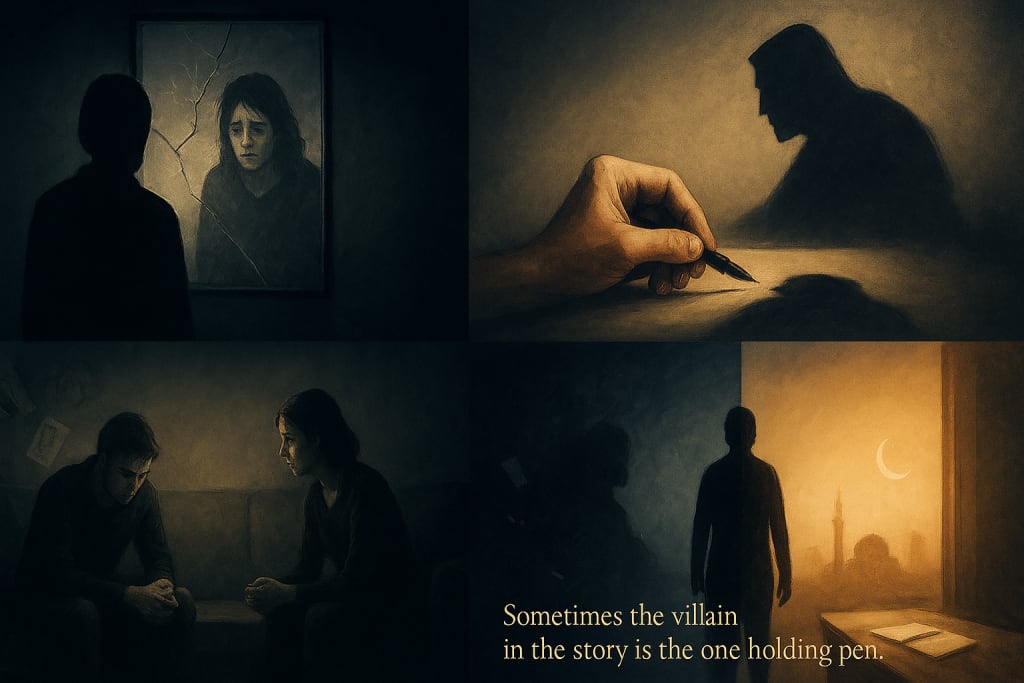
I always thought I was the victim. In every failed relationship, every misunderstanding, every fight—I told myself I was the one who gave too much and received too little. I’d vent to friends, post vague quotes online, and cry quietly at night.
My narrative was simple: I loved too deeply, and others just couldn’t handle it.
But that illusion shattered the day I realized—I was the toxic one.
It didn’t happen in some explosive moment. There was no screaming, no dramatic breakup. It came quietly, like the sting of cold air when you step out of a warm bath.
One morning, I looked into my partner’s eyes and saw something I hadn’t seen before: exhaustion. Fear. Defeat.
And the worst part? I wasn’t shocked. I was caught.
Looking back, the signs had always been there. I craved constant reassurance. Every unanswered text felt like betrayal. I needed to know where he was, who he was with, and why he said “I love you” twice instead of three times.
I convinced myself it was love. But really, it was control dressed up as insecurity.
I nitpicked over everything—a missed call, a delayed reply, a joke I didn’t find funny. If he had a good day without me, I’d make him feel guilty. I compared us to other couples, turning our love into a competition he never agreed to play.
And every time he pulled back, I panicked. I’d cry, accuse, threaten to leave. When he stayed, I took it as proof of his love—when in truth, it was proof of his exhaustion.
We were sitting on the couch when it happened. He was quiet. Distant. I kept pressing him—demanding attention, connection, something.
Then he said softly, “Do you realize how hard it is to be around you sometimes?”
At first, I snapped back with denial. But he didn’t argue. He just looked at me—not with anger, not with hate. Just… tired.
I walked into the bathroom and looked in the mirror. Not at my makeup, not at my reflection—but at me.
And in that moment, it hit me: If I were dating someone like me, I’d be miserable too.
The truth was, I carried unhealed wounds. From childhood. From past heartbreaks. From years of believing I wasn’t enough unless someone constantly reminded me I was.
But instead of healing, I projected. I made my partner responsible for filling my emptiness. I expected him to parent me emotionally, to validate me endlessly, to never falter—even when I was crumbling.
It wasn’t fair. To him. Or to me.
That night, I apologized. Not to manipulate, not to win him back, but because I finally understood the weight of my actions.
But apologies aren’t magic wands. Healing takes time. I had to face the uncomfortable truth of who I had become.
So I started therapy. I journaled. I studied emotional intelligence. I sat with my own silence. I learned that love isn’t about possession or perfection—it’s about freedom, safety, and respect. Things I hadn’t been offering.
Some people told me, “Don’t be so hard on yourself. We all make mistakes.” But there’s a difference between a mistake and a habit.
And I had made toxicity a habit.
Changing that meant being brutally honest with myself. Healing wasn’t pretty. It was messy. Lonely. Raw. It meant crying in solitude, admitting my faults when my ego burned, and letting people walk away instead of chasing them with promises to do better “next time.”
I don’t know if that relationship can ever be repaired. And maybe that’s okay. Some people come into your life not to stay, but to hold up a mirror.
And the reflection they show you can change everything.
Now, I’m not the same person.
When I feel insecurity rising, I pause. I breathe. I ask myself, “Is this really about them—or about me?”
I set boundaries—with others, and with myself. I’ve learned to love without clutching, to speak without cutting, to sit in silence when my only words would be wounds.
If you find yourself always pointing fingers, always the “victim,” stop. Ask yourself:
- Do I feel entitled to someone else’s constant energy?
- Do I manipulate and call it “love”?
- Do I avoid being alone because it forces me to face myself?
If the answer is yes—it doesn’t mean you’re broken. It means you’re human. But now, you have a choice.
Don’t wait until someone breaks under your weight to finally see the truth. Look in the mirror now.
The hardest truths are the ones that transform us the most.
Because sometimes, the villain in the story is the one holding the pen.
About the Creator
Shehzad Anjum
I’m Shehzad Khan, a proud Pashtun 🏔️, living with faith and purpose 🌙. Guided by the Qur'an & Sunnah 📖, I share stories that inspire ✨, uplift 🔥, and spread positivity 🌱. Join me on this meaningful journey 👣
Keep reading
More stories from Shehzad Anjum and writers in Psyche and other communities.
Addicted by Design
Every day, millions of us tap open our favorite apps—liking photos, scrolling through memes, sharing stories. It feels harmless, even fun. But behind the endless feeds and filters lies a hidden truth: these platforms aren’t designed to empower us. They’re designed to control us.
By Shehzad Anjum5 months ago in Psyche
Do You have a Support Network?
Life is harder when you’re on your own. Human beings are social creatures, and we usually feel better when we have support from a strong social network around us. For most people, it’s our families that hold us together like glue.
By Elizabeth Woodsabout 2 hours ago in Psyche
Beyond the Doll: Moving from Token Gestures to Real Support for Autistic People
This week, Barbie announced the release of a new autistic Barbie doll, aiming to increase visibility and acceptance for autistic individuals. While the intention is commendable, it raises important questions about whether symbolic gestures like this truly address the needs of autistic people. Research and lived experience suggest that meaningful representation and concrete support in society are far more impactful than launching a product labelled as “inclusive”.
By Sarah Xenosa day ago in Psyche
Getting Serious About Comedy (Part I)
If I were asked to remark on my life and the childhood that paved some road leading me to this point, I would have to say something about all the funny people who surrounded me for the last 26,872 days (and counting). Somewhere along that road, I became a big fan of laughter and the comedy that spawns it – and, I mean not only my own laughter, but the laughter of others, some of which I have actually been responsible for inducing.
By John Oliver Smith7 days ago in Humor


Comments
There are no comments for this story
Be the first to respond and start the conversation.