
To Dissociate or Not? Low‑Dose vs Full State Ketamine Infusions Explained
Unlocking the Healing Potential Through Understanding Dosage Depth

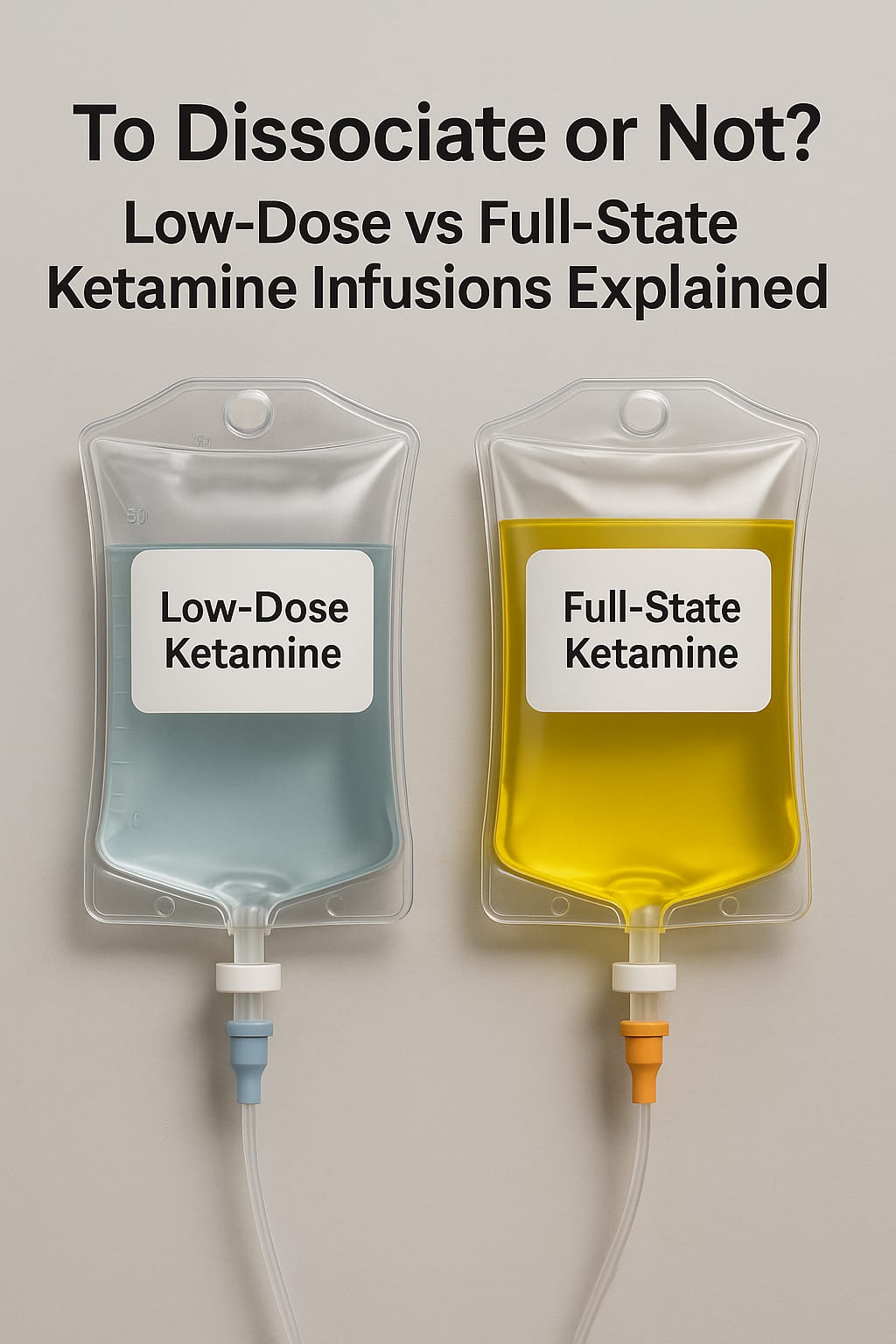
The Spectrum of Ketamine Therapy
In the realm of mental health and chronic pain management, ketamine has carved out a profound reputation. Once known primarily as an anesthetic and party drug, it’s now respected for its fast-acting relief in treatment-resistant depression, PTSD, anxiety, and other hard-to-treat conditions.
But within ketamine therapy itself, there is a growing debate: should patients receive low-dose infusions that keep them grounded, or full-dose treatments that trigger dissociative states?
Understanding the difference between these two approaches is vital for both clinicians and patients. This isn’t just about dosage. It’s about intention, effect, neuroplasticity, and long-term outcomes.
What Is Ketamine Therapy, Really?
At its core, ketamine therapy involves the administration of ketamine, either intravenously or via other routes, under clinical supervision. While ketamine’s roots are anesthetic, its benefits at sub-anesthetic doses, especially for mental health, have been a subject of increasing scientific attention.
It works primarily by antagonizing the NMDA receptor, leading to a cascade of downstream effects, including increased glutamate release and a boost in brain-derived neurotrophic factor (BDNF). These mechanisms promote neuroplasticity, helping the brain “re-wire” itself. But the degree to which this rewiring occurs often depends on how deeply the patient is taken into the experience.
And that’s where dosage matters.
Low-Dose Infusions: Staying Present with Subtle Shifts
Low-dose ketamine infusions are typically delivered at 0.1–0.5 mg/kg over 40 minutes. At this range, patients remain largely alert and aware. They might feel slightly “floaty,” experience mild perceptual changes, or a light emotional distance, but they do not enter a dissociative or psychedelic state.
Benefits of Low-Dose Ketamine:
- Accessibility: Easier to tolerate for first-timers or those with anxiety about losing control.
- Functionality: Patients can often return to work or daily life more quickly.
- Clarity: More suitable for concurrent talk therapy or coaching during sessions.
- Safety: Lower risk of overwhelming psychological content emerging.
Low-dose ketamine works subtly but effectively over time. Many protocols call for multiple sessions across weeks, creating a cumulative therapeutic effect.
However, for some patients, low doses might not be enough. That’s where the deeper end of the pool, the full dissociative state, comes into play.
Full-State Dissociation: Crossing the Threshold
Dissociative ketamine infusions usually start at 0.7 mg/kg and can reach 1.0 mg/kg or more, depending on the patient's tolerance and treatment goals.
In these sessions, the line between body and mind blurs—or disappears entirely.
People often report:
- Floating outside their bodies
- Ego dissolution
- Powerful visions or symbolic experiences
- A sense of timelessness or oneness
- Revisiting traumatic memories in symbolic or abstract form
This deeper state can feel surreal, overwhelming, or euphoric—but often, it’s therapeutic.
Why Go Deep?
Full-state ketamine infusions allow for profound psychological and emotional access. The dissociative state can break rigid thought patterns and bypass the defenses that normally keep trauma or deep-seated emotional pain locked away.
For some, it creates a spiritual sense of rebirth or catharsis that accelerates healing in ways traditional therapies never could.
Low-Dose vs Full-State: Which Is More Effective?
Effectiveness depends on the individual and their intention.
Low-Dose May Be Best For:
- Ongoing mood maintenance
- Patients with high anxiety or fear of ego loss
- Those in the early stages of treatment
- Integration-focused sessions with psychotherapy
- Patients who want to remain conscious and verbal during treatment
Full-State May Be More Impactful For:
- Deep trauma processing
- Existential depression
- Chronic, treatment-resistant conditions
- Individuals seeking a psychedelic-type experience
- Accelerated transformation or “pattern reset”
There is no one-size-fits-all answer. Some clinics start with low-dose protocols and escalate based on patient response. Others alternate between both styles, leveraging the benefits of each depending on therapeutic timing and readiness.
What About the Risks?
Neither approach is risk-free, but both are generally well-tolerated under clinical supervision. That said, full dissociative states can be psychologically destabilizing if not adequately prepared for or integrated afterward.
Without integration support, the emotional intensity of full-state infusions might fade into confusion rather than clarity. Likewise, low-dose treatments, while gentler, may lack the power to dislodge entrenched cognitive and emotional loops on their own.
Preparation, setting, and follow-up integration are critical, no matter the dose.
Integration: The Bridge Between Experience and Outcome
Here’s the truth: the infusion itself, regardless of dose, is only one part of the healing equation.
What you do with the insights, emotions, or relief that follow the session is where transformation takes root. This is where integration practices such as journaling, therapy, mindfulness, movement, and structured reflection come into play. They help make sense of what the ketamine experience reveals or initiates.
Without integration, even the most profound dissociative trip can become a fleeting memory. With integration, even a mild low-dose session can ripple into long-term change.
Dissociation Isn’t the Goal—Healing Is
To dissociate or not? That’s not the ultimate question.
The goal of ketamine therapy isn’t just to chase visions or avoid discomfort. It’s to heal, rewire, and rediscover vitality. Both low-dose and full-state infusions offer distinct pathways toward that goal. The key is knowing which door to walk through, and when.
The right choice is rarely based on a fixed protocol—it’s based on individual readiness, support systems, goals, and guidance from experienced professionals.
Whether you’re staying grounded or letting go completely, the medicine works best when paired with intention, integration, and a safe, supportive environment. Dosage determines the depth. But it’s the work before and after that determines the outcome.
About the Creator
Richard Bailey
I am currently working on expanding my writing topics and exploring different areas and topics of writing. I have a personal history with a very severe form of treatment-resistant major depressive disorder.
Keep reading
More stories from Richard Bailey and writers in Psyche and other communities.
Beyond the Infusion: Integration Tools That Solidify Ketamine’s Benefits
Ketamine infusions are not a cure. They are a powerful beginning. For many, ketamine offers rapid relief, especially from depression, PTSD, anxiety, or chronic pain, when traditional treatments fall short.
By Richard Bailey8 months ago in Psyche
Top tipple tricks
Been thinking a lot about drinking, lately. Not least because of a recent episode of over-indulgence and the inevitable after effects. Some readers may recall the earlier articles I wrote about beating the booze. Here I set out an experiment in techniques for cutting down on my alcohol intake. The experiment was successful, the techniques worked, and I have armed myself with an arsenal of weapons in the war against the demon drink. I have yet to fire the first round however. It's all a question of timing (perhaps procrastination).
By Raymond G. Taylor6 days ago in Psyche
Psychological Mechanisms Underlying Tarot Consultation: A Critical Examination of Subjective Experience and Cognitive Bias
The question of whether tarot possesses a scientific basis requires disaggregation into two distinct inquiries: whether tarot constitutes a valid predictive instrument (for which no empirical evidence exists) and whether the practice engages documented psychological mechanisms that produce subjective value for participants. This analysis examines three such mechanisms — the Barnum effect, cold reading dynamics, and narrative therapy parallels — through the lens of existing peer-reviewed literature.
By Enrique Martinez4 days ago in Psyche
Why Didn't Anyone Tell Us
Men, move along. This is not for you. This is for the women. I was forty-five when I began menopause. It is pretty young for that to be going on in a woman’s life, but I had undiagnosed PCOS, my entire life. Thank you to all the gynecologists I had seen my entire life. That in itself should encourage women to keep seeking second opinions, especially when you are not getting correct answers or any at all.
By Alexandra Grant4 days ago in Humans




Comments
There are no comments for this story
Be the first to respond and start the conversation.