
The Waiting Room
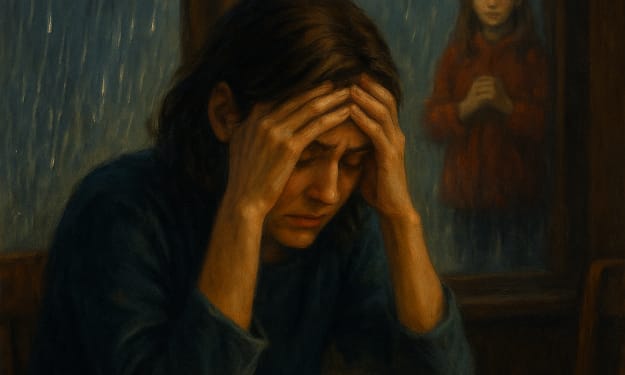
A story about the space between addiction and recovery (AI cover)

The Waiting Room
The waiting room smells like wet paper and lemon sanitizer. I’ve been here before, though the walls are a different color now — pale green instead of beige — as if someone decided recovery needed freshness. It doesn’t help. Everything in here feels used, like it’s been waiting longer than any of us.
A digital clock above the receptionist’s desk says 9:13, then 9:13 again, as if it doesn’t believe itself either. The second hand twitches but never fully moves.
There are five of us sitting, each in a chair that looks like it was built to punish fidgeting. A man in a construction jacket taps his knee in perfect time with something only he can hear. An older woman keeps flipping through the same three pages of a magazine — perfume ad, horoscope, perfume ad. A young guy across from me stares at his shoes like they’ve insulted him. And me — I’m trying to hold still, pretending that the air isn’t humming.
There’s always a hum. It starts in the fluorescent lights, then crawls under my skin until I can’t tell if it’s sound or memory. I used to chase noise — casino bells, bar laughter, coins tumbling through machines like rainfall. Now it’s all gone except the hum.
The receptionist calls a name that isn’t mine. Her voice sounds like it’s underwater. Someone stands, someone sits, the door opens, closes, and I’m back to counting the hum.
Nine-thirteen becomes nine-fourteen. I don’t remember the minute changing.
There’s a poster on the wall: “You Are Not Alone.” The letters are soft blue, the kind used for baby products or funeral homes. Beneath it, a smiling man holds a coffee cup as if it’s saving his life. His teeth look too perfect. I wonder if he’s ever sat here, waiting for someone to call his name. Maybe he’s the doctor. Or maybe he’s a ghost who got tired of being real.
My reflection swims faintly in the glass frame of the poster. My eyes look hollowed out, like something’s been scooped from behind them. Maybe that’s how I’ve stayed sober — hollow people have nothing left to spill.
A phone buzzes behind the desk. The receptionist murmurs. She laughs once, quick and sharp. I wonder what could be funny here. Maybe she’s talking to someone on the outside — the world where time moves properly and coffee tastes like coffee, not dust and regret.
I pick at the frayed seam of my jacket cuff. A strand of thread catches on my nail and I pull it, watching it unravel, feeling an echo rise in my chest. That’s how it started before — a pull, small at first, then impossible to stop.
A man sits down beside me. I didn’t see him come in. His jacket is wet, raindrops still clinging to the shoulders. He doesn’t look at me, but I feel something heavy about him — like static before lightning. He smells faintly of cigarettes and rain.
“You waiting long?” he asks, his voice low, familiar.
“I don’t know,” I say. “Time’s strange here.”
He nods, looks toward the clock. “Yeah. Same every time.”
He leans forward, elbows on knees, hands clasped like he’s praying to the floor. There’s a scar across his right hand, pale and thin. It looks like mine.
I glance down. My hand is bare. No scar.
When I look back up, his chair is empty.
The hum grows louder.
The woman with the magazine clears her throat. “You all right, dear?”
I nod too quickly. “Fine. Just thinking.”
She smiles in that cautious way people smile when they’re afraid they’ve made a mistake. “Thinking’s good,” she says. “Better than the alternative.”
I want to ask her what the alternative is — forgetting? Remembering? — but she’s already gone back to her perfume ad.
A memory drips through the ceiling of my mind: a bar at noon, the smell of bleach and hops, the bartender’s hands shaking as he poured. My voice saying just one, my hands already reaching for two. The first drink was always a promise. The second was the proof that I lied.
I blink and the ceiling here is blank again. The hum swells and settles, like breath.
The young guy across from me starts muttering. His words are soft, too fast. I catch fragments: “...not real... she said... they don’t know...”
He glances up suddenly, meets my eyes. His pupils are wide, black swallowing brown. “Do you hear it too?”
My heart knocks once, hard. “Hear what?”
“The tone,” he says. “Behind the lights. It’s not electricity. It’s them.”
I want to tell him there are no them, that it’s just circuits and nerves misfiring, but my tongue sticks to my teeth. Because what if he’s right? What if the hum isn’t inside me, but all around — a language only broken people understand?
The receptionist calls his name. He freezes, then smiles faintly, as if waking from a dream. He walks to the door and disappears.
The hum dips lower, like it’s disappointed.
I try to remember why I’m here. Routine check-in, that’s what the paper said. Medication review. Simple enough. But under that, there’s something else I can’t quite touch — a night I keep skirting around.
There was rain. There was a streetlight flickering. There was a voice shouting my name.
Then nothing but silence and a wet taste in my mouth.
The door opens again. The man with the scar walks out, holding a paper cup of water. He looks at me, nods once. “You’re next,” he says.
“I thought you left.”
He doesn’t answer. The door closes behind him and he’s gone again.
The receptionist looks up. “Mr. Hale?”
That’s me. At least, that’s the name on the form.
“Yeah,” I say, standing. My knees pop like old wood.
She gestures toward the door. “Dr. Simons will see you now.”
Her voice sounds distant, like she’s speaking through rain.
The hallway is narrow, lined with identical doors. I walk slowly, my shoes squeaking against the polished floor. Each door has a nameplate, but the letters blur when I try to read them. Dr. Something. Dr. Someone.
The last door on the left is open. A man inside stands by the window, back turned.
“Come in,” he says, without turning.
I sit in the chair across from his desk. The leather sighs beneath me.
“You’ve been doing well,” he says. “Mostly.”
I stare at the back of his head. “You haven’t looked at me yet.”
He turns. His face is familiar — too familiar. It’s the man from the waiting room, the one with the scar.
I blink. The scar is gone now.
He smiles. “You’re expecting someone else?”
“I... don’t know.”
He sits behind the desk, folds his hands. “You know why you’re here.”
I shake my head.
“You wanted to talk about the noise,” he says.
I grip the armrests. “You hear it too?”
“Tell me about it.”
“It’s everywhere. In the lights. The walls. Sometimes in people.”
“And when did it start?”
I think of coins spinning in a slot, the clink of glass on wood, the slow applause of a losing crowd. “A long time ago.”
He nods. “When you were still gambling?”
The word slaps the air. Gambling. I want to deny it, but it feels like relief to hear it spoken.
“I thought I stopped.”
“You did,” he says gently. “But stopping isn’t the same as silence.”
Something shifts in the room. The air grows dense, pressing down.
I look around — there are no windows now, no door. Only the hum, thick and constant, vibrating through my bones.
“I can’t breathe,” I whisper.
“You can,” he says. “You’re just remembering what it felt like not to.”
The hum rises, a low chorus. It’s the casino again — machines singing, coins pouring, people shouting. My heart races.
“Make it stop.”
“You can,” he says again. “Listen closer.”
I cover my ears. The sound doesn’t fade. It moves inside my skull, pulsing behind my eyes.
“Listen,” he repeats.
And then I realize — beneath the noise, there’s something else. Not sound, but space. A gap. A pause. The hum isn’t solid; it’s full of tiny silences stitched together.
I drop my hands. The sound thins.
“There,” he says. “You found it.”
The room expands. Air rushes back. The door is visible again.
He stands, walks toward it. “You’ll forget this when you leave,” he says. “But the silence will stay.”
Before I can ask what he means, the door opens and light floods in.
I blink and I’m back in the waiting room.
The receptionist smiles politely. “All done?”
I look around. The others are gone. The clock reads 9:13 again, but now the second hand is moving.
“Yeah,” I say slowly. “All done.”
Outside, the rain has stopped.
On the walk home, the streets are slick and shining. Cars hiss by, their headlights slicing through puddles. I pass the liquor store and, for a moment, my reflection stares back from the window — older, tired, but still here.
Inside, bottles gleam like trophies. I remember the burn of whiskey, the rush, the hum that used to drown everything out.
But now I notice something new: the space between sounds. The click of a passing bicycle chain. The drip from an awning. The whisper of my own breath.
Silence, I realize, isn’t the absence of noise. It’s what’s left when the noise no longer owns you.
I keep walking.
A block from my building, I see the young guy from the waiting room standing under a streetlight. He looks different — calmer. He nods at me, like we’re part of the same secret.
“You hear it too?” he calls.
I smile faintly. “Not anymore.”
He tilts his head, listening. “Lucky you.”
I think about telling him it’s not luck, it’s work — every day, every breath — but the words would sound too heavy.
Instead, I raise a hand in quiet farewell and keep moving.
My apartment smells faintly of dust and soap. On the counter sits a cup of cold coffee I forgot to drink this morning. The walls are still bare — I never got around to decorating. There’s something honest about emptiness; it doesn’t pretend to be whole.
I sit by the window and watch the city pulse — lights flashing, sirens wailing, a thousand stories overlapping. The hum is still there somewhere, faint and distant, like an old song on a radio left in another room.
I breathe. The silence breathes back.
For the first time in a long while, I don’t feel like I’m waiting.
About the Creator
Theodore Homuth
Exploring the human mind through stories of addiction, recovery, and the quiet places in between.
Keep reading
More stories from Theodore Homuth and writers in Psyche and other communities.
The Verge
The Verge by Theodore Homuth Elena had never been afraid of hard work. She had learned young that love and obligation often shared the same shelves. Her mother, a stubborn optimist, taught her that running their café was more than a business—it was a promise to the community, a gathering place woven out of warmth, music, and coffee.
By Theodore Homuth3 months ago in Psyche
Flower Bloom 369
FLOWER Bloom 2/25/26 Wednesday By Mariann Carroll Karen had been with Tony for 7 years. Tony started acting strangely after her surgery. He would mow the lawn in the rain and be on his cellphone. He started pushing Karen away. Tony came clean about seeing someone. Karen moved out two months later. Karen moved in with a friend. She felt betrayed.
By Mariann Carroll5 days ago in Fiction


Comments
There are no comments for this story
Be the first to respond and start the conversation.