
The Smell They Pretend Not to Notice:
A Behavioral Look at Why Smokers Think the Rest of Us Don’t Mind

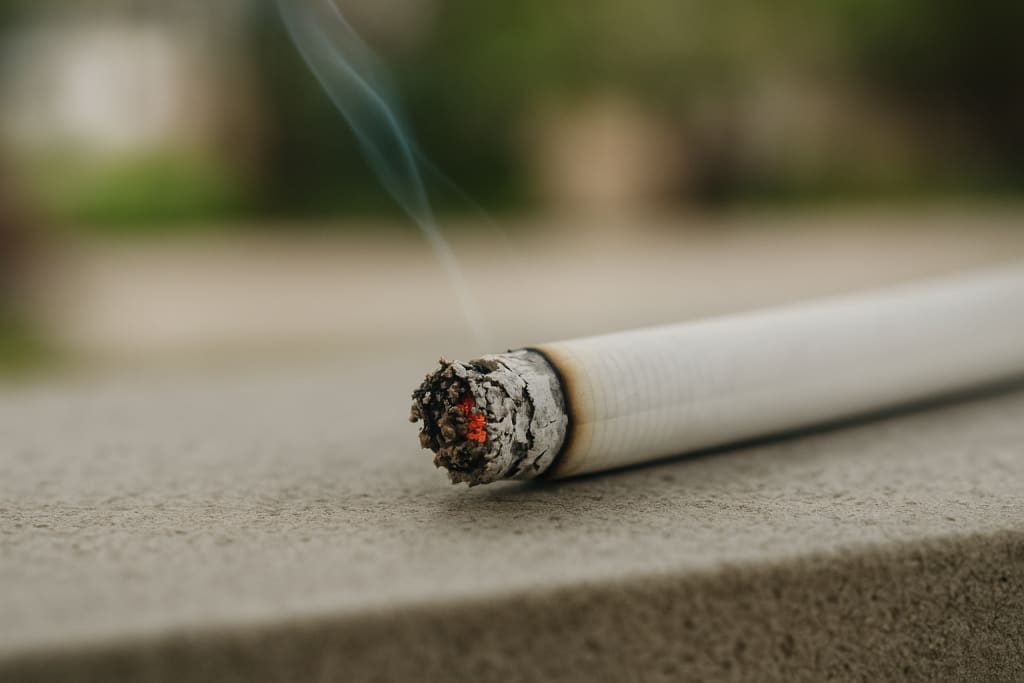
The Familiar Smell of Other People’s Choices
If you grew up with chain-smoking parents like I did, you know that smell. It lived in your hair, your clothes, and the upholstery of your entire house. The odds were high that I’d become a smoker too—but I never did. Not because of that smell, but because of something I saw in fourth grade.
Inside them was that wiry, fibrous fluff used in fish-tank filters—white and airy, almost innocent-looking. She lit a cigarette, placed it in the translucent dummy’s mouth, and within seconds the fibers turned black. She explained that every cigarette smoked steals nine minutes of life. I was horrified. I begged my parents to stop. My begging fell on deaf ears, and decades later I had to watch both of them die from smoke-related diseases.
Even now, years after their deaths, walking past a single cigarette can resurrect the whole memory of that secondhand fog—the one I never chose to breathe. And maybe you didn’t either.
So it’s hard not to wonder: if smokers know it smells awful, why do they still make everyone else share it? They lean out of car windows, flick ash into the wind, step just outside restaurant patios—small gestures that say See? I’m being polite.
But it isn’t politeness. It’s displacement.
The Illusion of Courtesy
Smokers often believe that holding a cigarette out the window or smoking “only outside” protects others. In reality, they’re protecting their own comfort. They don’t want that sour haze inside the car or house, but they still need the chemical relief nicotine provides. The compromise feels moral to them—as if they aren’t hurting anyone.
Behaviorally, that’s cognitive-dissonance reduction: mental gymnastics that preserve a self-image of decency while doing something known to be harmful. The arm hanging out the window isn’t empathy; it’s evidence management.
The Science of Smell Blindness
The human nose adapts quickly. Repeated exposure to an odor dulls the receptors that detect it. That olfactory habituation is why people stop noticing their own perfume, pets, or cigarette smoke.
For smokers, the desensitization can be so strong they no longer register how invasive the scent is to others. Their brains reclassify the smell as neutral background data. They forget that for nonsmokers, the same odor signals toxins, danger, and disgust.
Addiction’s Blind Spot
Nicotine dependency reshapes priorities. It breeds what behavioral economists call addictive rationalization—the belief that small mitigations (stepping outside, spraying air freshener, cracking a window) erase the social and health consequences.
Those rituals make smokers feel considerate without ever confronting the real ethical question: why should my comfort outweigh someone else’s breath? Addiction narrows empathy. It trains the brain to value relief over awareness, even in good people who would otherwise never choose harm.
The Ethics of Shared Air
Secondhand smoke doesn’t respect property lines. The molecules travel, linger, and latch onto hair, clothing, and porous surfaces. Patios, sidewalks, and car windows don’t solve the problem—they export it.
This isn’t a debate about freedom; it’s about communal responsibility. Breathing isn’t optional. No one should have to map their route around another person’s self-destructive ritual.
Behavioral Takeaway
The people who hold cigarettes outside their cars are telling the truth about one thing: they know it’s unpleasant. They just haven’t connected that awareness to accountability. Like many addictions, smoking thrives on compartmentalization—the illusion that you can isolate the harm.
But air is shared. So is consequence.
Sources That Don’t Suck
U.S. National Library of Medicine, “Olfactory Adaptation and Habituation”
American Psychological Association, Cognitive Dissonance: Progress on a Pivotal Theory in Social Psychology
National Institute on Drug Abuse, “How Nicotine Addiction Works”
World Health Organization, “Secondhand Smoke and Public Health”
Behavioral Economics Review, “Addictive Rationalization and Moral Self-Licensing in Substance Use”
About the Creator
Dr. Mozelle Martin
Behavioral analyst and investigative writer examining how people, institutions, and narratives behave under pressure—and what remains when systems fail.
Keep reading
More stories from Dr. Mozelle Martin and writers in Psyche and other communities.
The Daily Crime Against Your Own Brain
Feed your brain junk long enough and it starts acting like a suspect under pressure—fidgety, unreliable, and ready to snap. That isn’t poetry. It’s what shows up in psychological evaluations, probation reports, and medical charts across professions and age groups.
By Dr. Mozelle Martin5 months ago in Psyche
Belle of the Bayou
Bad move, cher. Not just the slip of her kitten heel on the rainy February cobblestones in the Fourth Ward. She got caught snooping. Detective Deleon clucked and strutted like a rooster in his rush to clear her from the scene, waving cigar smoke to and fro as he gesticulated amid the thick air of the speak easy. An experienced crime reporter, Marie knew better than to let the coppers catch her on the wrong side of the line, but curiosity had gotten the better of her.
By Maia Gadwall the metAlchemist6 days ago in Fiction


Comments