
The Science of Overthinking — and How to Break the Loop
Why your brain loves to spiral — and how to train it to stop

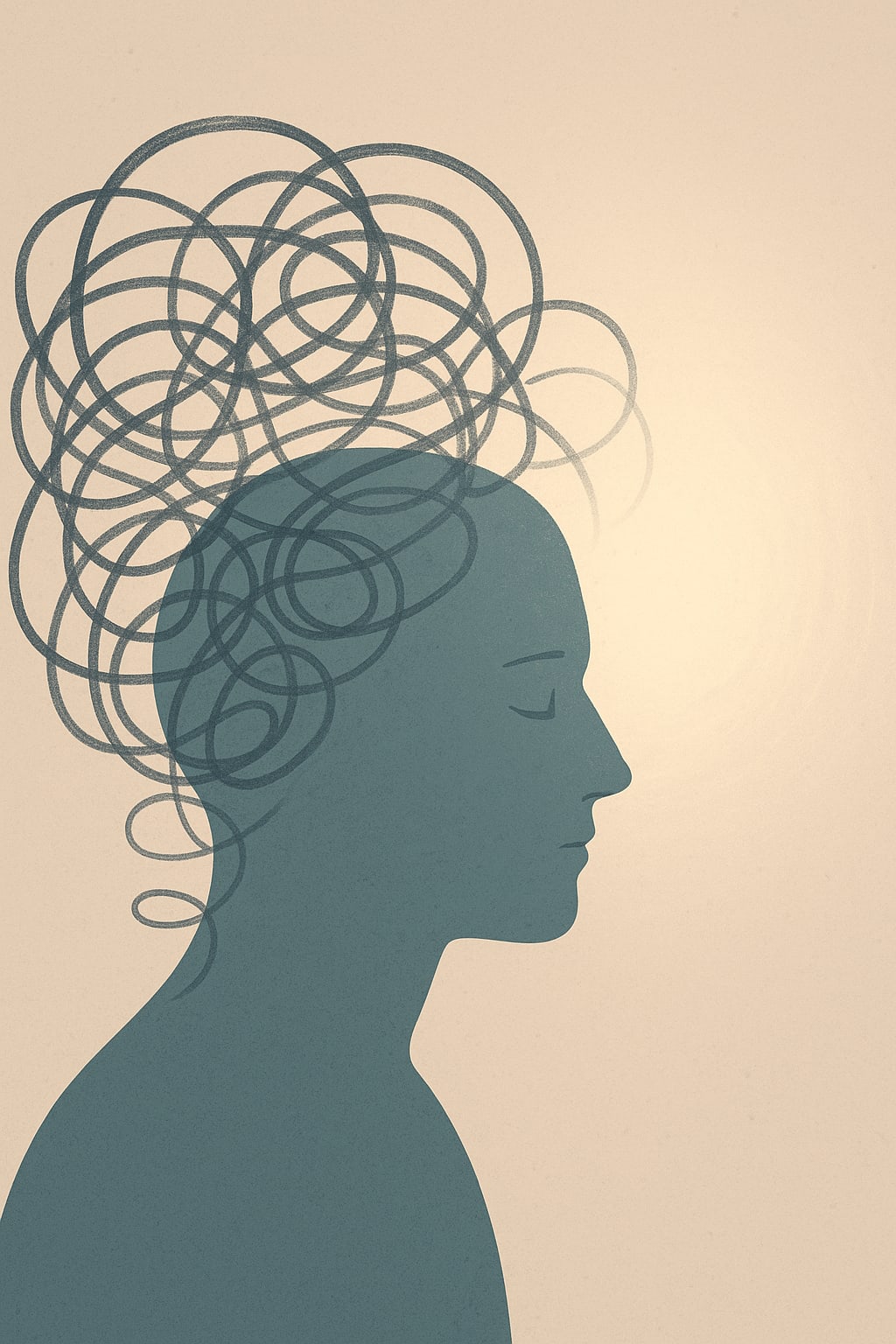
The Spiral Begins
It starts small — a single thought that flickers and fades.
But before you know it, that one thought grows branches. You replay an old conversation, a mistake, a possibility that never happened. The mind builds worlds out of maybes and what-ifs.
That’s overthinking — the brain’s illusion of control.
We believe that if we think long enough, hard enough, or deep enough, we’ll finally arrive at certainty. But instead of peace, we find paralysis. Our thoughts begin to chase their own tails.
The question isn’t why we do it — it’s why we can’t seem to stop.
The Science Behind the Spiral
Neuroscience offers an uncomfortable truth: overthinking is not a personal flaw — it’s a brain feature gone rogue.
When you’re lost in thought, a specific network in your brain lights up called the Default Mode Network (DMN). This system is most active when your mind isn’t focused on a task — when you’re daydreaming, self-reflecting, or worrying.
The DMN helps us plan, imagine, and make sense of ourselves. But when it’s overactive, it loops — like a record stuck on the same note. You revisit the same memory, the same worry, the same outcome, again and again.
Research shows that chronic rumination triggers higher levels of cortisol, the stress hormone, and activates regions like the medial prefrontal cortex, associated with self-referential thinking. In short, your brain begins to obsess over you — your choices, your image, your mistakes.
And here’s the paradox: overthinking releases small bursts of dopamine, giving the illusion of problem-solving. It feels productive — but chemically, it’s a stress loop disguised as insight.
Why We Do It
From an evolutionary standpoint, overthinking once kept us alive. Our ancestors survived by anticipating danger — scanning the bushes for movement, analyzing every sound.
The modern world, however, offers no predators — just unanswered texts, uncertain futures, and endless choices. Our brains haven’t caught up. The same system designed to detect threats is now searching for meaning in silence.
Overthinking, then, is the mind’s desperate attempt to control uncertainty.
It’s fear wearing the mask of logic.
Your brain isn’t trying to hurt you — it’s trying to protect you, just too much.
Breaking the Loop
The goal isn’t to silence your thoughts — that’s impossible. The goal is to see them differently.
Here’s what science (and mindfulness) suggest:
1. Name it.
Simply saying, “I’m noticing I’m overthinking,” activates the prefrontal cortex — the rational part of the brain — and lessens emotional reactivity. Awareness weakens the loop.2. Shift from thinking to sensing.
Bring attention to your breath, your hands, or the sound of your environment. The moment you engage the senses, you deactivate the DMN and return to the present.
3. Write it down.
When thoughts live on paper, they lose power. Journaling transforms abstract worries into visible patterns — things you can question, reframe, or release.
4. Set a “worry window.”
Give yourself ten minutes a day to overthink intentionally. When the time’s up, move on. You train your brain to contain the spiral instead of being consumed by it.
5. Act, however small.
Action interrupts rumination. Send the message, make the call, take the step. Clarity rarely comes before movement — it comes from it.
6. The 5-5-5 Rule.
Ask: Will this matter in 5 days, 5 months, or 5 years?
It’s a gentle way to shrink the weight of unnecessary worry.
The Peace Beyond Thought
You can’t stop waves from coming — but you can learn to surf.
Overthinking isn’t something to hate; it’s something to understand. It means your mind cares deeply, that it’s trying to protect you from pain and uncertainty.
But the truth is: not every thought deserves your attention.
When you learn to watch your thoughts instead of obey them, the storm softens. You begin to notice gaps of stillness between the noise — moments where awareness lives quietly, untouched.
Peace, then, isn’t the absence of thought.
It’s the space between them.
About the Creator
minaal
Just a writer sharing my thoughts, poems, and moments of calm.
I believe words can heal, connect, and remind us that we’re not alone.
Do You have a Support Network?
Life is harder when you’re on your own. Human beings are social creatures, and we usually feel better when we have support from a strong social network around us. For most people, it’s our families that hold us together like glue.
By Elizabeth Woodsabout 5 hours ago in Psyche
You're Not Lazy — You're Mentally Exhausted (And No One Told You)
You’re Not Lazy — You’re Mentally Exhausted (And No One Told You) For years, many of us have carried the same quiet belief. That we’re lazy. That we lack discipline. That everyone else seems to have life figured out—except us. We watch others move forward while we feel stuck in place, and the conclusion feels obvious: Something must be wrong with me. But what if that conclusion is wrong? What if the problem was never laziness at all—but a level of mental exhaustion you were never taught how to recognize, name, or respect? The Silent Burnout Nobody Talks About Mental exhaustion doesn’t always announce itself loudly. It doesn’t always come with breakdowns, tears, or visible collapse. More often, it shows up quietly. It looks like wanting to do better, but feeling unable to start. Like beginning tasks with good intentions, only to abandon them halfway through. Like feeling guilty for resting, yet too drained to be productive. Like losing interest in things you once cared deeply about—without knowing why. From the outside, you may still be functioning. You show up. You meet expectations. You get things done—just enough to survive. So you call it laziness. And eventually, you start believing it. But laziness doesn’t come with guilt. It doesn’t come with frustration or shame. Exhaustion does. Why Motivation Alone Doesn’t Work We are constantly told to “push harder.” To “wake up earlier.” To “stop making excuses.” But motivation cannot fix a tired nervous system. When your mental energy is depleted, discipline feels heavy. Focus becomes painful. Even simple decisions begin to feel overwhelming. This is not a failure of character. It’s a biological and psychological response to prolonged pressure. A mind that has been running on survival mode cannot suddenly switch into inspiration. No amount of self-criticism will create energy where none exists. You’re not broken. You’re overloaded. The Pressure to Always Be Improving We live in a culture obsessed with progress. Hustle culture. Productivity culture. Comparison culture. There is always someone doing more, achieving faster, resting less. And without realizing it, we internalize the message that slowing down equals falling behind. Rest becomes something you must earn. Slowness feels like failure. Pausing feels dangerous. So instead of listening to our limits, we punish ourselves for having them. We push through exhaustion. Ignore warning signs. And call it “self-improvement.” But there is nothing healthy about constantly overriding your own capacity. That isn’t growth. That is self-neglect disguised as ambition. What Actually Helps (Quietly) Real progress doesn’t begin with pushing harder. It begins with honesty. Honesty about your energy—not your intentions. Honesty about your limits—not your potential. Healing mental exhaustion often looks unremarkable from the outside: Acknowledging that you’re tired without turning it into a flaw Allowing yourself to pause without guilt or justification Reducing noise instead of adding more pressure Choosing consistency over intensity Creating space instead of forcing motivation Energy cannot be bullied into returning. It must be restored. And restoration is not weakness—it is strategy. A Different Kind of Strength We’ve been taught that strength means doing more. But real strength often looks like knowing when to stop. Like choosing clarity over chaos. Like offering yourself compassion instead of criticism. It’s the courage to admit that something isn’t working—without blaming yourself for it. If you are struggling right now, hear this clearly: You are not lazy. You are mentally exhausted. And exhaustion is not a personal failure—it’s a signal. A signal that something needs care, not punishment. You don’t need to become a different person. You don’t need to “fix” yourself. You need rest. You need understanding. You need permission to be human. And that is not a weakness. That is where healing actually begins.
By Med Abdeljabbar5 days ago in Psyche



Comments
There are no comments for this story
Be the first to respond and start the conversation.