
The Sad Truth About Feeling Unseen
The Invisible Girl in the Front Row


Lila sat in the front row of every class, answered questions when called on, turned in perfect assignments on time.
And her teacher still forgot her name.
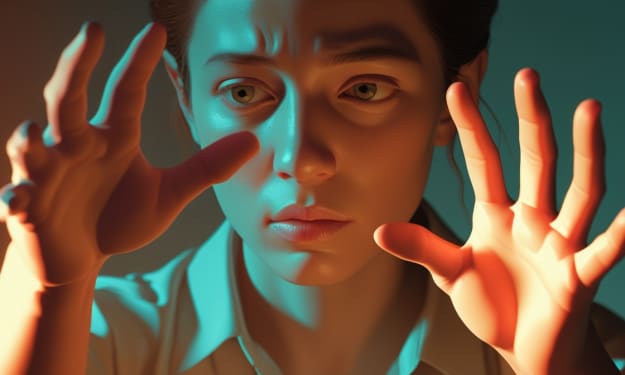
"Lily? Lisa?" Mrs. Patterson would say, squinting at her like she was trying to bring a blurry image into focus.
"Lila," she'd correct quietly, for the seventh time that semester.
"Right, right. Lila. Sorry."
But she wasn't sorry enough to remember. And Lila had learned by fifteen that some people look directly at you and still don't see you. That you can be present, visible, right there—and still be invisible.
It wasn't just Mrs. Patterson. At lunch, Lila's friends would talk over her mid-sentence, not rudely exactly, just as if she hadn't been speaking at all. At family dinners, her parents would ask her older brother about his day in detail but give her a distracted "That's nice, honey" when she tried to share something.
At her part-time job, her manager would forget to include her in group texts about schedule changes. At parties, she'd be in the middle of conversations that somehow shifted around her, like water around a stone, until she was standing alone wondering how she'd become irrelevant.
Lila wasn't shy. She wasn't awkward. She participated, showed up, contributed. She was there.
She just somehow wasn't there enough to register. Not memorable enough to be remembered. Not significant enough to be seen.
By the time she was twenty-three, Lila had developed a strange relationship with her own existence. She felt like a ghost haunting her own life—present but not perceived, visible but not seen, speaking but not heard.
And the worst part was that no one was being intentionally cruel. There was no villain to blame. Just a slow, accumulated weight of being overlooked so consistently that she'd started to wonder if maybe she actually was invisible. If maybe there was something fundamentally forgettable about her that made people's eyes slide right past her even when she was standing in front of them.
The sad truth about feeling unseen is that it's not always dramatic. Sometimes it's just a thousand small moments of being forgotten, dismissed, talked over, or looked past. Until one day you realize you've become a supporting character in your own life—present for everyone else's stories but absent from your own.
The Psychology of Social Invisibility
Here's what Lila didn't know: feeling chronically unseen isn't about being inherently forgettable. It's about a complex interplay of social dynamics, trauma responses, and the way humans allocate attention.
Dr. Tanya Chartrand's research on social mimicry reveals that people unconsciously mirror the energy others bring. If you've learned to make yourself small—to take up minimal space, to speak quietly, to signal that your presence is negotiable—others unconsciously treat your presence as background noise.
Lila had learned this young. She was the middle child between a charismatic older brother and a demanding younger sister. Her parents' attention was a finite resource, and Lila had concluded early that the way to be loved was to be easy. Undemanding. The child who didn't cause problems.
"Lila's so self-sufficient," her mother would tell relatives proudly, as if independence at age eight was a virtue rather than a survival strategy.
What her mother didn't see: Lila had stopped asking for attention because asking hurt more than not receiving it. She'd made herself easy to overlook to avoid the pain of being actively ignored.
By adolescence, this had calcified into her social presence. Lila had perfected the art of being there without taking up space. Of contributing without demanding acknowledgment. Of existing in a way that required nothing from anyone.
And people—who are generally overwhelmed and cognitively overloaded—had unconsciously accepted the role she offered: the person you don't have to think about. The friend who's always available but never needs you. The colleague who does good work but doesn't require recognition.
Neuroscience research shows that human attention is selective and limited. We literally can't pay attention to everything, so our brains create hierarchies. Some people become central to our attention field—we notice them, remember them, track their emotional states. Others drift to the periphery.
Lila had spent her whole life drifting to the periphery. Not because she deserved to be there, but because she'd trained people that her needs were optional. And once you're peripheral in someone's attention field, becoming central again requires disrupting their established patterns—which Lila had never learned how to do.

The Friendship That Revealed the Pattern
Lila's roommate, Jenna, was everything Lila wasn't: loud, dramatic, impossible to ignore. When Jenna walked into a room, people noticed. When she told a story, people listened. When she had a problem, people dropped everything to help.
Lila watched this with fascination and envy. What did Jenna have that she didn't? Why did people see Jenna immediately while Lila could stand in the same room for an hour and remain invisible?
One evening, Lila tried an experiment. They went to a party together, and Lila consciously tried to mimic Jenna's energy. She spoke louder. Gestured more. Told an animated story the way Jenna would.
And something remarkable happened: people listened. They laughed. They engaged. For twenty minutes, Lila felt what it was like to be seen.
But it was exhausting. The performance required a level of energy and self-assertion that felt foreign, almost aggressive. By the end of the night, Lila was drained in a way Jenna never seemed to be.
Walking home, Jenna said: "You were different tonight. More out there."
"Did it seem fake?"
"A little. Not in a bad way, just... not like you."
"How would you know what's like me? You barely notice when I'm in the room."
Jenna stopped walking. "What?"
"Nothing. Sorry. I'm just tired."
"No, say that again. You think I don't notice you?"
Lila felt tears threaten. "Jenna, we've lived together for eight months. You've never once asked me how I'm really doing. You tell me about your life constantly—your dates, your problems, your feelings. And I listen. I'm always listening. But you've never asked about mine. You don't even know what I'm studying. You don't know my major."
Jenna's face went pale. "Psychology. Right?"
"English literature. I'm writing my thesis on Virginia Woolf."
"Oh my god." Jenna sat down on a bench, looking genuinely stricken. "You're right. I have no idea who you are. I've been living with you for eight months and I know nothing real about you."
"It's not just you," Lila said quietly. "It's everyone. I'm just... forgettable."
"You're not forgettable. You're invisible. And I think you've been making yourself invisible."
The Invisibility We Create
Dr. Harriet Braiker's research on people-pleasing reveals that chronic invisibility is often a learned response to environments where being seen felt dangerous. Children who grow up in families where expressing needs leads to punishment or dismissal learn to minimize their presence as a protective strategy.
Lila remembered being seven, excitedly interrupting her parents' conversation to share something she'd learned at school. Her father had snapped: "Adults are talking. Wait your turn."
She'd waited. They'd never come back to ask what she wanted to say.
She remembered being ten, crying about being excluded by friends at school. Her mother had said: "Stop being so sensitive. You need to toughen up."
She remembered being thirteen, trying to tell her parents about a teacher who made her uncomfortable. They'd been distracted, half-listening, and dismissed her concern: "I'm sure it's fine. He's a good teacher."
One by one, Lila had learned: My experiences don't matter. My feelings are inconvenient. My presence is disruptive. The way to be loved is to need nothing.
So she'd made herself need nothing. Made herself take up minimal space. Made herself so easy to be around that she became easy to forget.
Dr. Bessel van der Kolk's work on trauma and the body reveals that people who feel chronically unseen often develop what he calls a "collapsed" presence—they make themselves physically smaller, speak more quietly, take up less space as a way of managing the pain of not mattering.
Lila had been doing this her entire life without realizing it. She sat at the edges of rooms. Spoke at a volume that required people to lean in. Prefaced her opinions with "I don't know, maybe..." to signal that disagreeing with her would be easy. Made herself so unobtrusive that overlooking her became the path of least resistance.
She wasn't forgettable. She'd just spent twenty-three years training people to forget her.
The Moment She Demanded to Be Seen
Something shifted after the conversation with Jenna. Lila started paying attention to how she moved through the world.
She noticed that she apologized constantly—"Sorry, can I just..." "Sorry to bother you..." "Sorry, one quick thing..."—as if her presence required justification. She noticed that she made herself physically smaller, hunching her shoulders, taking up minimal space. She noticed that she spoke in questions rather than statements, always leaving room for others to override her.
She was performing invisibility. And she'd gotten so good at it that she'd convinced herself it was just who she was.
In her next class, when Mrs. Patterson called her Lisa again, Lila didn't quietly correct her. She said loudly, clearly: "My name is Lila. I've been in your class for twelve weeks. I sit in the front row. I've answered questions seventeen times this semester. My name is Lila."
The room went silent. Mrs. Patterson looked shocked. "I... I'm sorry. You're right. Lila. I apologize."
Lila's heart was pounding. She'd just taken up space. Demanded acknowledgment. Refused to accept being overlooked.
It felt terrifying. And exhilarating.
At lunch, when her friends started talking over her, Lila didn't stop talking. She raised her voice slightly and finished her sentence. When they looked surprised, she said: "I was speaking. I'd like to finish my thought."
One friend looked embarrassed. "Sorry. Go ahead."
And they listened. Actually listened. Because Lila had signaled, for the first time, that her voice was worth listening to.
Dr. Amy Cuddy's research on presence reveals that visibility isn't something others grant you—it's something you claim. When you take up space, speak with conviction, and refuse to accept being overlooked, people's brains recalibrate. You shift from peripheral to central in their attention field.
But it requires overriding years of conditioning that taught you making yourself small was the way to be safe.
The Cost of Finally Being Seen
As Lila started claiming visibility, she discovered something painful: some people preferred her invisible.
Jenna, after their initial conversation, had seemed committed to seeing Lila more. But within a few weeks, she'd drifted back to the old pattern—dominating conversations, forgetting to ask about Lila's life, treating her as an audience for Jenna's experiences rather than a person with her own.
When Lila called this out, Jenna got defensive: "God, you're so demanding lately. You've changed."
"I haven't changed. You're just noticing me for the first time and you don't like it."
"That's not fair."
"What's not fair is that our friendship only worked when I made myself invisible. When I stopped being your supporting character and started having my own needs, you didn't want to know me anymore."
Jenna moved out two months later. And Lila grieved the friendship—but also recognized the truth in its loss: it had never been a real friendship. It had been Lila performing invisibility while Jenna accepted the performance.
Some of her other friends drifted away too. The ones who'd valued her for being low-maintenance, always available, never demanding attention. When Lila started having boundaries, needs, and a presence that required acknowledgment, they found her "difficult."
Dr. Harriet Lerner's research on relationships reveals that when you shift from invisible to visible, you expose which relationships were built on your self-erasure. Some people loved the role you played, not the person you actually are. When you stop playing that role, those relationships often dissolve.
It hurt. But Lila was learning: being unseen hurts more than losing people who only wanted you invisible.
The People Who Finally Saw Her
As the people who preferred her invisible fell away, new people appeared. People who were drawn to the more visible Lila—the one who took up space, had opinions, required acknowledgment.
She met Marcus in a writing workshop. After class, he approached her: "Your story was incredible. The way you depicted isolation—it felt so real."
Lila waited for him to shift the conversation to himself, the way people usually did. But he didn't. He asked: "What inspired it? Where did that come from?"
And Lila, for the first time in her life, told the truth: "From feeling invisible my whole life. From being in rooms full of people and feeling like a ghost."
Marcus didn't minimize it or change the subject. He said: "I see you. For what it's worth, I see you."
And Lila believed him. Because his attention felt different from the performative interest she was used to. He remembered details about her life. Asked follow-up questions weeks later about things she'd mentioned. Saw her as a full person, not a background character.
She also reconnected with an old friend, Sophie, who she'd drifted from years ago. When they met for coffee, Sophie said: "You seem different. More... present."
"I'm trying to stop making myself invisible."
"You were always a little hard to hold onto. Like you were apologizing for existing. It's nice to see you actually here."
"Did you notice back then? That I was disappearing?"
"I did. But I didn't know how to tell you. And honestly, I was going through my own stuff and didn't have the bandwidth to draw you out when you were so committed to staying hidden."
The honesty hurt but also helped. Lila understood now: her invisibility hadn't just been others ignoring her. It had been her actively hiding while simultaneously resenting not being found.
Learning to Stay Visible
Two years into her journey of claiming visibility, Lila still struggles. Her default is still to make herself small. To apologize for existing. To speak quietly and take up minimal space.
But now she notices when she's doing it. And she makes a choice: Do I want to be invisible right now, or do I want to be seen?
Sometimes, she chooses invisibility. Sometimes it feels safer, easier. And that's okay. Invisibility as a choice is different from invisibility as a prison.
But more often now, she chooses visibility. She speaks at a normal volume instead of forcing people to lean in. She takes up physical space instead of making herself smaller. She states opinions instead of phrasing everything as a question.
She's learning that being seen requires maintenance. You can't demand visibility once and then revert to invisibility. You have to consistently signal that your presence matters, that your voice is worth listening to, that you're a person who deserves acknowledgment.
It's exhausting sometimes. Lila understands now why Jenna's constant visibility never seemed effortless—it wasn't. It required energy to maintain that level of presence.
But the alternative—spending another decade as a ghost in her own life—is worse.
Her therapist explained: "You spent twenty-three years teaching people to overlook you. Retraining them takes time. And some people won't retrain. They'll prefer the version of you that required nothing. Those aren't your people."
Lila is learning to accept this. To let go of relationships that required her invisibility. To build new ones where she's seen from the start.
The Sad Truth She Finally Accepted
The sad truth about feeling unseen is this: sometimes you're invisible because you've spent years teaching people not to see you.
Not because you wanted to be overlooked. But because being unseen felt safer than being seen and rejected. Because asking for attention and being denied hurt more than not asking at all. Because making yourself small was the only way you knew to be loved.
Lila carries that truth now. Not as shame, but as understanding. She wasn't forgettable. She was protecting herself the only way her younger self knew how.
But she's not that frightened child anymore. She's an adult who can choose differently. Who can risk being seen even though it's scary. Who can take up space even though it feels selfish. Who can demand acknowledgment even though it feels aggressive.
She looks in the mirror now and sees someone who's finally visible—not to everyone, but to the people who matter. Not perfectly, but genuinely.
The teacher who forgot her name graduated her class with honors and a personal note: "Lila, your voice was one of the strongest in our discussions this semester. Don't let anyone make you small."
Mrs. Patterson had finally seen her. But more importantly, Lila had finally learned to see herself.
She's not invisible. She never was. She was just hiding in plain sight, hoping someone would find her while actively making herself unfindable.
Now she's done hiding. Done apologizing for existing. Done making herself small to make others comfortable.
She's here. She's visible. She's seen.
And if you can't see her, that's not her problem anymore.
The sad truth about feeling unseen became a liberating one: you can spend your whole life waiting for people to notice you, or you can learn to take up space until they have no choice but to see you.
Lila chose the latter. And everything changed.
-----------------------------------------------
Thanks for Reading!
About the Creator
Keep reading
More stories from Ameer Moavia and writers in Psyche and other communities.
Watch Out Wednesdays - 2/25/26 (Opinion)
We are already nearing the end of February. With 28 days, this month always seems to go by really fast whether or not it's a Leap Year. Here are some tips that will help you get through the remaining five-sixths of this year.
By Adrian Holman5 days ago in Psyche
This Is What I Do When People Throw Rocks At Me
Rocks have been thrown at me for a greater part of my life. Some have been small and missed hitting me. When people don't get a reaction from me, they throw bigger rocks with a better aim. Many have been hurled at me with precision over the years. For a long time, I thought my only options were to dodge them or be crushed by them.
By Margaret Minnicks5 days ago in Confessions


Comments
There are no comments for this story
Be the first to respond and start the conversation.