
The Mirror We Avoid: Why We’re Afraid to See Ourselves Clearly
We edit our photos, our memories, and our truths — but what happens when the real self finally demands to be seen?

The Reflection We No Longer Trust
The most recorded time in human history is being now lived.
We share our experiences with strangers, chronicle our everyday life, arrange our memories, and continuously photograph ourselves. Still, never have we felt more estranged from our true selves than we have now despite this clear exposure.
Though seldom do we genuinely see ourselves, we look into reflective surfaces every day: whether it be phone screens, front-facing cameras, or bathroom mirrors. Rather, what we see is a version edited, a trained demeanour, a slightly changed perspective. a self that presents as suitable, presentable, and tolerable.
We hide behind precisely chosen examples, captions, and filters.
Not out of a wish to deceive others either.
but because we are afraid to face the unvarnished reality.
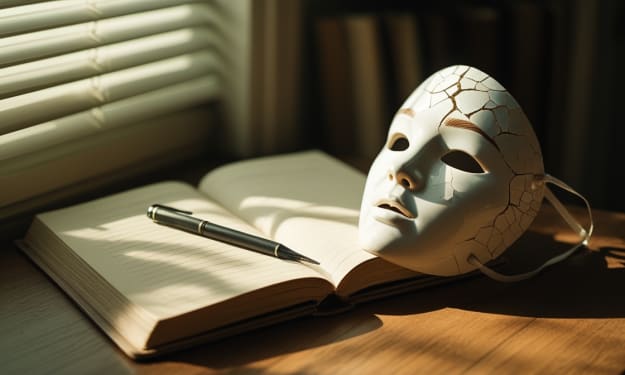
The true mirror is not constructed of glass.
It's the peaceful moment when the activity passes and we meet the individual we have been avoiding.
The Self We Hide and the Self We Create
Two identities belong to everyone:
1. The side of ourselves we offer others—refined, glossy, understandable.
2. Quietly, the aspect we coexist with is chaotic, confused, and flawed.
We feel under ever pressure to portray a coherent picture of ourselves as society continually pushes us to define our identities. a simple thing. Anything digestible.
But real identity rarely follows a simple path. True identity is complicated, changing, layered. It covers fears we hide, anxieties we choose not to voice, and conflicts we rather ignore.
We present ourselves as less difficult to show, an identity developed from societal expectations rather than from genuineness, in order to protect us from that anxiety.
We modify our images to make our look better.
We change our stories to present them in a more favorable light.
We change our memories to generate more pleasant emotions.
Whatever degree we shine the outside, the untouched parts of ourselves wait patiently, silently to be acknowledged.
Why Seeing Ourselves Clearly Feels So Hard
Confronting one's true nature calls for courage.
Not noisily, yet in a muted fashion. It entails sitting with facts we would rather ignore.
Self-realization frightens us because:
1. It jeopardizes the persona we have created.
Should we accept insecurities, envy, feeling overwhelmed, or being lost, what will happen to the front we have worked painstakingly to maintain?
2. It forces us to reconcile our contradictions.
We may love someone at the same time resenting them.
We might be afraid of change but still wish for it.
Although we long for isolation, we abhor loneliness.
Seldom are human emotions neat.
3. It expects accountability.
We have to decide how to respond to that truth after we come to know ourselves completely.
Acting is more difficult than avoiding it.
4. It reveals injuries we have ignored.
Sometimes the reflection does not reveal who we are now:
who we once were, yet to recover from becoming,
Many people are busy, preoccupied, and amused for this reason.
Dealing with noise is easier than dealing with oneself.
In quiet, the truth surfaces; that voice might be disturbing.
The Age of Adjusted Reality
Technological developments have made it easy to bypass one's actual self.
By selectively sharing, we may hide errors, alter our life for appearances, and rewrite recollections.
We can create a portrayal of ourselves so persuasive that even we begin to believe it to be real.
The danger of living in a changed reality, though, is that the real, unfiltered self floats farther away.
Performers in our life are what we start to feel like.
showing happiness, self-assurance, stability.
The more we shine our public image, the more terrified we grow of someone seeing reality.
and the stinging sarcasm?
Everyone else is acting in the same way.
While wanting someone who is real, we dread authenticity.
When the Real Self Demands to Be Seen
The façade cracks at some point—whether modestly or considerably.
It might happen on a silent evening when you are too worn out to preserve the façade.
Next could be a setback, a terrible event, or a sudden death.
Someone's great affection for you can be the trigger for it, which will enable you to grasp how difficult it is to show your true identity.
In these circumstances, the perfect exterior disintegrates to reveal something genuine:
The actual you: afraid, imperfect, wounded, honest.
This is not a sign of weakness.
Being a human being is this.
Most needing our attention is the one we frequently try to avoid.
Not an enemy but a guide the mirror is
Being able to see oneself correctly depends on understanding rather than being judgmental.
It's about caring for yourself with:
1. inquisitiveness instead of hatefulness
2. Instead of retribution, love
3. Openness instead of fear
"Fix this," a crisp mirror doesn't shout.
It transmits the idea, Watch this. Get this. Start from here.
We could finally change when we let ourselves embrace the whole reality, including the good, the evil, and the incomplete.
Being honest does not mean being immaculate.
It stands for truthfulness.
What Happens When We Stop Avoiding Ourselves
When we dare to face the mirror with honesty, something shifts:
1. Relationships deepen
People can finally love the real you — not the performance.
2. Anxiety decreases
Pretending is exhausting. Truth is liberating.
3. Confidence becomes real
Confidence built on illusion crumbles.
Confidence built on truth endures.
4. Life becomes less about image, more about meaning
You stop living for the audience and start living for yourself.
The most profound changes do not come from reinvention —
but from recognition.
The Most Courageous Kind of Seeing
The world tells us to “find ourselves,” as if identity were buried treasure.
But maybe the task is simpler —
Maybe we need to stop running from the self that’s been here all along.
To stand in front of the mirror — literal or emotional — and say:
“This is who I am. Not the edited version. Not the performance. Me.”
Not perfect.
Not complete.
But real.
And sometimes, reality is the bravest thing a person can be.
About the Creator
Keep reading
More stories from Shahjahan Kabir Khan and writers in Psyche and other communities.
The Weight of Perfection: Escaping the Illusion of a “Better You”
The Quiet Pressure to Be “Better” There’s a silent burden many of us carry today — the feeling that we must always be improving. We wake up thinking about what needs fixing: our body, our productivity, our mindset, our habits, our purpose. It’s as if simply existing isn’t enough anymore; we must always be optimizing, evolving, upgrading.
By Shahjahan Kabir Khan4 months ago in Psyche
Top tipple tricks
Been thinking a lot about drinking, lately. Not least because of a recent episode of over-indulgence and the inevitable after effects. Some readers may recall the earlier articles I wrote about beating the booze. Here I set out an experiment in techniques for cutting down on my alcohol intake. The experiment was successful, the techniques worked, and I have armed myself with an arsenal of weapons in the war against the demon drink. I have yet to fire the first round however. It's all a question of timing (perhaps procrastination).
By Raymond G. Taylor6 days ago in Psyche
How to Get Cocaine Out of Your System Safely and Effectively
Cocaine is a powerful stimulant drug that can have serious effects on both the body and mind. While some individuals may initially use cocaine for its short-term feelings of energy or euphoria, repeated use can quickly lead to dependence and addiction. Over time, cocaine can impact physical health, emotional stability, and overall well-being.
By Jordan Blake2 days ago in Psyche
Author’s Advice
If you would’ve asked me 20 years ago did I know I’d become a writer and an author, I would’ve said “nope, ain’t happening”. As fate would have it I did become an author and I can honestly say I’m loving it so far. It really does feel good to be a writer. I’ve learned a lot on this journey and I feel like with even me being as new to this world as I am, there’s some wisdom I need to share with every other aspiring author.
By Joe Patterson4 days ago in Journal



Comments
There are no comments for this story
Be the first to respond and start the conversation.