
The Loneliness of Hyperconnection
In the age of endless notifications and constant interaction, true connection has never felt rarer.


We live in a time of perpetual connection. A buzzing phone, a new message icon, a red notification badge—our days are punctuated by digital voices calling for our attention. We can reach anyone, anywhere, at any time. By all measures, humanity should feel more connected than at any point in history. And yet, an epidemic of loneliness shadows our era.
This paradox—that we are both hyperconnected and deeply alone—is not a glitch in the system. It is the system. Hyperconnection has not solved loneliness; it has redefined it.
The Mirage of Constant Contact
Scroll through any social platform and you’ll see endless streams of communication: comments, likes, emojis, replies. A thousand voices humming in unison. But beneath the noise is often silence—the silence of real absence. A digital interaction can mimic the warmth of connection, but it rarely replaces it.
Psychologists describe this as ambient loneliness: the sensation of being surrounded by people yet feeling fundamentally alone. In crowded cities, in group chats, even in video calls, we may be immersed in signals of presence without experiencing true presence itself.
Why Digital Interaction Feels Thin
The human brain evolved to recognize connection in touch, tone, and eye contact. These signals carry more information than text ever could. A hug communicates safety. A glance conveys trust. A pause in conversation can say more than a paragraph.
In contrast, digital communication strips away context. An emoji is not a laugh. A “like” is not love. Even a video call, while rich compared to text, still confines intimacy to a two-dimensional screen. The nervous system knows the difference, even if our minds pretend not to.
The Economics of Loneliness
Where there is pain, there is profit. And loneliness is no exception.
Dating apps monetize longing by keeping people swiping rather than satisfied. Social networks maximize engagement by designing infinite feeds that rarely deliver fulfillment. Even platforms selling guided meditation or online therapy sometimes package themselves as cures for the very alienation their broader digital ecosystem sustains.
We are sold the promise of connection, but the business model thrives on its absence. The lonelier we feel, the more we engage. The more we engage, the lonelier we feel.
From Letters to Notifications
There is a historical irony to our condition. Once, a single letter took weeks to arrive, and the anticipation itself was part of the intimacy. The slowness gave meaning. Words were chosen with care because they could not be erased.
Today, messages vanish as quickly as they are sent. We can type, delete, and replace in an instant. We can ghost with a swipe. We can send a hundred emojis without effort. Communication is easier, but meaning is thinner.
The New Solitude
Loneliness is not just the absence of people. It is the absence of resonance. We can be at a dinner party, checking our phones under the table, and feel utterly disconnected. We can post a picture that receives hundreds of likes but leaves us hollow. We can be online all day and still crave one moment of genuine recognition.
This is the loneliness of hyperconnection: to be visible to everyone but known by no one.
Rediscovering the Depths
If hyperconnection leaves us stranded, what is the way back?
First, we must reclaim slowness. Silence between messages does not signal rejection; it creates space for reflection. A slow conversation is a deeper one.
Second, we must practice embodied presence. A walk with a friend, a face-to-face coffee, or even sitting in silence together restores what no app can replicate.
Finally, we must resist the idea that loneliness is a personal flaw to be fixed with digital tools. Loneliness is not only an individual state—it is a cultural signal. It tells us that our world is oversaturated with noise and starved of intimacy.
A Closing Reflection
Perhaps the loneliest thing about hyperconnection is that it convinces us we are never alone, while robbing us of the chance to feel truly together.
We are not meant to process connection in fragments and alerts. We are meant to share time, presence, and silence. In the end, the cure for loneliness is not more voices in our pocket—it is one voice, across the table, saying, “I’m here.”
About the Creator
Ahmet Kıvanç Demirkıran
As a technology and innovation enthusiast, I aim to bring fresh perspectives to my readers, drawing from my experience.
Keep reading
More stories from Ahmet Kıvanç Demirkıran and writers in Psyche and other communities.
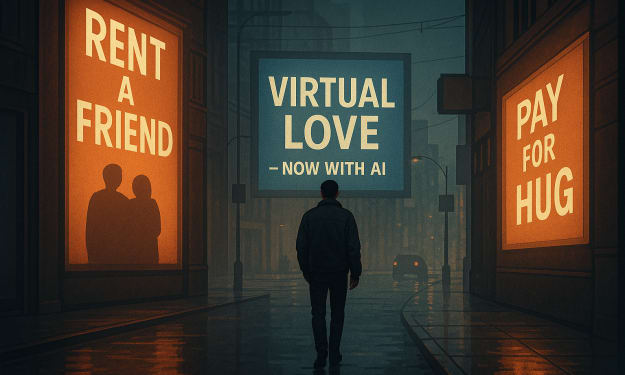
The Loneliness Vending Machine: How We Started Paying for Connection
I. A Machine for Love Last month, I rented a friend. Not metaphorically. I paid $29.99 for a one-hour video call with someone who promised to listen to me, validate me, and laugh at my jokes. The app was clean, the interface sleek, and the calendar surprisingly full. My session started with a smiling young woman named Emma—probably not her real name—who said, “So, how was your day?” with the kind of warmth you’d expect from someone you’ve known since high school. Except we hadn’t.
By Ahmet Kıvanç Demirkıran7 months ago in Psyche


Comments
There are no comments for this story
Be the first to respond and start the conversation.