
The Lifeline We Ignore: Asking for Help in Depression
Depression’s Trap: Breaking Free by Reaching Out

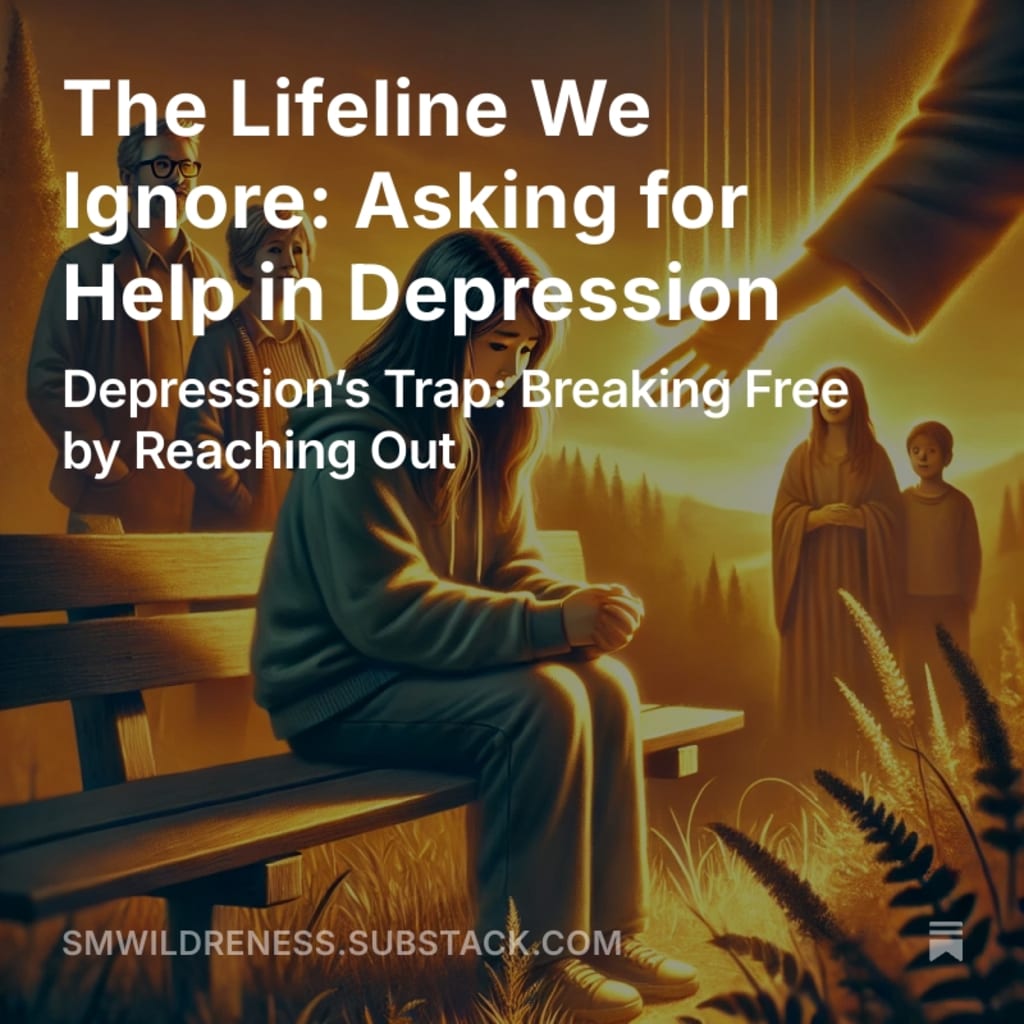
To start with, I was ashamed of my depression.I felt more burdened because of the trouble I was causing my loved ones. Today, I know that’s one of my most powerful tools I had and will always have.
A quote I picked up in my school days:
“Agar kholte dil doston ke samne, to aaj nahi kholna padta aujaron se.”
It took time for those words to resonate with me, but they stuck with me and reinforced my belief in sharing. Whenever something bothered me, I would share and ask for help.
Depression made me struggle with my reasons to ask for help, But I talked about the truth, asked for care and demanded help, and learned great lessons.
More than a few responses I got for asking for help had something in common:
“You have everything. You have nothing to be depressed about. You have no idea what struggles people have. Stop crying. Just cheer up and don’t take tension. Think Positive.”
I wanted to shout at them from the bottom of my heart that, “All of this is known to me. I know people have bigger problems. I didn’t choose to cry all day nor stop feeling happy. I know it doesn’t seem logical, and few know the lack of logic or sense better than me. But I accepted it knowing it’s a disease I didn’t cause. I’m tired of crying that it feels like there are no tears left. I’d give up everything and more to feel normal for a moment.”
But all I stayed quiet and decided to share my feelings only with a few people who I consider as close to me. I did my work and kept my feelings to myself. I left the court of people where they judged me. Because I also came to terms with the fact that not everyone would understand my depression, which I am dealing with to get better as an authority upon myself.
The incident that broke my heart was when an old friend told me not to call him for help because he thinks I’m emotionally unstable. He chose to break our friendship over it. And he wouldn’t have me as a friend unless I get better. We can resume our friendship once I get better. It was a punch in the stomach and a reality check about asking for help.
I had fewer people who didn’t see it as a burden. After this experience, I felt like I was burdening everyone, so I stopped sharing with my friends and family, fearing they’d shut me off in the same way. And Thinking my existence burdened them made it hopeless to ask for help.
It worsened to the point of ending it all.
Everyone visited to show their love. My mother came to visit me and stayed with me for a week. When I felt better, I told her to go home, but I could still see the tears in her eyes. Against her wish, she left. I had hurt them enough. Seeing me cry hurt her too. She made me promise not to think about suicide anymore and when everything seems like ended just give up the job and everything and come home. She and my father are well capable of taking my care of me for life. My family would care for me with no questions asked. She requested, with all her love, not to do anything like that because they love me.
My family and friends told me to call them whenever I needed. I hesitated. But after my first suicide attempt and sharing it with Yogesh Dada, a neurologist and my mentor, he told me we need a plan for emergencies. Especially when I was alone. Though I had thoughts, I had an iron will to live and get better. We needed to tackle those critical moments urgently. So we created a plan with my family, friends, and mentor.
In a sequence of family, friends, and mentors, I will demand help. If I had a thought, I’d call my brother, Aditya. If I had a severe feeling, Harshali, my friend (and psychiatrist), and if it worsened, Yogesh Dada would help. All three were told not to ignore my call, this arrangement helped me. Rather than fighting those thoughts alone, I had company to control and restrict thoughts from going haywire.
I learned not to grab hurtful stuff from cheap seats and pull it close. I just had to step over it and keep going. I knew it wouldn’t get easier and so I had to get stronger. Because those who judge are on sidewalks, not in the arena. And they are alien to the suffering.
I started sharing again, but carefully and with a few people whose opinions mattered and who are willing to get into the arena and fight against depression with me. Although sharing previously caused hurt and grief, I knew for a fact that losing love out of fear for harm and disappointment was a deal I should never make. I chose love and care above all.
In depression, truth lies. I mistakenly focused on people who didn’t love me instead of those who did love me. My friends, Shubhangi and Pratik, risked their jobs to stay with me defying their superiors’ orders, A dear friend put his career on hold for a year to be with me in that phase. My family let me choose my treatment path once they understood. My colleagues did extra work to lighten my burden. My seniors gave me rest in the middle of the work.
If this isn’t love, I don’t know what is.
Two days ago I asked on social media, ‘What’s the most important thing while dealing with depression?’ and 12 of 20 said having a loved one to speak to about the struggle. A systematic review of help-seeking interventions for depression evaluated randomized controlled trials targeting help-seeking attitudes and behaviors. The review highlighted that interventions designed to encourage help-seeking can effectively improve mental health outcomes for individuals with depression. According to Dr. Sagar , A Psychiatrist ,Human brain has many networks that are designed to promote social interaction and derive comfort/ pleasure . Talking to loved ones is an augmenting agent in treatment. And if someone has no brain impairment, talking to loved ones can act as a protective factor by reducing stress. So has preventive value also.
I realized professional spaces are hard to be open about our feelings, but we spend half our lives at work. It would be better for all of us if we could muster the courage to have hard conversations there too.After getting better, I took it as my job to excavate the unsaid about depression in my life.
I learned I have to let myself be seen to be loved. It’s hard. Opening up to someone about my deepest fears and hoping they understand and keep my trust is the most vulnerable thing I did. It’s counterintuitive. It’s not easy to ask as it’s a vulnerable act. But it was a path back to each other. Through the act of asking I connect with them and when I connect with people who want to help, I don’t see them as a risk,I see them as trust. I believe when we really see each other we want to help each other.
Any perfect tool can’t help us if we can’t face each other and give and receive fearlessly, and more importantly, is to share and ask openly.
Resourses-
The art of asking | Amanda Palmer
Brene Brown : The Call To Courage on Netflix
About the Creator
Smita
After enduring the depths of depression, I can now say with conviction: “I am not a depressed person. I have depression—it's a disease, not a choice, and it does not define me."
Why "Good Morning" Texts Are Not Enough to Sustain a Long-Distance Relationship
If you are in a Long-Distance Relationship (LDR), you know the feeling. It’s 2:00 AM. You just hung up a video call. You spent two hours talking, laughing, and updating each other on your day. But the moment the screen goes black, the silence hits you like a truck. You are alone in your room, and they are thousands of miles away.
By Tsg.official09about 24 hours ago in Psyche


Comments
There are no comments for this story
Be the first to respond and start the conversation.