
🕊️ The Conference of the Birds and the Mirror of the Self
A mystical tale from 12th-century Persia retold through the lens of ego, Jungian psychology, and the oneness of being.
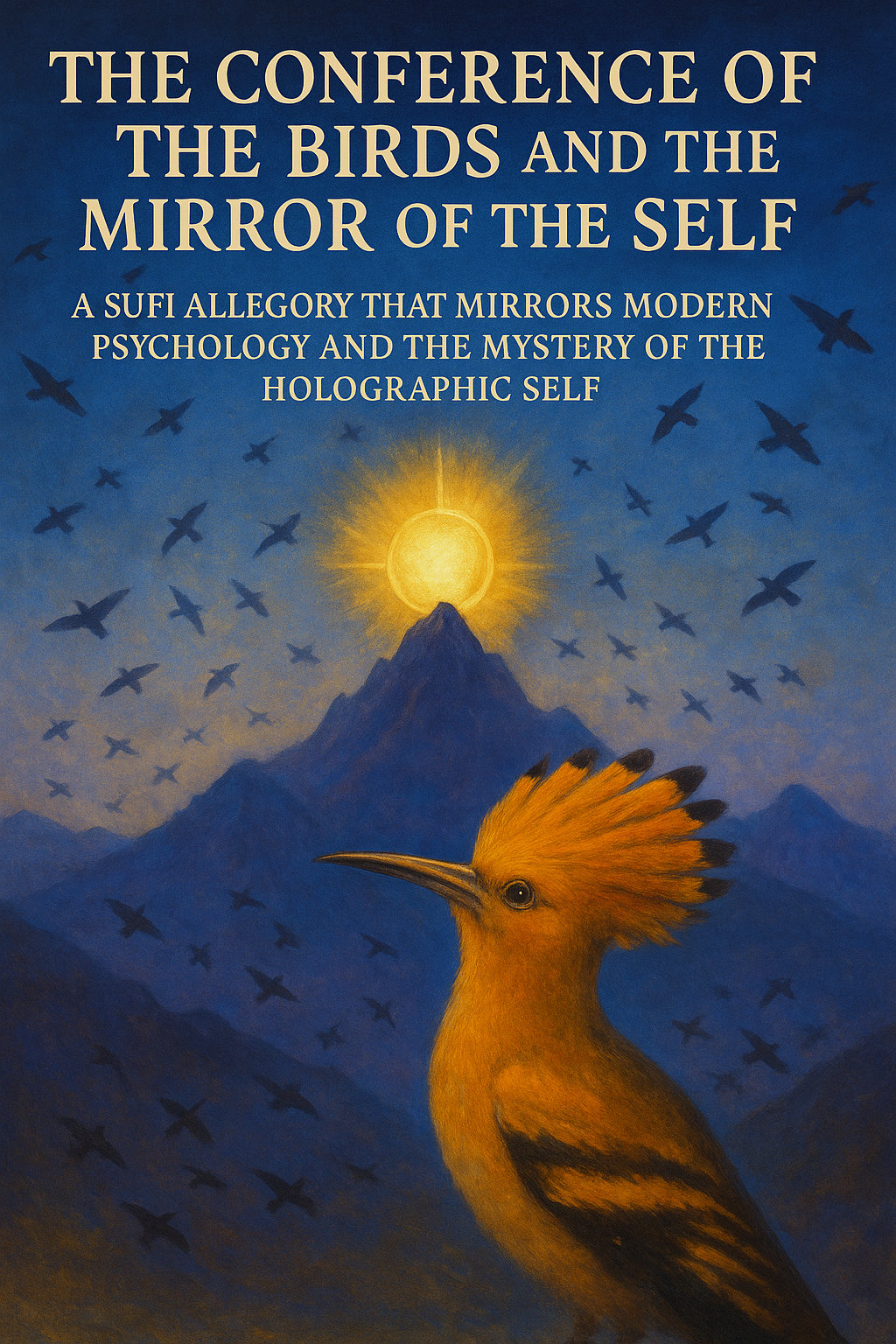
Introduction: A Journey Begins with Loss
In 12th-century Persia, a man named Attar began a journey of deep introspection after witnessing a dervish willingly surrender his life. This experience shattered the illusions of worldly desire and triggered a search for the true self. The result was The Conference of the Birds—a poetic allegory that speaks across centuries.
The story centers around the hoopoe bird, a creature that has achieved all worldly goals only to realize that the meaning of life lies elsewhere. The hoopoe invites all the birds of the world to embark on a quest to find their true king, the legendary Simurgh. This is not a political mission, but a spiritual one—an inner call for unity.
⸻
Birds of the Ego: Characters of Our Inner World
Each bird in Attar’s story represents a facet of the ego—a psychological blockage that prevents us from seeing the whole truth of who we are. Their excuses are painfully familiar:
• The Nightingale: Lost in romantic obsession, it symbolizes how we confuse love with attachment.
• The Parrot: Obsessed with eternal life, unwilling to risk real transformation.
• The Peacock: Longing to return to paradise, but still chained by pride.
• The Duck: Comfortable in its spiritual surroundings, yet refusing to leave its comfort zone.
• The Finch: Fears the difficulty of the journey and lacks trust in the unknown.
These birds are not just metaphors for medieval souls—they’re reflections of us today. In our time, the ego hides behind productivity, vanity, trauma, or spiritual consumerism. We say: “I’m too busy,” or “I’m not ready,” while deep inside, we yearn for something more.
⸻
Jung and the Hoopoe: Mirrors of the Psyche
Carl Jung, in The Red Book, speaks of reaching the peak of his worldly achievements—only to discover an inner emptiness. He felt called not to external success, but to descend into his own soul. This echoes the hoopoe’s message: that true kingship lies not outside, but within.
Both Jung and Attar describe a journey through shadow, loss, and surrender. The goal is not perfection, but wholeness—where every part of the self is seen, known, and integrated.
⸻
The Simurgh and the Holographic Soul
At the end of the journey, the birds who survive the trials finally meet the Simurgh. But what they see is not an external being—it’s a reflection of themselves. “Si-murgh” literally means “thirty birds.” They discover that the divine they were seeking was within them all along.
This moment holds a deep mystical truth, one that aligns with the holographic view of reality in both spiritual and scientific traditions. Just as each part of a hologram contains the whole, each soul contains the entire cosmos within. The fragmentation we experience is an illusion. Unity is our origin and our destination.
⸻
Conclusion: A Story for Our Time
The Conference of the Birds is not just a Sufi tale; it’s a spiritual roadmap. It teaches us that the journey to truth begins by confronting the illusions of the ego. It reminds us that unity is not about losing individuality, but realizing that we were never separate to begin with.
Today, perhaps more than ever, we need this story—not just to read, but to live.
⸻
✅ Disclaimer:
This article was developed with research support and editorial guidance from AI tools. All final writing, voice, and creative direction are by the author.
About the Creator
Keep reading
More stories from writers in Psyche and other communities.
The Color We Learned to Fear
Black is a color that refuses to be neutral. It enters a room with history on its shoulders and silence in its wake. For some, it is elegant, powerful, and endlessly modern. For others, it is heavy—too heavy—with meanings they did not choose but inherited. The dislike of black is rarely about the color alone. It is about what black has been taught to represent, the emotions it awakens, and the stories people carry inside them.
By LUNA EDITHabout an hour ago in Psyche
How to Succeed at the Benson Directory®
Congratulations and welcome to the Benson Directory® employee #22391! As our newest call handler, you will have the privilege of speaking with dozens of unique and interesting people on a daily basis as well as the opportunity to earn bonuses for high performance. Contained within this handbook you will find a set of ease to follow instructions designed to help you settle in to your new role and begin paving the way to success.
By S. A. Crawford3 days ago in Fiction




Comments
There are no comments for this story
Be the first to respond and start the conversation.