
Talking to Your Boss About Your Mental Health Without Regret
How to Open Up at Work Without Sacrificing Your Confidence, Reputation, or Future

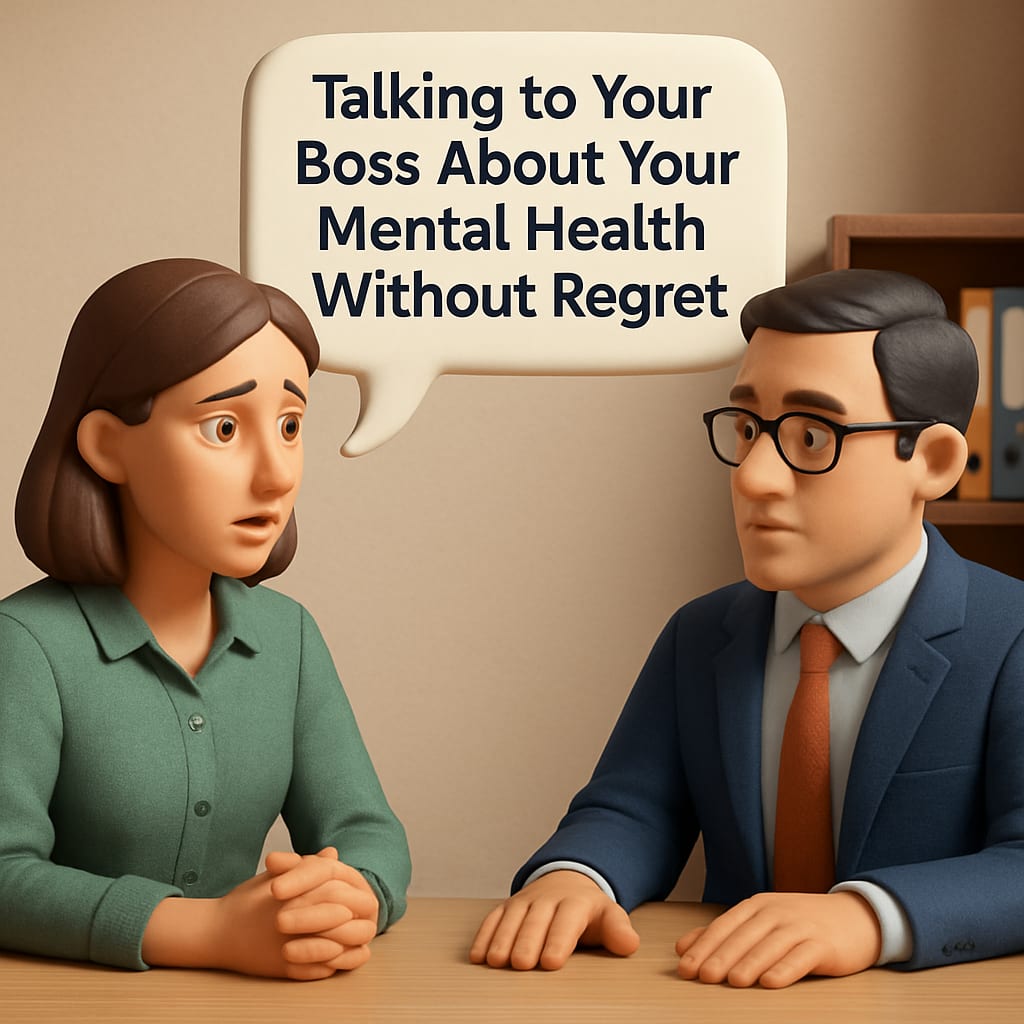
The Weight of Silence
Mental health challenges don’t take a break just because you’re at work. Whether it’s depression, anxiety, burnout, or a combination of emotional struggles, carrying that silent burden day after day can erode not just your well-being, but your performance, focus, and sense of purpose, too.
At some point, you may reach a moment where the pressure becomes too heavy to bear alone. You may realize that talking to your boss is not just necessary, it’s unavoidable. But the thought of opening up about something so personal in a professional setting can trigger a wave of fear.
What if they don’t understand? What if it changes how they see me? What if I regret saying anything at all?
This article will guide you, step-by-step, through the process of talking to your boss about your mental health, with clarity, courage, and without regret.
You’ll learn how to prepare mentally and emotionally, what to say and how to say it, how to set boundaries, and how to protect your rights and reputation in the process.
Understanding the Stakes: Why This Conversation Matters
Let’s be honest, many workplaces still treat mental health as an afterthought. Even in organizations that claim to support wellness, employees often feel pressure to power through instead of speaking up. But silence comes at a cost.
Untreated mental health challenges can lead to absenteeism, presenteeism (when you’re physically present but mentally exhausted), and job dissatisfaction. Over time, this erodes both productivity and your sense of personal agency.
Talking to your boss, when done thoughtfully, can open doors to accommodations, understanding, and even trust. It doesn’t make you weak. It makes you wise. But only if you approach the conversation with a strategy rooted in self-awareness and respect.
Step 1: Assess What You Need and Why You’re Speaking Up
Before you say a word, get clear on your purpose. Are you hoping to get time off? Adjust your workload? Work remotely a few days per week? Set clearer boundaries? Access employee assistance programs?
Your “why” determines your message. And without it, your conversation may feel aimless or too vulnerable.
Ask yourself:
- What am I struggling with right now, specifically?
- How is it impacting my work and well-being?
- What would help me show up better, both mentally and professionally?
This is not about spilling your entire life story. It’s about identifying the core challenge and the support you need.
Step 2: Choose the Right Time and Setting
Timing is everything. Don’t bring this up in the middle of a crisis, in passing, or when your boss is visibly overwhelmed. Request a private meeting when you can have uninterrupted time.
You might say,
“I’d like to speak with you privately about something important regarding my health and workload. Can we set aside 30 minutes this week?”
Avoid digital conversations for this. Emails or Slack messages lack tone, nuance, and empathy. In-person or video calls are far better for complex conversations like this.
Step 3: Craft Your Message with Intention
When the moment comes, keep your message grounded, focused, and professional. You don’t need to go into deep personal history or medical detail. Instead, use simple, honest language.
Here’s a sample structure:
Open with appreciation or context
“I value my role here and the work I do, which is why I want to be transparent.”
Name the challenge (without overexplaining)
“Lately, I’ve been managing some ongoing mental health challenges—specifically, anxiety and burnout.”
Describe the impact
“It’s starting to affect my ability to stay focused and engaged, and I don’t want it to reach a point where it compromises my work.”
Offer a proposed solution or request
“I’m wondering if we can explore some options that would help me manage my workload more sustainably—like adjusting deadlines or temporarily shifting priorities.”
Reassure your commitment
“I’m committed to my work and want to keep contributing in a way that’s healthy and sustainable for both of us.”
Be calm. Be clear. And stay rooted in the fact that this is not a weakness—it’s a proactive step.
Step 4: Prepare for a Range of Reactions
Even the most empathetic managers may not know how to respond immediately. Some will express support. Others may look uncomfortable. A few may seem indifferent or dismissive, not because they don’t care, but because they lack training.
Don’t measure the success of the conversation by their facial expressions. Give them time to process.
Also, prepare for questions, but know your boundaries. You are not obligated to disclose a diagnosis or personal trauma. You can always say:
“I’d prefer to keep the details private, but I’m happy to talk about what will help me stay effective in my role.”
Step 5: Document the Conversation
After the meeting, take a few minutes to write down what was discussed. Send a follow-up email thanking your boss for their time and briefly summarizing any decisions made.
Example:
“Thanks again for taking the time to meet today. I appreciate your openness and support. As discussed, I’ll be shifting to remote work two days per week for the next month while I prioritize my mental health. Please let me know if you’d like to revisit any part of the plan.”
Documentation helps protect you if misunderstandings arise. It also shows initiative and professionalism.
Step 6: Know Your Rights
In many countries, including the U.S., mental health conditions like depression and anxiety can qualify as protected disabilities under workplace laws. This means employers may be legally required to provide reasonable accommodations.
You don’t have to invoke legal rights during the first conversation. But if things don’t improve, or if you face pushback, you may want to consult HR, a mental health professional, or a legal expert.
Resources to explore:
- Employee Assistance Programs (EAPs)
- Occupational Health services
- National mental health organizations that advocate for workplace rights
Step 7: Keep the Door Open for Ongoing Dialogue
Mental health isn’t static. It shifts. Sometimes you’ll feel stable; other times you’ll need more support. Keep checking in with yourself and with your manager if needed.
A follow-up conversation can sound like:
“Things have improved since our last talk, and I’m feeling more grounded. I’d like to keep the flexibility we discussed for now, and I’ll check in with you again in a few weeks.”
Or:
“I’ve noticed my symptoms flaring up again. Can we revisit the plan and make a few tweaks to help me stay productive?”
A one-time conversation rarely fixes everything. But it opens a door, and you get to keep walking through it on your terms.
Courage Without Regret
Talking about mental health at work is one of the bravest things you can do. It’s also one of the most strategic. You are not weak. You are self-aware, responsible, and strong enough to advocate for what you need.
Will it feel scary? Probably.
Could it feel awkward? Maybe.
Might you regret it? Not if you approach it with clarity, purpose, and respect.
Regret doesn’t come from speaking the truth. It comes from hiding it for too long. When you speak with intention, you give yourself a chance to work with more freedom, more honesty, and a lot less fear. And that’s something worth fighting for.
About the Creator
Richard Bailey
I am currently working on expanding my writing topics and exploring different areas and topics of writing. I have a personal history with a very severe form of treatment-resistant major depressive disorder.
Keep reading
More stories from Richard Bailey and writers in Psyche and other communities.
When Getting Out of Bed Feels Impossible: Micro Goals for Mental Health at Work
The Weight of the Morning There are days when the alarm clock feels like an enemy. Your body is still, and your mind is overwhelmed before your feet even touch the floor. The weight of responsibilities, emails, meetings, deadlines, can press down before you’ve even opened your eyes. For those living with depression, anxiety, or burnout, this sensation isn’t just emotional. It’s physical. Getting out of bed doesn’t feel hard, it feels impossible.
By Richard Bailey8 months ago in Psyche
Top tipple tricks
Been thinking a lot about drinking, lately. Not least because of a recent episode of over-indulgence and the inevitable after effects. Some readers may recall the earlier articles I wrote about beating the booze. Here I set out an experiment in techniques for cutting down on my alcohol intake. The experiment was successful, the techniques worked, and I have armed myself with an arsenal of weapons in the war against the demon drink. I have yet to fire the first round however. It's all a question of timing (perhaps procrastination).
By Raymond G. Taylor4 days ago in Psyche
Why I Stopped Reading Self-Help Books — And What I Read Instead
For years, I believed self-help books were the shortcut to a better life. Whenever I felt stuck, unmotivated, or confused about the future, I would buy another self-help book. The titles were always promising: Change Your Life in 30 Days, The Secret to Unlimited Success, The Mindset of Winners. Each one seemed to hold the key to a more productive, happier version of myself.
By Shahid Zamana day ago in Psyche




Comments
There are no comments for this story
Be the first to respond and start the conversation.