disorder
The spectrum of Mental Health disorders is incredibly vast; we showcase the multitude of conditions that affect mood, thinking and behavior.
Borderline Personality Disorder
Many people experience times when they’re feeling down, hopeless, like nothing’s worth fighting for anymore. But for most people these episodes will pass after a few days or even a couple of weeks. When living with BPD, these episodes happen too often. So let’s start from the beginning...
By Matthew Loveridge7 years ago in Psyche
Mental Health and Apology Fatigue
I've been writing for some time for a particular audience of which I have been a member: women with premenstrual dysphoric disorder. But recently, I've noticed that much of what I write can be helpful to anyone with a nonvisible, behavorial challenge... men and women. So, while this is written specifically pertaining to PMDD, it is dedicated to anyone who finds him or herself in the predicament of having to say, "I'm sorry" a lot.
By Cheeky Minx7 years ago in Psyche
Confessions of a Binge Shopper
I’ve been down on my luck for almost a year now since my inevitable university convocation. Within eight months, I’ve managed to obtain four jobs and lose them all before 2018 came to an end. If there are any acclamation for a person acquiring four jobs and still ending up unemployed after twelve months, I think I deserve all the accolades. However, this is not the point I wish to address and I can save my employment woes for another article.
By Alystair Kade7 years ago in Psyche
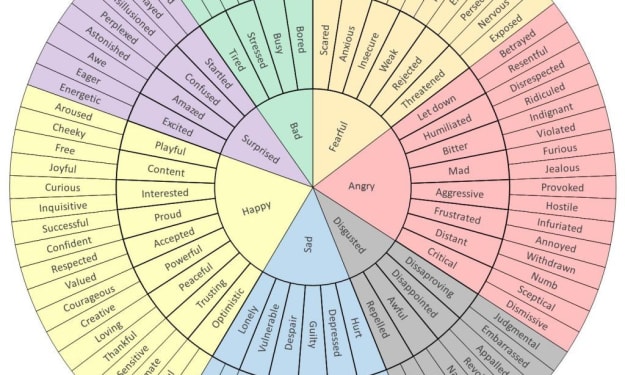
Naming Our Emotions
What are emotions and how do we describe them? Often it's not a subject we give much thought to. Even within the field of psychology there are various theories espoused by various researchers. Some emotions may be easy to recognize, like happiness, sadness, anger, and jealousy. Often, though, if you dig beneath the surface just a little bit, you can discover there are actually a lot of emotions going on in addition the obvious ones. Realizing this may make it easier to understand where those strong obvious emotions are coming from, which can then help us to better manage our emotions.
By Ashley L. Peterson7 years ago in Psyche
'Quiet' Borderline Personality Disorder
Please do not read if you feel like you may have a negative reaction to reading about mental illness. No one ever talks about borderline personality disorder, let alone “quiet” BPD, and, to be quite honest, it makes me feel extremely invalidated and pushed to the side. Not a lot of people even know what it is. BPD is “a pervasive pattern of instability of interpersonal relationships, self-image, and affects, and marked impulsivity beginning by early adulthood and present in a variety of contexts, as indicated by five (or more) of the following:
By Siena Dini7 years ago in Psyche
Understanding Narcissistic Abuse
The term narcissism comes from the story in Greek mythology of Narcissus, who fell in love and became obsessed with his own reflection in a pool. In modern usage, narcissist may refer to a personality trait or narcissistic personality disorder.
By Ashley L. Peterson7 years ago in Psyche
Internet Addiction Disorder Is a Mental Disease, Not a Joke
For the earlier years of my childhood, I suffered from a disorder that doesn't exist. As a naive, innocent child, I was easily dragged into hypnosis in the form of a desktop computer that I simply couldn't get enough of. I never was able to fathom how technology became my biggest enemy, although I didn't have it nearly as bad as the cast of the Terminator franchise. However, I suffered from a disease whose existence is still deep in debate.
By Carson David7 years ago in Psyche
10 Fascinating Books About Eating Disorders
Eating disorders are something that plague many people, young and old. Although they are stereotypically considered the stuff of "teen angst" or limited to women—that’s not the case. There are some fascinating books about eating disorders that truly show how devastating they can be.
By Stephanie Gladwell7 years ago in Psyche
Manufacturing Pathology
Mental illness stigma often takes the form of dismissing the experience of those living with mental illness, but it can also take a subtler form. When normal emotions like sadness and anxiousness are spoken of as if they are on par with mood or anxiety disorders, this can result in those illnesses being viewed as just a common occurrence who importance is exaggerated. Many people lack the vocabulary and knowledge to be able to to distinguish between occasionally feeling depressed and having a depressive disorder, or occasionally feeling anxious and having an anxiety disorder.
By Ashley L. Peterson7 years ago in Psyche