art
Art of an introspective nature; a look at artwork that reveals the artist's psyche and comments on the inner workings of a chaotic mind.
The Cost Of Counting
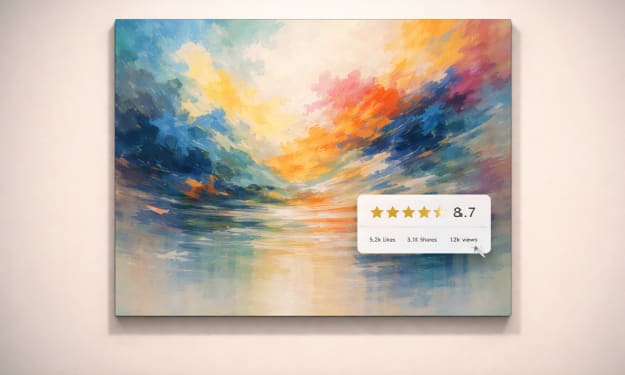
You check your phone and it tells you who noticed you, how well you slept, how productive you’ve been, how far you’ve walked. The numbers arrive before your thoughts do. They don’t just inform you — they interpret you. A good sleep score feels like success. A low step count feels like failure. A spike in notifications becomes proof that something mattered. Most of us accept this without hesitation. Numbers feel objective. Neutral. Trustworthy. But why do we care so much about what can be counted — and so little about what can’t? It’s easy to blame modern life. Smartphones. Algorithms. Dashboards for everything. Unfortunately, humans were mistaking numbers for meaning long before anyone invented a smartwatch. There’s even a name for the pattern: the McNamara Fallacy. During the Vietnam War, U.S. Secretary of Defense Robert McNamara attempted to measure progress through statistics — body counts, sortie numbers, territory percentages. The data looked precise. Objective. Reassuring. On paper, progress could be tracked. Charts moved upward. Reports suggested momentum. But many of the most important variables refused to cooperate with measurement. Morale couldn’t be quantified. Cultural resistance couldn’t be graphed. Political realities shifted faster than any spreadsheet could capture. No one woke up one day and decided to ignore reality. The shift happened gradually. Each new report reinforced the belief that measurable progress must reflect actual progress. Over time, the metrics became the story. The numbers weren’t false. They were simply incomplete — and what couldn’t be easily measured slowly faded from view. That instinct never disappeared. It just moved closer to home. Today, measurement surrounds us. Fitness trackers translate movement into steps. Platforms convert attention into engagement metrics. Productivity tools turn effort into streaks and checkmarks. None of this is inherently bad. Measurement helps us see patterns we might otherwise miss. Data improves medicine, reveals inequality, and helps us navigate complexity. The trouble begins quietly when measurable signals start to stand in for deeper realities. Nowhere is this tension more visible than in creative work. Writers, artists, musicians, filmmakers — anyone who makes something — now receives constant numerical feedback. Views. Likes. Shares. Follower counts. Watch time. Creative work has always involved uncertainty. You make something and hope it resonates. Often, you don’t know if it has — or when. Metrics offer relief from that ambiguity. They speak clearly. Immediately. Undeniably. And that clarity is seductive. Creative life now exists between two feedback systems. One is slow, ambiguous, and emotional: the sense that something meaningful has been expressed or received. The other is immediate, visible, and quantifiable: engagement numbers that arrive instantly and feel definitive. Both systems have value. Metrics help creators find audiences, refine communication, and understand reach. But they also introduce a subtle gravitational pull. A piece that performs well numerically feels validated. One that disappears quietly can feel like failure, regardless of its depth or originality. Over time, creators adapt. Certain formats travel further. Certain tones provoke faster reactions. Certain ideas convert reliably into attention. The shift rarely feels like compromise. It feels like learning the system. Slowly, almost imperceptibly, the measurable begins to redefine what feels worth creating. There’s a cognitive bias sometimes called the streetlight effect. A person searches for lost keys under a streetlight — not because that’s where they dropped them, but because that’s where the light is strongest. Metrics function the same way. They illuminate certain aspects of creative work very clearly: reach, growth, frequency. Once that light exists, effort naturally gathers there. Decisions cluster around what is visible. The danger isn’t that the light exists. It’s that we forget how much remains in the dark. Resonance is hard to quantify. Slow influence is invisible. A story that changes someone years later won’t show up in this week’s analytics. Metrics measure applause. They rarely measure silence — and silence is where many meaningful ideas begin. If this tension feels familiar, it isn’t a personal weakness. It’s human psychology. We trust numbers because numbers feel safe. Ambiguity is exhausting. Creative work, like life itself, is filled with variables we cannot predict. Measurement offers the illusion of certainty. A rising graph feels like progress. A score feels like clarity. Once a metric exists, it begins to exert gravity. Attention bends toward what performs. Decisions orient toward what can be optimized. The shift rarely feels dramatic. It feels logical. Which is precisely why it’s so difficult to notice. The goal isn’t to reject measurement. Numbers are powerful tools. The risk lies in letting measurement replace judgment rather than inform it. Sometimes the simplest safeguard is a question: What does this number fail to capture? Engagement measures reaction, not depth. Visibility measures reach, not meaning. Metrics can show who noticed — but rarely reveal who was changed. Creative work has always required making things without guaranteed validation. That hasn’t changed. What has changed is how loudly validation speaks. The uncomfortable — and perhaps hopeful — truth is that the most meaningful work often resists easy measurement. History suggests the most important variables in any system are often the ones that refuse to be counted. When we forget that, we don’t just misread the numbers. We begin to reshape our creativity around them. And over time, that reshaping carries a cost.
By Mina Carey9 days ago in Psyche
When Reflection Feels Like Accomplishment
There is a subtle experience many people recognize but struggle to name: the feeling of having done something meaningful without having actually changed anything. It often follows long periods of thinking, talking, organizing, or refining ideas. The mind feels clearer. Tension feels reduced. There is a sense of closure or completion. And yet, when examined closely, nothing in the external world has moved. No decision has been enacted. No behavior has shifted. No responsibility has been embodied. What changed was internal orientation, not external reality.
By Peter Thwing - Host of the FST Podcast10 days ago in Psyche