
Psychology’s Missing Link? New Theory Maps the Internal Architecture Behind Effort, Action, and Collapse
How “Lagunian Dynamics” explains mental effort through ignition, resistance, and cognitive noise.

What if your procrastination wasn’t a personal flaw — but a structural glitch in how your mind works?
We’ve all been there.
You care about the goal. You know exactly what needs to be done. And still… nothing.
You scroll. You hesitate. The cursor blinks — and your brain just doesn’t fire.
Most people chalk this up to laziness. Lack of motivation. Maybe even a bad habit.
But what if that’s not the problem?
A new theory called Lagunian Dynamics suggests something very different — and surprisingly hopeful:
You’re not broken. You’re just out of alignment.
Welcome to Cognitive Drive Architecture (CDA) — a fresh way of understanding effort, procrastination, burnout, and even those elusive flow states. And it might explain a lot about how your mind works when you're trying to get things done.
🔍 Drive Isn’t a Mood — It’s a System
Forget the idea that motivation is just a feeling you have to “wait” for.
According to independent researcher Nikesh Lagun, what we call “drive” is actually the result of six internal forces working together — or clashing. These forces shape whether you take action, how long you stay focused, and why you sometimes just… fall off.
It’s like your mind has its own operating system for effort. And when it’s misconfigured, things don’t move — no matter how much you want them to.
🧠 The Six Forces Running the Show (Whether You Know It or Not)
Here’s the deal: your ability to start something, stick with it, or totally crash out — it all comes down to six forces working behind the scenes in your brain.
Let’s talk about them in real-people terms:
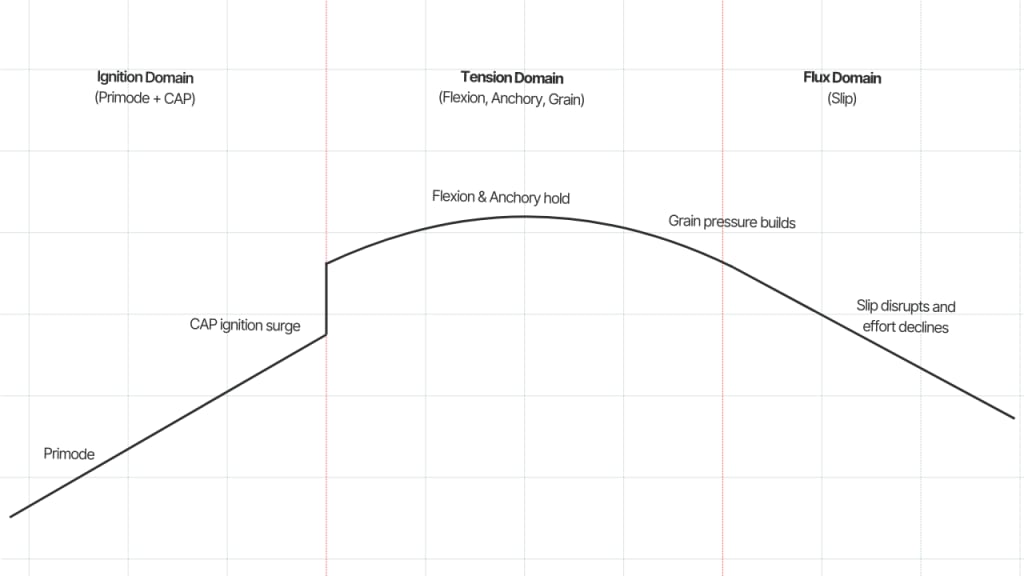
1. Primode – This is your “start switch.” It’s that moment when you stop just thinking about doing something and actually lean in and begin. No Primode? You’re stuck in neutral.
2. CAP (Cognitive Activation Potential) – Think of this as your emotional charge. It’s how much the task matters right now. Even if something’s important, if it doesn’t feel urgent or meaningful, CAP is low — and your spark fizzles.
3. Flexion – This is about how well a task bends to fit your mental state. If it feels approachable and you can find your way into it? That’s good Flexion. If it feels stiff, frustrating, or just “off”? Flexion’s low, and your brain pushes back.
4. Anchory – Your mental grip. It’s what helps you stay locked into something without constantly drifting off. Strong Anchory = deeper focus. Weak Anchory? You’re checking your phone again.
5. Grain – This is the resistance. It’s the mental and emotional weight that makes even easy stuff feel like a slog. Sometimes it’s stress, overthinking, or just plain burnout.
6. Slip – The curveball. Random mood dips, distractions, brain fog. Not your fault — just the normal chaos of being a human.
You’ve felt all of these, even if you didn’t know what to call them. Now you do.
And when you start seeing them for what they are — not flaws, but moving parts — you can work with them instead of fighting yourself.
⚙️ The Equation That Explains Effort
Lagun took it a step further — and built a literal equation to describe Drive. Sounds intense, but here’s the vibe:

Basically:
If ignition (Primode), emotional energy (CAP), and task-fit (Flexion) are high — and focus holds (Anchory) while resistance (Grain) stays low — you’re flying.
Throw in a little luck on the Slip variable, and you’re in flow.
But when Drive breaks down? This equation tells you exactly where and why.
🧩 It’s Not Just You — It’s Structural
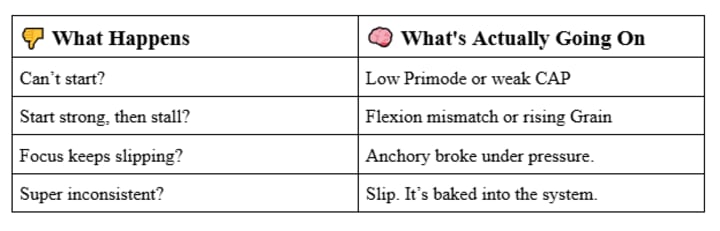
Here’s how common issues look through this model:
And flow? That zone where you lose track of time, and everything just clicks?
That’s not luck. It’s structural alignment:
High ignition, strong emotional charge, flexible task engagement, low resistance, and minimal interference. Lagun’s model shows that flow is buildable — not random.
🛠️ Stop Pushing. Start Tweaking.
You don’t need to force your way through effort.
You just need to adjust the system.
Try this:
- Struggling to start? → Add a small starting cue. A countdown, a change of scene — something that tells your brain, “we’re doing this now.”
- Feeling detached or blah? → That’s low CAP. Reconnect with why the task matters to you — even in a small way.
- Task feels weirdly hard? → Flexion’s off. Try a different angle, or break it into smaller chunks.
- Everything feels heavier than it should? → That’s Grain. Simplify the task. Clear distractions. Lighten the emotional load.
- On and off for no reason? → That’s Slip. Track your rhythms. Leave space for the wobble.
This isn’t about “grinding harder.”
It’s just giving your system what it actually needs.
🧪 The Future of Measuring Effort
One of the most exciting ideas in Lagun’s work is a futuristic tool called VIRELICH — a real-time mental mapping instrument. Think of it like a cognitive MRI that can actually show why you’re stuck, locked in, or losing steam — as it’s happening.
It’s still hypothetical, but the model opens doors for researchers to start building toward it — using behavior, mood, and focus patterns to map Drive variables from the outside in.
🧭 Final Thought: You’re Not Failing. The System Is Just Off.
This model doesn’t just change how we talk about effort. It changes how we see ourselves.
You’re not lazy. You’re not broken.
Your internal Drive system might just need realignment.
That tiny shift in framing?
It could change how you start.
How you focus.
And maybe, how you finish.
💬 What’s Your Pattern?
Which part of the Drive system do you struggle with most — ignition, tension, or inconsistency?
Leave a comment, share your thoughts, or explore the full theory here:
Read: Lagun’s Law and the Foundations of Cognitive Drive Architecture
About the Creator
Keep reading
More stories from Nikesh Lagun and writers in Psyche and other communities.
Struggle to Stay Focused? Anchory May Be the Missing Piece in Your Productivity System
Have you ever sat down to work, fully motivated, only to find your mind drifting away minutes later? You know the task. You care about it. You even want to get it done. But attention slips.
By Nikesh Lagun4 months ago in Psyche



Comments
There are no comments for this story
Be the first to respond and start the conversation.