
Posting for Therapists Taught Me More About Healing Than Any Self-Help Book
Lessons from the Therapist's Chair: How Writing for Healers Helped Me Heal, Too

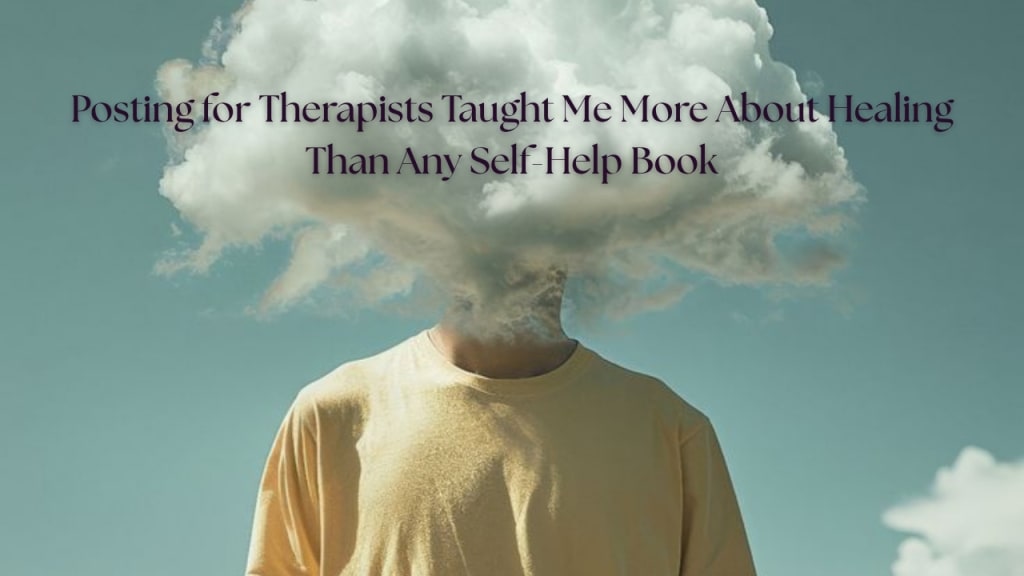
I used to think I was just the person behind the screen, crafting posts, scheduling content, and making sure therapists’ voices reached the people who needed them most. But after three years of immersing myself in the world of mental health social media, I’ve come to realize something profound: you can’t spend your days swimming in wisdom about healing without some of it washing over you.
It started innocuously enough. A simple job posting: “Social Media Manager for Mental Health Practice.” I thought I’d be writing about appointment availability and sharing generic wellness tips. I had no idea I was signing up for an accidental masterclass in my emotional landscape.
The Day the Mirror Turned Inward
There’s a particular Tuesday that changed everything for me. I was drafting a carousel post about emotional validation, you know, the kind that breaks down why saying “at least you have…” dismisses someone’s pain. As I typed out slide three (“Your feelings are data, not drama”), something clicked.
I realized I’d been invalidating my stress for months. Every time I felt overwhelmed, I’d tell myself I was being dramatic. Every anxious moment got brushed off with “other people have it worse.” Here I was, advocating for emotional validation in a post, while completely denying it to myself.
That’s when it hit me: this work was holding up a mirror I didn’t know I needed to look into.
Learning to Speak a Language I Didn’t Know I Was Missing
When you manage content for therapists, you become conversational in concepts you’ve never formally studied. Terms like “co-regulation,” “window of tolerance,” and “somatic awareness” stop being clinical jargon and start becoming tools you recognize in your own life.
I remember the first time I truly understood what “emotional dysregulation” meant — not from a textbook definition, but from watching my reactions during a particularly stressful client deadline. My heart was racing, my thoughts were spiraling, and I felt completely out of control. Then I remembered a post I’d written the week before about grounding techniques.
Five things I could see. Four things I could touch. Three things I could hear.
It worked. Not perfectly, not magically, but enough to remind me that I had more agency in my emotional experience than I’d ever realized.
The Weight of Other People’s Stories
Working in this space means you’re constantly exposed to raw human experience. The comments on posts, the stories therapists share, and the vulnerability that lives in the space between content and connection. Some days, it feels like holding space for collective healing, even from behind a computer screen.
I’ll never forget reading a comment thread under a post about childhood trauma. Person after person sharing pieces of their story, finding recognition in each other’s words. I found myself tearing up at my desk, not just from the pain they were sharing, but from the courage it took to name it publicly.
It made me think about my own untold stories, the ones I’d been carrying quietly, assuming they were too small or too common to matter. If these strangers could be brave enough to share their truths in a comment section, maybe I could be brave enough to examine mine in private.
The Unexpected Education in My Patterns
Three months into the job, I started noticing something strange. I could identify attachment styles in the romantic comedies I watched, spot cognitive distortions in my friends’ venting sessions, and recognize trauma responses in family dynamics. It was like being given a new language to describe things I’d always felt but never had words for.
But the real revelation came when I turned that lens on myself. I started seeing my patterns with uncomfortable clarity: how I shut down during conflict (hello, avoidant attachment), how I catastrophized minor inconveniences (cognitive distortions, anyone?), and how my body held stress in ways I’d never noticed before.
The funny thing about working in mental health content is that you can’t stay a passive observer forever. The insights have a way of finding their way home.
When Scheduling Posts Becomes Self-Care
There’s an intimacy to crafting content about healing that I wasn’t prepared for. When you spend your mornings writing captions about self-compassion and your afternoons researching trauma-informed care, something shifts in how you move through your own life.
I started treating my evening routine like the self-care posts I’d been writing. Not in a performative way, but in a genuinely nurturing one. I began asking myself the questions I’d help therapists pose to their audiences: “What do I need right now?” “How can I show up for myself today?” “What would I tell a friend going through this?”
The line between work and personal growth became beautifully blurred.
The Ripple Effect of Borrowed Wisdom
Perhaps the most surprising part of this journey has been watching how the concepts I engage with professionally have rippled out into my relationships. I found myself setting boundaries with more clarity, approaching conflict with more curiosity than defensiveness, and offering the kind of empathy to others that I was finally learning to extend to myself.
My partner noticed it first. “You’ve gotten really good at not taking things personally,” they said one evening after a conversation that might have derailed us months earlier. They were right — I had learned to pause, to wonder about the story behind someone’s reaction instead of immediately making it about me.
The therapists I work with often talk about how healing happens in relationships. I never expected that some of my healing would happen through the act of amplifying their voices.
The Quiet Revolution of Daily Exposure
Working in mental health social media is like getting micro-doses of therapy throughout your day. A quote about resilience while you’re drinking your morning coffee. A technique for managing overwhelm during your lunch break. A reminder about the importance of rest right before you log off for the day.
It’s not dramatic. It’s not a lightning-bolt moment of transformation. It’s more like a gentle, persistent invitation to pay attention to your inner world with the same care and curiosity you bring to your work.
What I Wish I’d Known When I Started
If I could go back and tell my past self anything, it would be this: the work you’re about to do isn’t just about helping others heal. It’s about creating conditions for your growth that you didn’t even know you needed.
You’ll find yourself crying at posts about fathers who struggle to show emotion, recognizing your dad in every word. You’ll discover that the anxiety techniques you’re sharing work when you try them yourself. You’ll learn that boundaries aren’t walls — they’re bridges to better relationships.
Most importantly, you’ll realize that healing isn’t a destination you arrive at, but a practice you commit to, one post, one insight, one moment of self-awareness at a time.
The therapists I work with are changing lives through their content, but they’re also changing mine. And maybe that’s the point, maybe the best work we do is the kind that transforms us in the process of transforming others.
After all, isn’t that what connection is really about? Finding ourselves reflected in the stories we help others tell, and discovering that healing, like good content, is most powerful when it’s shared.
If you’re curious about this intersection, you can find these communities very helpful on Instagram, LinkedIn, and Facebook.
About the Creator
Cosmic Spellcaster
Digital strategist writing at the intersection of mental health, healing, and ethical marketing. Exploring how content can support care, connection, and change.
Keep reading
More stories from Cosmic Spellcaster and writers in Psyche and other communities.
The Power of Storytelling in Healing
I remember a client story I heard while managing content for a small therapy collective. She was a woman in her thirties, grappling with years of buried grief. During a session, her therapist asked her to tell the story of her loss, not just the timeline, but the messy, raw emotions tied to it. At first, she stumbled, her voice shaky. But as she spoke, something shifted. Her story poured out like water breaking through a dam, and by the end, she was crying not from sadness, but from relief. “I didn’t realize how much I needed to say that out loud,” she said. That moment hit me hard. It was one of many times I’ve seen storytelling become a turning point in mental health therapy.
By Cosmic Spellcaster7 months ago in Writers
Counselling in Perth and the Quiet Work of Rebuilding Self-Trust
When we think about emotional wellbeing, often the first images that come to mind are big breakthroughs, life-changing moments or dramatic “aha” experiences. But for many people, the process of rebuilding confidence and self-trust doesn’t announce itself with fanfare. It unfolds slowly, quietly and often behind the scenes of everyday life. In Perth, like in other parts of Australia, conversations about emotional health are becoming more commonplace, and counselling in Perth is one pathway many explore not as a quick fix, but as a space for reflection and reconnection.
By Rochelle Martinez6 days ago in Psyche


Comments (1)
This was such a good read. And I completely agree. Great work. :)