
Living on the fucking border(line).
Like Madonna said, feel's like I'm going to lose my mind.


Now I am not talking about upstate New York. Or down south in El Paso, Texas. I am talking about a personality disorder so confusing, even the title leaves many people confused. Borderline. Teetering on the edge of something. Almost there. Well yes, but in actuality, quite the opposite. The term “borderline” was first introduced in the United States in 1938. It was a term used by early psychiatrists to describe people who were thought to have a tendency to regress into “borderline schizophrenia” in certain situations. At the time, people with neurosis were believed to be treatable, whereas people with psychoses were deemed untreatable. These patients were especially confusing. They didn’t quite fit into the the category of neurotic personality. Or psychotic. Ultimately, where these patients inhabited is somewhere in purgatory – no man’s land if you will. Somewhere on the borderline between neurosis and psychosis.
A little back story. I was sitting on the beach in Magnolia with my two children this past summer. I was walking with my son to the water when I passed a man reading a large book regarding Dialectal Behavior Therapy. As I passed, I called over to him and said, “heavy reading for the beach, huh?” He laughed and replied, assuming I was a therapist. “Oh, no. I have just spent a long time understanding various personality disorders and have come to learn about Borderline and DBT therapy.” He replied saying he was studying for his license and how it is interesting how even medically trained professionals are not versed in diagnosing or treating borderline personality disorder (BPD). He wanted to make it his specialty. I thanked him because the world needs more people such as this…
So what exactly is BPD (read: NOT the Boston Police Department, I have mislead a few people with my short hand from time to time this past year)? Borderline is defined by the Mayo Clinic as:
Borderline personality disorder is a mental health disorder that impacts the way you think and feel about yourself and others, causing problems functioning in everyday life. It includes self-image issues, difficulty managing emotions and behavior, and a pattern of unstable relationships.With borderline personality disorder, you have an intense fear of abandonment or instability, and you may have difficulty tolerating being alone. Yet inappropriate anger, impulsiveness and frequent mood swings may push others away, even though you want to have loving and lasting relationships.Borderline personality disorder usually begins by early adulthood. The condition seems to be worse in young adulthood and may gradually get better with age.
Have you ever experienced a feeling of walking on eggshells? I was referred to a book called: Stop Walking on Eggshells and the very first page blew my mind. I read:
I must be defective. That was the only explanation I could think of for his behavior. Why did he act so loving one moment and then rip me to shreds the next? Why did he tell me I was talented and wonderful then scream at me that I was contemptible and the cause of all his problems? If he loved me as much as he said he did, why did I feel so manipulated and powerless? And how could someone so intelligent and educated sometimes act so completely irrational?
Now this isn’t about me, per se. This isn’t about you. You may think it is but that may just be a product of your NPD (Narcissistic personality disorder, the two are closely linked and both fall under the group “Cluster B,” which I will circle back to later). I kid. Ahem. Anyway, what this is about is uncovering and bringing to light a commonly misdiagnosed and misunderstood personality disorder which affects many if not all of us one way or another. So let’s cross the border, if you will.
There are various signs and symptoms of BPD. A few are listed here:
- Efforts to avoid real or imagined abandonment, such as rapidly initiating intimate (physical or emotional) relationships or cutting off communication with someone in anticipation of being abandoned
- A pattern of intense and unstable relationships with family, friends, and loved ones, often swinging from extreme closeness and love (idealization) to extreme dislike or anger (devaluation)
- Distorted and unstable self-image or sense of self
- Impulsive and often dangerous behaviors, such as spending sprees, unsafe sex, substance abuse, reckless driving, and binge eating. Please note: If these behaviors occur primarily during a period of elevated mood or energy, they may be signs of a mood disorder—not borderline personality disorder
- Self-harming behavior, such as cutting
- Recurring thoughts of suicidal behaviors or threats
- Intense and highly changeable moods, with each episode lasting from a few hours to a few days
- Chronic feelings of emptiness
- Inappropriate, intense anger or problems controlling anger
- Difficulty trusting, which is sometimes accompanied by irrational fear of other people’s intentions
- Feelings of dissociation, such as feeling cut off from oneself, seeing oneself from outside one’s body, or feelings of unreality
I’d first like to discuss the idea of episodes. Episodes are periods where the person you are dealing with is for lack of a more compassionate term off their fucking rocker. With borderline, the individual typically withdraws as they have been triggered. Triggered by what? Their intimate partners and family members likely have no idea as it could have been something as casual as saying “hello” wrong. Borderline then withdraws until an explosion occurs, referencing a distorted reality where they are being wronged and their victims are the source of all their problems. Some of the explosive seemingly underlying tangental issues may even seem rational. A messy house. Money problems. A child doing well at school. In an episode, BPD typically experiences “splitting,” a notion the person they are engaging with is either all good or all bad. In this case you are bad. The person on the receiving end may try logic. They may try to ground their parent, sibling, friend, or partner back down to Earth. It can seem as though you look out the window and see a blue sky and in an episode BPD sees a completely different color. You should be able to resolve this disagreement, however volatile, by merely comparing colors. This will surely induce a feeling of rational and end this terror! No, BPD most certainly sees the sky as how they see it, and you are wrong, and crazy, and everyone agrees you are wrong and crazy, and you are the bane of their existence. I wish this were typically about sky colors but unfortunately that is not the case…
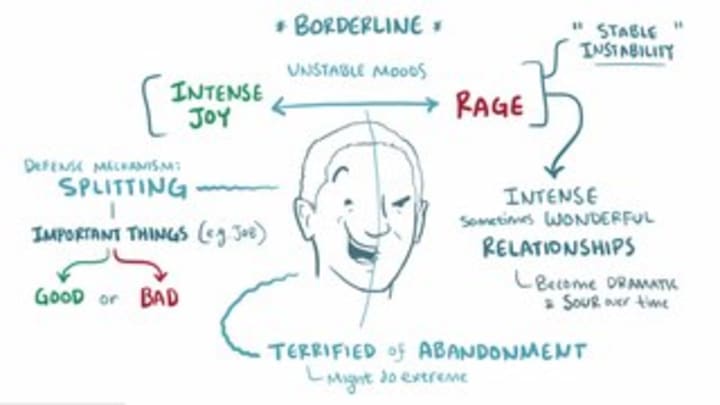
After an episode, BPD returns back to a more stable sense of self and the pattern of abusive, co-dependency recycles. The friend, parent, child, or partner resumes living, timidly, afraid of the next episode and adheres to a life of catering to BPD, trying to keep the peace, and the triggers at bay. The problem is the actual triggers are any little thing and the manifested triggers in episodes create a constantly moving goal post. For a game you will never win.
Borderline personality disorder falls under a category called Cluster B. Cluster B personality disorders are characterized by dramatic, overly emotional or unpredictable thinking or behavior. They include antisocial personality disorder, borderline personality disorder, histrionic personality disorder and narcissistic personality disorder. Typically there is much blur between these four and as such it can be terribly hard to diagnose.
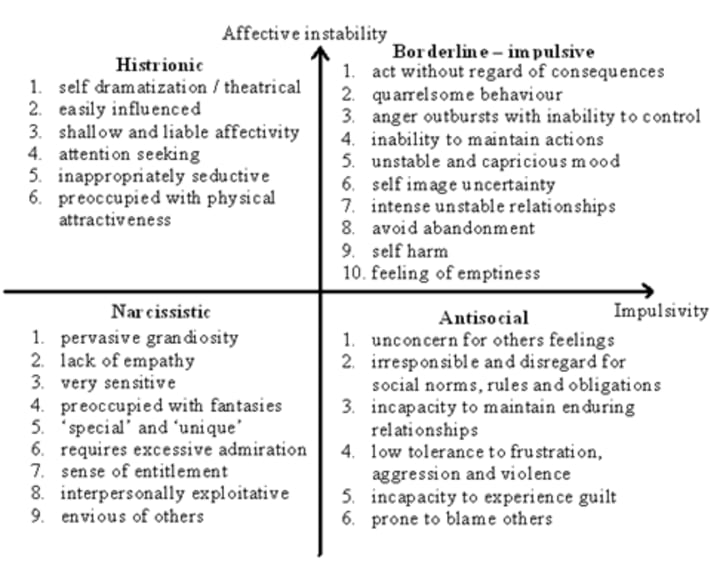
The other issue with such personality disorders is they are not fixed with a little pharmaceutical. If you can even receive a proper diagnosis (people under Cluster B are just fine and have no issues, they are the victim of YOUR issues and as such rarely seek treatment), they require rigorous, specialized therapy such as Dialectal Behavior Therapy and are never really cured. Like Cancer, they may hope to achieve remission…

Another thing to note with borderline is there is a shifting sense of self, negative self-image, chronic feelings of emptiness, and lack of core values. With this, BPD will often merge and amass the interests and beliefs of those they are close with, those they are trying to replicate so to speak. As an extreme attachment disorder, BPD wants so very much to be loved, cared for, and unnoticed as having such flaws. As such they will mirror very closely the picture to most of a stable, sensible human, thus working against hope of a proper diagnosis. In term of diagnosis, BPD is often even misdiagnosed in men as depressive disorder.
This mis-characterization is challenging as the answer for the above diagnosis is typically medication, which is ultimately ineffective in treating the disorder for the person with BPD and thus the trauma to those around continues.
Do you have a therapist? Did you know your therapist likely has a diagnosis for you? Did you know all you have to do is ask? Of course as stated above, if you are only sharing with your therapist what you want them to know, or in the case of BPD, a distorted reality which you believe to be true, you may not receive a proper diagnosis. I started to wise up to this in early 2020. I was watching Crazy Ex Girlfriend and in the show the main character is diagnosed with borderline personality disorder. “How does one receive a diagnosis? Wow…I went on to ask my therapist. All you have to do is ask. My diagnosis for example is anxiety disorder with PTSD with the ability to trigger depression. Well at least I am not borderline….wait, hold my gluten free beer.
If someone has lived with Cluster B personality disorders and experienced a trauma bond in an intimate relationship (read: close friend, partner, child, parent, etc.) characteristics of Cluster B will rub off. It is virtually impossible to have experienced such trauma, abuse, and exposure without adapting to your environment. As I touched on in my piece on Gaslighting (Cluster Bs are amazing gaslighters), many of the actions are not intentional. Cluster B residents started out just like you are I. They experienced emotional instability as children and likely abuse. Typically sexual abuse. Trauma happened and the experiences which followed began to solidify a personality disorder which unfortunately continued well into adulthood. See, it really isn’t their fault! I digress…
A victim, so to speak, BPD looks to connect with someone who will meet their emotional needs. In a romantic relationship for example, they may come on strong and quick. They work hard to show the best versions of themselves and win over the love of their potential partner. Around all the time, and moving “fast,” the romance is a whirlwind! And the person on the other side of this equation is typically equally damaged…just in a very different way. (Read: Patterns) The person on the other side is typically an empath. In love with the idea of love. Looking for a relationship to rescue, transcend, and be all those amazing things we grew up seeing in movies. Things maybe you didn’t have as a child. You may think you won the lottery! But remember, taxes are always due on that “win” eventually…
So what is the resolve? As support groups would tell you, the simple answer is to run. But this doesn’t work when you have a BPD child or parent, a relationship you cannot simply drop. Much improvement has been found with Dialectal Behavior Therapy, a type of cognitive-behavioral therapy. It’s main goal is to teach people how to live in the moment, develop healthy ways to cope with stress, regulate their emotions, and improve their relationships with others. DBT is hard work. It is not a pill and it is not a cure. It is a lifelong process of treatment and recovery. When I see people suggesting you “run” from BPD, the empath in me struggles as isn’t everyone deserving of love? And I think the answer is yes. But you cannot help someone who cannot help themselves. And you cannot love someone who does not love themselves, as they cannot reciprocate love. Your efforts are futile and those taxes are a royal bitch when they come to collect. Like the old saying says, you can lead a horse to water but you cannot make them drink. What you can do is take steps to improve communication, set healthy boundaries, and stabilize your relationship. Here are some tips from HelpGuide:
Realize the person with BPD or uBPD (undiagnosed borderline personality disorder) is in intense emotional pain. The destructive and hurtful behaviors are not about you. Learning about BPD will not solve the problem but it will help you understand what you are dealing with and attempt to manage it in constructive ways. Recognizing the signs and symptoms of borderline personality disorder is not always easy. BPD is rarely diagnosed on its own, but often in conjunction with co-occurring disorders such as depression, bipolar disorder, anxiety, an eating disorder, or substance abuse. Your family member or loved one with BPD may be extremely sensitive, so small things can often trigger intense reactions. Many people in a close relationship with someone who suffers from BPD often know that there’s something wrong with their loved one, but have no idea what it is or if there is even a name for it. Learning a diagnosis of borderline personality disorder can come as a source of both relief and hope.
In your relationship:
Do you feel like you have to tiptoe around your loved one, watching every little thing you say or do for fear of setting them off? Do you often hide what you think or feel in order to avoid fights and hurt feelings?
Does your loved one shift almost instantaneously between emotional extremes? For example, are they calm one moment, raging the next, then suddenly despondent? Are these rapid mood swings unpredictable and seemingly irrational?
Does your loved one tend to view you as all good or bad, with no middle ground? For example, either you’re “perfect,” and the only one they can count on, or you’re “selfish” and “unfeeling” and never truly loved them.
Do you feel like you can’t win: that anything you say or do will be twisted and used against you? Does it feel as if your loved one’s expectations are constantly changing, so you’re never sure how to keep the peace?
Is everything always your fault? Do you feel constantly criticized and blamed for things that don’t even make sense? Does the person accuse you of doing and saying things you never did? Do you feel misunderstood whenever you try to explain or reassure your partner?
Do you feel manipulated by fear, guilt, or outrageous behavior? Does your loved one make threats, fly into violent rages, make dramatic declarations, or do dangerous things when they think you’re unhappy or may leave?
If you answer “yes” to most of these questions, your partner or family member might have borderline personality disorder. When a family member or partner has borderline personality disorder, it’s all too easy to get caught up in heroic efforts to please and appease him or her. You may find yourself putting most of your energy into the person with BPD at the expense of your own emotional needs. But this is a recipe for resentment, depression, burnout, and even physical illness.You can’t help someone else or enjoy sustainable, satisfying relationships when you’re run down and overwhelmed by stress. As in the event of an in-flight emergency, you must “put on your own oxygen mask first.” (I recall hearing about oxygen masks on a plane a as a child and recall it sounding selfish. How would I help myself first, selfishly, before someone else? I wish I could see the writing on the wall, then.) What you can do when things are calmer:
- Avoid the temptation to isolate. Make it a priority to stay in touch with family and friends who make you feel good. You need the support of people who will listen to you, make you feel cared for, and offer reality checks when needed.
- You’re allowed (and encouraged) to have a life! Give yourself permission to have a life outside of your relationship with the person with BPD. It’s not selfish to carve out time for yourself to relax and have fun. In fact, when you return to your BPD relationship, you’ll both benefit from your improved perspective.
- Join a support group for BPD family members. Meeting with others who understand what you’re going through can go a long way. If you can’t find an in-person support group in your area, you may want to consider joining an online BPD community.
- Don’t neglect your physical health. Eating healthfully, exercising, and getting quality sleep can easily fall by the wayside when you’re caught up in relationship drama. Try to avoid this pitfall. When you’re healthy and well rested, you’re better able to handle stress and control your own emotions and behaviors.
- Learn to manage stress. Getting anxious or upset in response to problem behavior will only increase your loved one’s anger or agitation. By practicing with sensory input, you can learn to stay calm and relaxed when the pressure builds.
Above all else: Don’t ignore self-destructive behaviors and suicidal threats. If you believe your loved one is at an immediate risk for suicide Do NOT leave the person alone. Call your loved one’s therapist or:
In the U.S., dial 911 or call the National Suicide Prevention Lifeline at 1-800-273-TALK.
In other countries, call your country’s emergency services number or visit IASP to find a suicide prevention helpline.
At the end of the day, being on the receiving end of borderline can be scary and confusing. I have heard it described as a fog, and like a fog it can be hard to see clearly when you are stuck in one. If you have borderline, you are not alone. If you love someone with borderline, you are not alone. The stigma associated with BPD is often one reason people do not seek the help they need. NAMI suggests an estimated 1.4 percent of the U.S. population struggles with BPD and that number is underreported because men with BPD are often misdiagnosed.
If you are into Pop Culture, some fun/depressing films or TV shows to reference may be: Girl, Interrupted, The King of Staten Island, Crazy Ex Girlfriend.

Pete Davidson has recently been vocal about his struggles with BPD
When dealing with mental illness, know you may be in a fog. Know you may not be seeing things clearly. Learn to practice the three C’s: I didn’t cause it, I can’t cure it, and I can’t control it. At the end of the day you can rationalize it, make excuses for it, and deny it all you want. You can even delay the inevitable…but the inevitable remains: those taxes will become due. You get to decide how late you file and how much penalty you incur in the process with how much you delay.
Peace, love, solidarity. ✌ CKP
About the Creator
Christina K. Pierce
Single mama of two living in Boston's Back Bay.
Mindful AF ♋
Seeker of butterflies 🦋
Acknowledger of synchronicities ♾
Manifester 🧘♀️
High viber 💓
Craft beer drinker 🍻
www.mindfulAFmama.com
IG: @SingleMamaMagic
Keep reading
More stories from Christina K. Pierce and writers in Psyche and other communities.
Smelling fucking gas
It was 2020 when I first delved into the textbook meaning of the term “gaslighting.” The term has had a resurgence throughout Trump’s four years in office, creating a pop culture reference along the same lines as “fake news” so much so Anderson Cooper even created a special entitled “We will leave the gaslights on for you” about dishonesty amongst politicians. But what exactly is gaslighting? Are you a gaslighter? Have you been in an abusive relationship and a victim of gaslighting? If you are reading this, odds are yes. Aside from Trump and politicians, gaslighting was coined as far back as the 1940s when British playwright Patrick Hamilton wrote Gas Light which developed into a popular film. Let’s explore, shall we?
By Christina K. Pierce5 years ago in Psyche
Top tipple tricks
Been thinking a lot about drinking, lately. Not least because of a recent episode of over-indulgence and the inevitable after effects. Some readers may recall the earlier articles I wrote about beating the booze. Here I set out an experiment in techniques for cutting down on my alcohol intake. The experiment was successful, the techniques worked, and I have armed myself with an arsenal of weapons in the war against the demon drink. I have yet to fire the first round however. It's all a question of timing (perhaps procrastination).
By Raymond G. Taylor4 days ago in Psyche
The Quiet People Are Always Observing
The Quiet People Are Always Observing People often misunderstand quiet people. They assume silence means emptiness. They think a person who speaks less must have fewer thoughts, fewer opinions, or less confidence. In loud rooms, the quiet ones are easy to overlook. They sit slightly back from the center of the conversation, listening while others fill the air with stories, arguments, and laughter. But what most people don’t realize is that quiet does not mean unaware. Quiet often means observing. I used to think there was something wrong with me because I wasn’t the loudest person in the room. In school, the confident students were the ones who raised their hands first, spoke quickly, and seemed comfortable sharing every thought that crossed their minds. Teachers praised participation. Friends admired charisma. Meanwhile, I often found myself listening more than speaking. At first, it felt like a weakness. I wondered why my mind worked differently. While others talked freely, I was usually watching the details — the small pauses in conversation, the slight change in someone’s tone, the way a smile didn’t quite reach someone’s eyes. Over time, I began to realize something strange. The quieter I was, the more I noticed. People reveal a lot when they believe no one is paying attention. The friend who laughs loudly at every joke but becomes silent when the conversation shifts to their own life. The coworker who speaks confidently in meetings but nervously taps their fingers when someone questions them. The person who says “I’m fine” while their voice carries a quiet heaviness. These details rarely appear in loud conversations. They appear in the spaces between them. Quiet people tend to live in those spaces. While others focus on what they want to say next, observers focus on what is actually happening. They notice patterns in behavior. They sense tension before anyone mentions it. They understand emotions that people try to hide behind casual words. It’s not a special power. It’s simply what happens when someone spends more time listening than speaking. At some point, I began to understand that silence had given me something valuable. Perspective. When you are not constantly trying to control a conversation, you begin to see it more clearly. You notice who interrupts others. You notice who encourages people to speak. You notice who listens, and who only waits for their turn to talk. You begin to understand people in a different way. Loud personalities often dominate attention, but quiet observation reveals character. Some of the most revealing moments in life are incredibly subtle. A quick glance between two people. A long pause before answering a simple question. A nervous laugh that hides discomfort. These small signals say more than long speeches ever could. Of course, being observant has its challenges too. Sometimes you see things others miss — tensions in relationships, hidden insecurities, or unspoken conflicts. You may notice when someone’s confidence is fragile even though everyone else believes they are strong. And once you see these things, you can’t easily ignore them. Observation creates understanding, but it can also create loneliness. When you understand people deeply, you sometimes realize how rarely people understand each other. But there is also something quietly beautiful about it. Observant people often become the ones others trust most. Because when they finally speak, their words carry weight. They are not speaking simply to fill silence; they are speaking because they have truly considered what they want to say. And people can feel that difference. Quiet people may not lead every conversation, but they often understand the room better than anyone else. They know when someone is uncomfortable. They notice when someone feels excluded. They recognize when someone is pretending to be okay. Because they have been watching. In a world that celebrates constant noise and endless opinions, silence can seem invisible. But silence is not empty. Silence is where awareness grows. Some of the most thoughtful people in the world are not the ones who speak the most — they are the ones who observe carefully, think deeply, and choose their words with intention. The truth is, quiet people are rarely disengaged from what is happening around them. If anything, they are often the most present people in the room. They see the things others miss. They hear the meaning hidden behind casual words. And while the world may overlook them at first, the quiet observers often understand far more than anyone expects. So the next time you notice someone sitting quietly during a conversation, don’t assume they have nothing to say. They may simply be watching the story unfold. And chances are, they understand it better than anyone else.
By Faizan Malika day ago in Psyche




Comments
There are no comments for this story
Be the first to respond and start the conversation.