
Ketamine vs. SSRIs: Which Works Faster for Depression?
Exploring the Fastest-Acting Antidepressant: How Ketamine Compares to SSRIs in Speed, Effectiveness, and Treatment for Depression

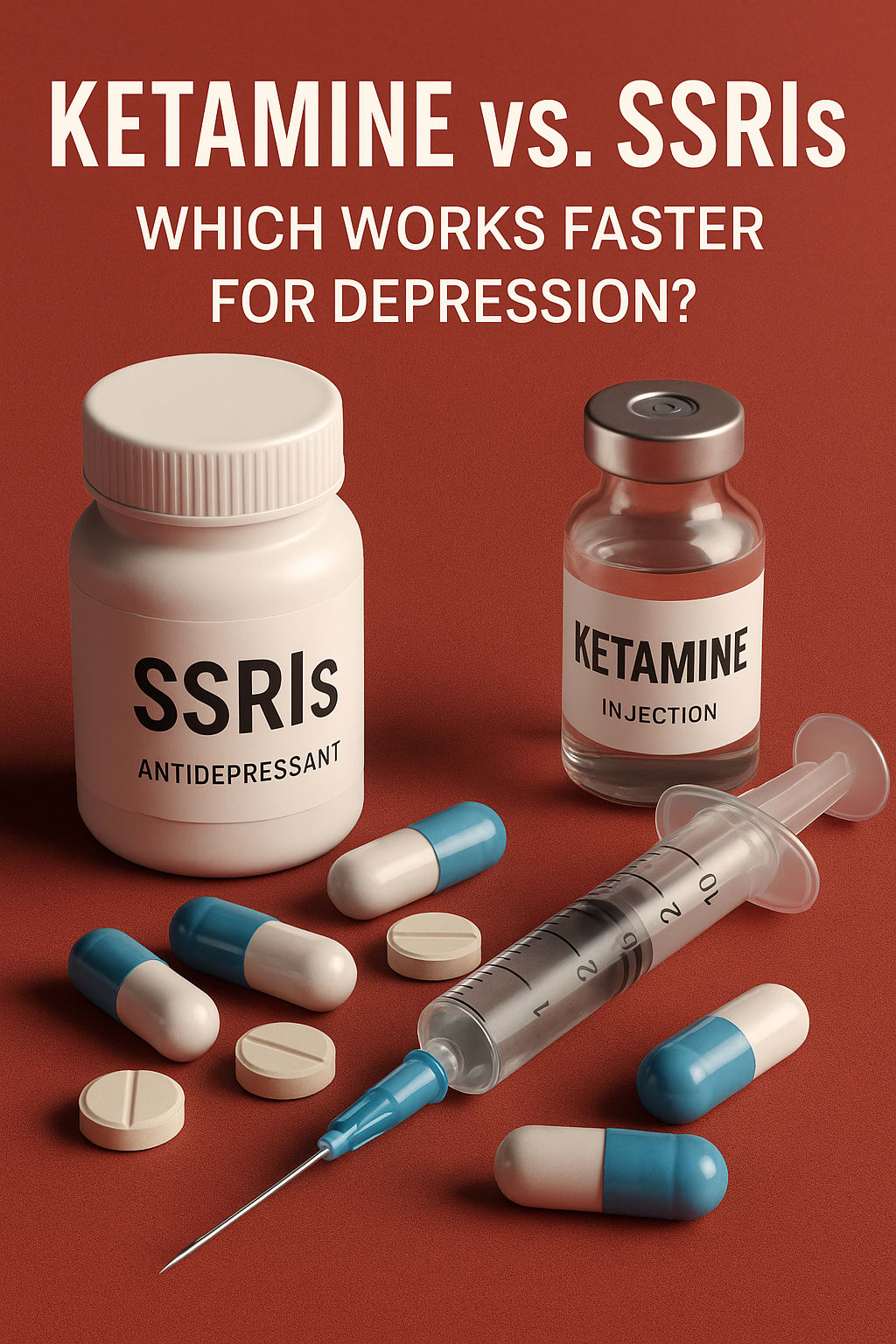
Depression is more than just feeling down. It can crush motivation, ruin relationships, and dull every part of life. For millions, antidepressants offer a path back—but not all antidepressants work the same way, and not all of them work quickly. When someone is deep in the grip of depression, especially with suicidal thoughts, time becomes a critical factor.
That’s where the debate between ketamine and SSRIs becomes especially relevant.
Both are used to treat major depressive disorder (MDD). Both can relieve symptoms. But when it comes to how quickly they work, the differences are striking.
Let’s break it down in depth.
Understanding SSRIs: The Traditional Route
SSRIs, or Selective Serotonin Reuptake Inhibitors, are one of the most commonly prescribed classes of antidepressants. Names you’ve likely heard—Prozac, Zoloft, Lexapro, Celexa, Paxil—all fall under this umbrella.
How They Work:
SSRIs increase the amount of serotonin, a neurotransmitter associated with mood regulation, in the brain. They do this by blocking the reabsorption (or reuptake) of serotonin into neurons. The idea is simple: if serotonin lingers longer in the brain, mood may gradually improve.
But There's a Catch:
SSRIs take time to show results. Weeks, sometimes months. On average, it takes 4–6 weeks for most patients to feel a noticeable improvement in symptoms. Some report small changes earlier, but meaningful relief can be elusive at first.
In the meantime, some patients experience side effects—nausea, insomnia, restlessness, headaches, or even a temporary worsening of depression. These early discomforts can make the wait even more difficult.
Why the Delay?
SSRIs don’t directly “fix” the brain. They slowly change the chemical environment. Their true antidepressant effects are believed to stem from longer-term changes in brain plasticity, not just serotonin levels. They help nudge the brain into a new pattern of functioning, but that process requires time—like trying to reroute a river.
Enter Ketamine: The Disruptor
For decades, ketamine was known primarily as a surgical anesthetic. In other circles, it was recognized as a club drug ("Special K"). But in recent years, ketamine has reemerged with remarkable potential in psychiatry, especially for treatment-resistant depression.
How Ketamine Works Differently:
Rather than working on serotonin, ketamine targets the glutamate system—specifically, the N-methyl-D-aspartate (NMDA) receptors. Glutamate is the brain’s most abundant excitatory neurotransmitter and plays a central role in synaptic plasticity, memory, and learning.
Ketamine blocks NMDA receptors, triggering a surge in glutamate. This sudden increase activates AMPA receptors, which then stimulate brain-derived neurotrophic factor (BDNF)—a protein that supports neuron growth and connectivity.
In short, ketamine encourages the brain to form new neural pathways quickly—which may explain its rapid antidepressant effects.
Speed of Relief: Ketamine vs. SSRIs
When you're drowning in depression, waiting even a few more days can feel impossible. This is where ketamine changes the conversation.
What the Evidence Shows:
SSRIs: Clinical trials consistently show a delayed onset of action. Some patients begin to feel minor improvements within two weeks, but full response often takes four weeks or more.
Ketamine: In contrast, patients often report a significant reduction in depressive symptoms within hours to days after their first dose.
In a groundbreaking 2006 study from the National Institute of Mental Health (NIMH), a single low-dose intravenous ketamine infusion showed rapid antidepressant effects within 4 hours, with peak effects around 24 hours.
Follow-up studies reinforced these findings, with many patients experiencing relief from suicidal thoughts within hours of treatment—something no SSRI can claim with the same certainty or speed.
Why the Difference?
SSRIs aim to rebalance chemicals over time. Ketamine appears to reset brain circuits—disrupting entrenched patterns of negative thinking and emotional pain in real-time.
For someone in crisis, that speed can be lifesaving.
Duration of Effect: The Other Side of the Coin
Ketamine’s quick action is impressive—but it’s also not permanent.
Most patients need multiple doses to maintain relief. A typical course might include 6 infusions over 2 to 3 weeks, followed by maintenance treatments every few weeks or months.
SSRIs, in contrast, are designed for daily, long-term use. Once they begin working, their effects can be stable for years with consistent use. This makes them a better fit for chronic maintenance, while ketamine might serve as an intervention tool or part of a multi-pronged treatment plan.
Side Effects and Risks: A Complex Comparison
Ketamine Risks:
- Dissociation: Patients often experience out-of-body sensations during infusions.
- Elevated blood pressure and heart rate: This requires monitoring during administration.
- Potential for abuse: Though medical ketamine is given in controlled settings, its abuse potential outside the clinic is real.
- Unknown long-term effects: We’re still learning about the consequences of prolonged ketamine use in psychiatry.
SSRI Risks:
- Initial anxiety or agitation in some users.
- Sexual dysfunction, weight changes, and sleep issues.
- Serotonin syndrome, a rare but dangerous condition from too much serotonin.
- Withdrawal symptoms if stopped abruptly.
Importantly, while SSRIs carry fewer concerns about abuse, they can be ineffective for some people. Around 30% of patients do not respond adequately to any SSRI they try. This is known as treatment-resistant depression, and it's the population for whom ketamine shows the most promise.
Cost, Access, and Practical Realities
Cost is a key issue. SSRIs are often covered by insurance and available in generic forms for as little as a few dollars per month. Ketamine therapy, by contrast, can cost hundreds to thousands of dollars, depending on the clinic and treatment plan. Insurance coverage is limited, especially for off-label intravenous use.
Additionally, SSRIs are easy to prescribe. Any primary care physician can write a script. Ketamine treatments, however, are typically administered by specialized clinics, under close supervision, requiring more time and logistical planning.
When Should Ketamine Be Considered?
While ketamine isn't a first-line treatment for mild to moderate depression, it becomes a strong candidate in several situations:
- Treatment-resistant depression: After failing two or more antidepressants.
- Severe depression with suicidal thoughts: Where immediate action is critical.
- Patients needing rapid stabilization: For functional, social, or professional reasons.
In many cases, ketamine serves as a catalyst—lifting a patient out of crisis so they can engage in therapy, lifestyle changes, or begin other medications.
Final Verdict: Which Works Faster?
Ketamine, unequivocally.
It often provides rapid, near-immediate relief, especially for those who haven’t found success with traditional antidepressants. While SSRIs remain essential tools in mental health care, they simply can’t match ketamine in terms of speed.
That said, ketamine isn’t a silver bullet. Its effects fade without ongoing care, and its long-term safety profile is still evolving. SSRIs, while slow, are stable and reliable for many. The best outcomes may come from combining both approaches—using ketamine to disrupt the spiral of depression and SSRIs (plus therapy) to maintain the gains.
Ultimately, treatment should be personalized, based on history, biology, and needs. The good news is: you have options. And having choices, in the face of depression, is the first step toward hope.
About the Creator
Richard Bailey
I am currently working on expanding my writing topics and exploring different areas and topics of writing. I have a personal history with a very severe form of treatment-resistant major depressive disorder.
Keep reading
More stories from Richard Bailey and writers in Psyche and other communities.
How to Create a Mental Health Emergency Plan Before You Need One
Mental health crises can be sudden, intense, and overwhelming — making it difficult to think clearly or make safe decisions in the moment. That’s why having a mental health emergency plan is not just smart; it’s essential.
By Richard Bailey10 months ago in Psyche



Comments
There are no comments for this story
Be the first to respond and start the conversation.