
Is ADHD… trendy?
A quick dive into the increase of ADHD diagnoses in recent years.


An ADHD Pioneer
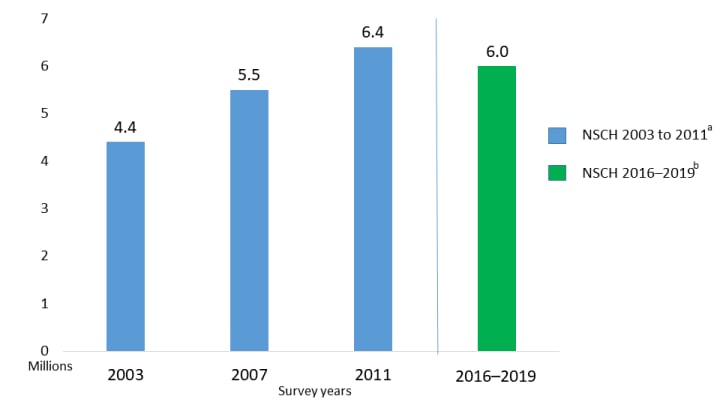
I was 12 years old when I was diagnosed with what is now known as Classic ADHD. Not only was it a rare diagnosis for the times, In 2003 only an estimated 4.3% of children aged 4-17 years were reported to have ever had an ADHD diagnosis, but also in the fact that I was female.
Though reportedly an “adequate student”, I was displaying behaviors that my teacher found bizarre enough to call attention to. Excessive talking, time management issues, inability to self start and anxiety were among the main concerns. Essentially, my teacher saw me struggling to maintain control and concentration (and becoming discouraged when I failed) and bravely decided to speak up during a routine parent teacher conference. Thankfully, my mother was receptive to these concerns and took them seriously. Within a few weeks I was tested and diagnosed, given a low dose of medication and sent on my way.
Looking back, I do remember not really understanding my social and academic inadequacies, but I never felt as though it held me back. I had friends, I wasn’t teased or isolated, but I was aware that I never seemed to fit in exactly the same as others. Not to mention, I didn’t know another female my age with the same diagnosis. My mom, a single parent of four aged 12 to 23 who worked full time, remembers noticing some “quirks” but chalked it up to me being the youngest and only girl in a family consisting of three rambunctious brothers. Needless to say, if it weren’t for my teacher, there’s no telling how the remainder of my school years would have played out. The medication was a low therapeutic dose that I remained on until my sophomore year of high school. During my time on the medication, there was a drastic difference in my productivity and I was able to delegate tasks and complete them from start and finish (an unheard of feat prior to my diagnosis) but as I got older, I knew I didn't want to rely on medication forever. I opted to stop my regular dose and instead attend therapy, where I learned skills to help me manage my condition. It was a success and I assumed, along with my doctor and mother, that I had grown out of it. Ten years later, I would be proven wrong- and research would show that I was certainly not alone.
The Rise of ADHD Diagnoses
Data collected by the CDC annually from 1997 to 2016 saw about a 67 percent increase in ADHD diagnosis in children and adolescents (ages 4 to 17), rising from 6.1 percent in 1997–1998 to 10.2 percent in 2015–2016. This increase was seen across the board, regardless of sex, race, ethnicity, family income, and geographic location-although it did vary slightly among these subgroups. So what’s with these growing numbers? According to a study published in JAMA in 2018, Increased awareness of the disorder and access to adequate treatment could be the key factors.
Understanding the Disorder
Experts reference several reasons for the rise in ADHD, including an increase in healthcare access. The study credits the Affordable Care Act with widening access and helping people, especially minorities and those in lower-income communities, access testing and other important services that were not available to them prior. But mainly, t hese experts believe that a better understanding of the disorder in general is behind the growing numbers. In their eyes, between the increase in public awareness and Doctors understanding the disorder in more detail, the increase shouldn't be a shock.
In addition to a general increase in knowledge about ADHD, we’ve also come to better understand how the condition presents itself in girls in particular. While boys are still diagnosed with ADHD more than twice as often as girls (14 percent of boys vs. 6.3 percent of girls), according to this recent study, the rate at which girls are diagnosed has doubled in the last 20 years from 3.1 percent to 6.3 percent (the rate in boys increased from 9 percent to 14 percent). This gap tracks with the increased understanding of ADHD in girls versus boys. While ADHD looks drastically different in every child, according to experts, its presentation in males vs. females is palpable. That is to say, boys classically demonstrate noticeable hyperactivity, while girls often exhibit their ADHD in less obvious, more subdued ways.
And though these aspects sound positive, growth and understanding, some experts are worried that this p articular study reflects an over diagnosis of ADHD in the U.S.
The Issue with Public Knowledge
There's no simple test to determine whether or not someone has ADHD, but a specialist can make a diagnosis after an in depth and detailed assessment, which often includes several combined sources- A physical examination (which can help rule out other possible causes for the symptoms), a series of interviews or reports from the individual as well as from significant people (such as partners, parents and teachers) and academic assessments are often used in the process. An accurate diagnosis takes time and patience, which leads experts to believe that several professionals are not taking the time needed to diagnose properly.
The same public knowledge that has led to a better understanding of this disorder, has also increased the likelihood of inaccurate and hasty diagnoses. Many non-specialists—pediatricians for kids and general practitioners for adults—are approached with parents and individuals seeking an ADHD diagnosis daily. With an extremely short evaluation, and especially given the increased recognition of the disorder these days, it's very possible that ADHD is a convenient diagnosis for people with other conditions, such as depression or anxiety.
Doctors analyzing the study suggest that the diagnostic rates that were reported seem high.
What we DO know is that ADHD is caused by both a mix of genetic and environmental factors and the interactions between those things. But there is no evidence to suggest that children are at greater risk of ADHD today than they were 20 years ago.
So, Where Does This Leave Us?
It's hard to say.
These days, with TikTok and other social media outlets overgeneralizing mental health conditions and spreading misinformation, we are at a greater risk than ever when it comes to over diagnosing an already stigmatized disorder.
But as stated above, without further research, we don’t yet have the full scientific picture as to why the numbers have increased so significantly. We just know that we need to get better at figuring out why people develop ADHD and how to properly diagnose it- while also making sure we’re not over- or mis-diagnosing it. A task that may be easier said than done.
What do you think? Did an increase in knowledge lead to better understanding thus more diagnoses? Or has the disorder been over generalized and poor testing has led to the rise?
About the Creator
Keep reading
More stories from Samantha Dunn and writers in Psyche and other communities.
As a Neuroscientist, I Quit These 5 Morning Habits That Secretly Destroy Your Brain
The First Hour Controls Everything : During a neuroscience workshop I attended hosted by researchers affiliated with Harvard University, one sentence completely changed my perspective on daily life: “The first hour after waking up determines your brain’s chemistry for the rest of the day.” At first, I thought that sounded dramatic. But the deeper I studied brain science, the more I realized something uncomfortable: Most of us are unknowingly damaging our brain every single morning. Not through drugs. Not through trauma. Not through disease. But through small, repeated habits. And because these habits feel “normal,” we never question them. Over time, I decided to experiment on myself. I removed five common morning behaviors — and the cognitive changes were undeniable. Here are the five morning habits I quit — and why neuroscience suggests you should reconsider them too.
By Shahid Zaman5 days ago in Psyche


Comments
There are no comments for this story
Be the first to respond and start the conversation.