
Today determines the course of the rest of my life. I wish this were hyperbole, but it’s absolutely and devastatingly true.
I could walk away changed. Or I might not walk away at all; if I fail, I have resolved to swallow an entire bottle of generic aspirin and die splayed across the shelves of the basement archives, my tears staining some original steamer blueprints, or a Muybridge plate. More likely my body would end up stiffly balanced across a stack of yellowed newspapers from the last fifty years, but I like to think our library has more cultural significance than just that.
I shall die with my eyes open, so that the librarian that descends the stairs in pursuit of the rotting source will know-- in the poetry of her librarian heart-- that I died staring into the abyss of what might have been. I begin to wonder if discovering me would inspire her to write her own speculatory novel on my death, but I shut down the thought. I can’t consider failure. Any more than I have already, I mean.
It takes my entire shoulder to combat the fortresslike oak of the library doors. I brace against it, leveraging pathetically. My earbuds are blaring Cat Stevens, and I hope my strain wasn’t audible. The only thing more shameful than watching my rubbery white arms feebly exert against the door would be being heard whimpering or groaning during the attempt. I adjust an earbud and peer surreptitiously over my shoulder. The library’s neighboring business, a small commercial gym, has no witnesses idling in the parking lot. With help from the protruding knob of my hip, the door has enough momentum to duck through. The library entry smells like disinfectant and damp earth.
In my backpack are three items: the generic bottle of aspirin, a 1.5 point black felt tip pen, and a smart moleskin journal, unruled, in an earnest shade of brown. The aspirin rattles with every step, and my entrance is punctuated with hollow maraca beats.
A librarian-- the one with the grey hair that tries to be blonde-- roves her eyes away from her computer screen to my approach. I think she will remark on my percussive cargo, and I prepare to say something about Mike & Ikes. And having a lot of them. In my backpack. For my friend’s-- birthday?
Warily, her eyes flick to my boots. I look down. I have tracked blotches of snow into the foyer, curling little imprints like remnants of funnel cake. Wordlessly, I stomp in place a few times, loosening the remaining stowaways. I make a big mess in the center of the library instead of trailing a series of small messes across it.
Satisfied, the librarian returns to her blue screen.
As I stride past the desk, my plastic bus card tumbles in my coat pocket. I reach into the pouch to finger the twenty-dollar bill there, reassured by that inimitable texture of cash. The twenty was a last minute touch, and an optimistic one; if everything went well-- if everything went swimmingly-- I could buy the Library Girl and I a cruller. Or an ice cream. Or a Coke. I wrack my brain for a date food that isn’t contrived and is seasonally appropriate. Hot chocolate, maybe.
I want to tell the Library Girl that she is the “curling birch of January,” something I wrote in my notebook margins a few days prior, but I’m afraid that she won’t know what I mean. Or that the metaphor is too convoluted. Or maybe she’d just scream and scream until I went away.
The Library Girl is singularly fascinating. She has dense, horse-like yellow hair, and despite its apparent thickness, it is wavy and coarse, and appears to skim her shoulders weightlessly. Her skin is the sort of Victorian ivory that would be utterly compromised from any minor exposure to the sun; I concluded this from the observation that she always closes the large wooden shades before she settles into the armchair by the window, no matter how distilled the light outside. She seems to endeavor to cover most of her body, even in the doldrums of summer, donning boxy pullovers and long skirts that appear handsewn, forged of unlikely patterns and with slightly deviant seaming. I have long been attentive to the way the fabric drapes down the armchair upholstery as she sits cross-legged and barefoot, reading, appearing to levitate while doing so. She seems to favor this particular armchair-- she is reliably settled into it each time I visit-- and, on the few occasions it was otherwise occupied, she paced the aisles with an air of ire, waiting out the interlopers.
Her face, lovely and perpetually startled in my memory, is eggshell-smooth and equally round, with a broad forehead and eyes that bulge becomingly from her skull, like some knowing nocturnal creature.
I spoke to her only once before, four months ago, asking to be lent a bookmark (of all things), in a pitiful compulsion to look down into her eyes, which I then learned were mahogany-colored. In reply, she had shaken her head once, holding my gaze for a tantalizing moment, and then bowed her attention back to the tome in her lap. This experience, although desperate and uncomfortable, did prove to be the cincher for my passion for her.
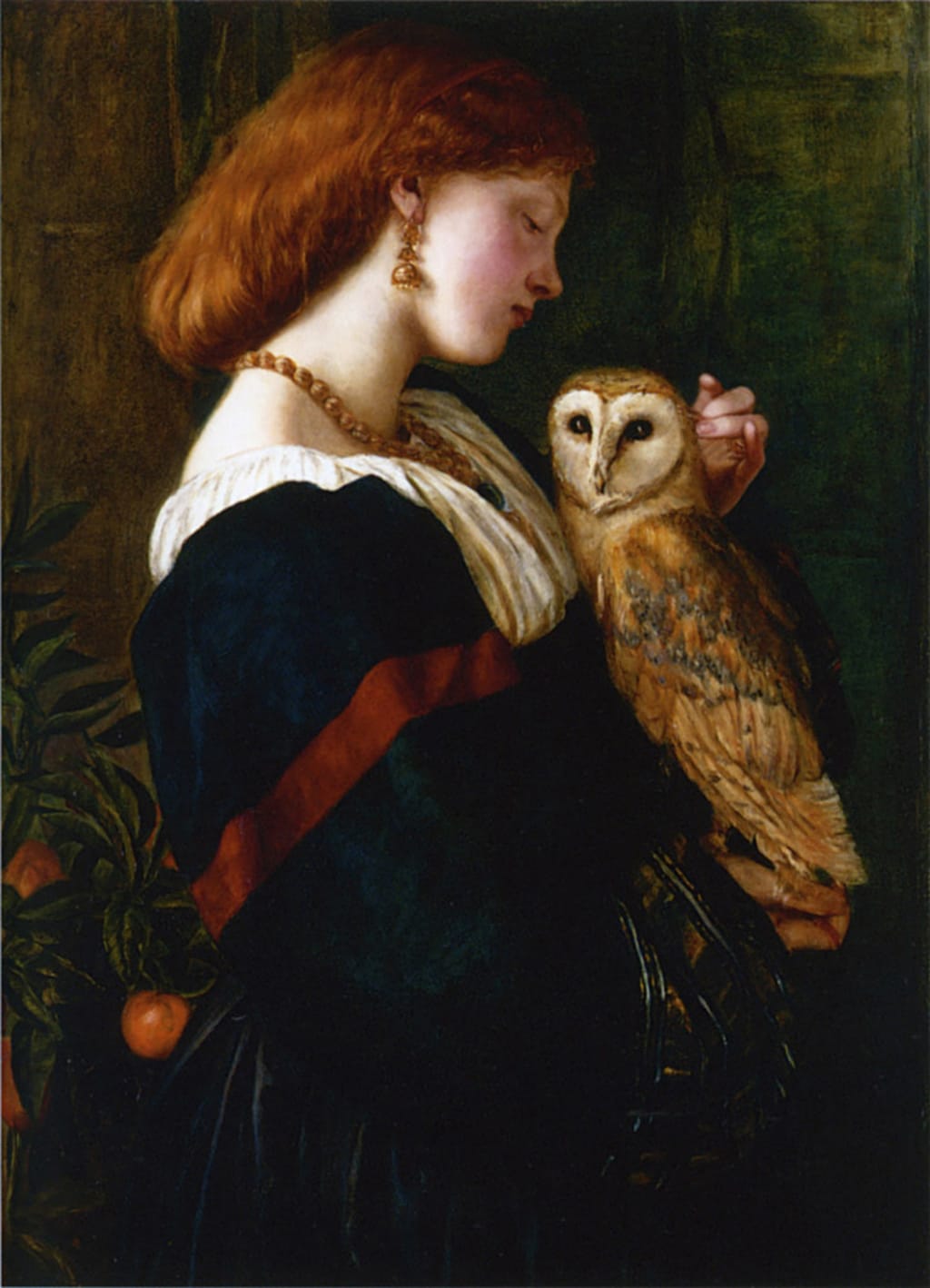
Her particular interest on that rainy afternoon had been art history, Pre-Raphaelite, and I had stolen a glance down at the portrait she had been intensely studying before I shrank away. A depiction of a copper-haired noblewoman filled one entire page; posed in profile, with a head slightly cocked, the woman pensively stroked a barn owl that was perched on her upturned opposite hand. A shadowed orange tree flanked her, and a scored and leafy lush green made the background. The shadows and light of the painting were so vibrant that they seemed edible. I was stricken. I wanted to keep looking, but my legs dutifully carried me away.
The moment that that art history volume appeared back on the shelf, I was interrogating it. After a glance at the index, I flipped hastily to the appropriate section, scanning and flicking pages in a frenzy. I felt our only link slipping away with every moment it was not replenished by the sight of the painting, a page still burning from her gaze, warm from her delicate hands.
Then, there it was: Il Barbagianni. The Owl.
I laid in bed that night, turning the image over and over in my mind. I thought of the way she had stared at it, stirred by something in it. We had a tether. Something profound, something unspoken-- an awareness. I was parched. I needed to understand. The barn owl, a symbol of death, and the orange tree, a symbol of love. What did it mean? The woman stroked the owl with austere serenity, accepting her mortality, while the orange tree flourished at her side. Love was death’s antithesis, I decided. Love mitigates mortality. And the Library Girl knew this, too.
Our solitary artistic temperaments had orbited one another in the same library in our grim hometown for years, and my intrigue became bloated, aching, a passion and preoccupation that manifested itself into a permanent stomach ache. I loved her. I loved her singular focus and her self-contained world, longed to diffuse into it in any way that I could.
My fascination for the Library Girl has been the most consistent part of this year. Through the emergence of stubble, an ill-conceived black dye job, my parent’s divorce, and the unveiling of the first chain business in my town-- a Culver’s-- this girl has been my circumpolar constellation, a fulcrum on which other events simply balance. She is predictable, but complex. She is quietly brilliant; completely, to my recollection, nonverbal, and set upon her course with her own momentum. I have watched her as a sailor watches the moon. Our compatibility is prophetic and undeniable.
But fate needs a push. Today is the day that we meet. Or I die. Either way, it must be the last day of bobbing aimlessly in admiration.
I am nearing the Home Improvement and DIY section, and my heartbeat gallops. At the end of this corridor of bright and oversized spines will be the familiar but arresting tableau: Library Girl floating over her armchair, washed in the tungsten glow of a gooseneck lamp, with a nearby table buckling under the weight of her interests. I will walk up to her-- confidently, not too quick, I know she’s easily alarmed-- and…
I stop so abruptly that I nearly pitch forward.
The armchair--her armchair-- appears vacant at the end of the shelves. I say “appears vacant” because I’m staring right at it and there is a decided absence of Library Girl, but this is impossible, because it’s 3:00 p.m. and she is here by 3:00 p.m., exactly, every day, not just a pattern-- a cycle, a certainty, an absolute. And she is absolutely not in this chair.
I am running, closing the last ten feet to the sitting area with panicked abandon. My eyes dart frantically, my mind actively rejecting the visual input. Empty chair. Empty table. No sign of use or interruption or Library Girl, not even a stray flaxen hair on the armrest. The drifting floral aura that usually fills this space is absent, replaced with a mustiness, as if no one has used this space in decades. In her absence, I realize that the sitting area is rendered dated and ugly, colorless and forlorn.
White light streams hatefully through the wooden blinds, stinging me. She hasn’t been here today. Her alcove has been abandoned.
And so have I.
I tell myself that she could be a number of places-- a wedding, or a funeral, or visiting family, or on vacation, or at a goddamn doctor’s appointment, but as quickly as I attempt to pacify myself with possibilities, the maw of despair widens, consuming each rational thought within its shadow because it knows-- and it knows because it feels, intuits-- that she is gone, really truly gone.
I am rattling on to Art and Literature, stumble-running, suddenly lost and disoriented in the maze of my hometown library. I don’t know who else to turn to. I have to consult Il Barbagianni, the oracle. I have to yank on our tether to be able to feel her. I dread the mustiness of the alcove wafting over all memories of her, threatening to dissipate them into objective recollection, and then reduce them to fantasy. I didn’t imagine her. Did I? I didn’t. I couldn’t have.
My fingers rake across the shelves. The volume is there, lying on its side at the end of its typically grouping. An afterthought. Or placed hastily.
I don’t have to look at the index. I gouge my ring finger into the center of the book, peeling it open.
This is where Il Barbagianni was. A jagged stump remains.
I trail my touch down the frill of the tear, where I imagine Library Girl had gripped her, and powerfully liberated her from the pages.
And then they both flew away.
The aspirin on my back seems to rattle louder still with the pounding of my heart. I stare and stare, unseeing; my despair bites pieces from my vision.
The Library Girl and Il Barbagianni.
Love and death.
About the Creator
Keep reading
More stories from Mia Hoffman and writers in Psyche and other communities.


Comments
There are no comments for this story
Be the first to respond and start the conversation.