
I Was On The Brink Of Throwing It All In. Here Are The Signs I Regret Ignoring.
Burnout doesn't always look the way you think it does.

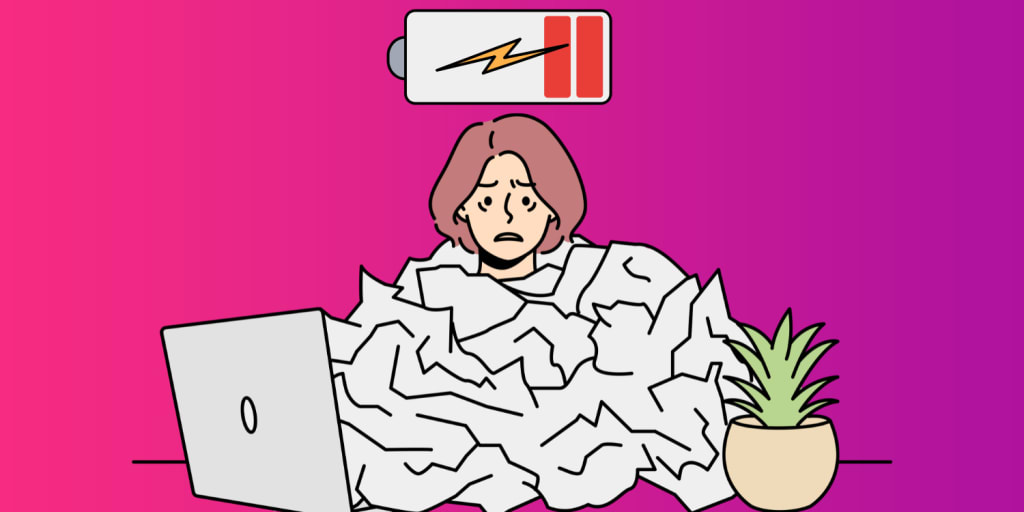
You know when you feel tired and a good sleep seems to fix it?
You know how you get a sore throat and you take the day off work and it turns out fine?
You know how you have sore shoulders, and you get some rest and you're fine?
Yeah, we all know that feeling.
And then there are the days when you feel like crap and it doesn't go away. You're sick. You know something isn't right. Time for the doctor.
If only we had such clarity when we're running a business.
When I was on the brink of walking away from my business, it never felt terminal. It always felt like I was one sleep away from being ok.
And I hate saying it, but I came too close to losing everything. I nearly lost my precious and much-loved writing career because I couldn't see, acknowledge or do anything about the burnout right in front of me.
Almost every day that goes by, I tell myself to stop regretting the fact I never saw the signs.
I don't want you to end up in the situation I found myself in. I consider myself lucky that I caught myself before I couldn't repair the situation.
And you have a chance to catch yourself too.
Here are the signs to pay attention to.
You want some work done, client? Yeah, no!
The demands, the enquiries from new and old customers keep coming in, and guess what you say? No. Nope. Move on.
Even worse is when your existing customer, who needs more from you and is happy to pay for it, asks you. And you still say no.
You have the time, too. It's not a capacity issue. But regardless, you say no.
I remember a former client asked me to write a quick blurb for them. It was about ten to twenty minutes worth of work and it was easy money. Yet, I declined. And without a good reason either. I couldn't tell you why I said no.
All I know is that I didn't want to do the work.
Aren't you meant to be at work?
I always started work at the same time. Even if it meant I had to forgo a shower and breakfast.
I knew it was important to stay consistent with my schedule like I was working at a traditional business. With a traditional boss.
Sometimes these invisible boundaries help you set boundaries when you need them, especially if you suck at self imposing boundaries, too.
But the rigidity I came to know, and others in my life came to rely on, vanished. Sure, you have moments when your schedule goes out the window. They are times in your life and business when you can explain that. Sickness. Extreme busy periods. Holiday preparation.
You can explain those times in which your schedule loses its predictability.
But because we don't clock in to work, so to speak, or have set shift hours like traditional employees, it's easy to miss this change.
Anyone working like this can become oblivious to a shrinking workday. It often takes someone pointing it out before you even know about it.
I can't seem to finish this list
The to-do list keeps growing but you don't seem to tick anything off. Or, for a lot of tasks, they don't make the task list at all.
With no plans to complete these necessary tasks, there is little point in putting them on your list. Why bother? You're not going to get to them. Putting them on the list might be a stark reminder you're not going to get it done, too.
In this situation, tasks are like your customers. They're nothing more than obstacles to finishing your workday, rather than a means to success.
This is how it happened to me. When I was crossing off items on my list, it exercised what I called re-prioritisation. I decided the task was no longer important, or no longer worth my time, so I deleted it from my list.
And if I thought it was still important, I would shift it to another time, another month. That seemed like the wise thing to do.
In reality, I was kicking the can down the road.
How dare you call me?
Once upon a time ago, a customer would ask you to jump on a Zoom call. Or schedule a meeting with you. Or call your phone at an unplanned time. And when they did, you gladly welcome the communication.
It's what you have to do, right? It's part of doing business, so you do it.
But now, this doesn't interest you. Or, like taking on the work, communicating with a customer feels like a hassle.
This applies to everyone else too. Putting on clean clothes to go to a meeting is impossible. Preparing for an in-person meeting seems challenging compared to a quick email reply. It all seems hard, though you don't know why. Especially when it wasn't hard before.
Worst of all, you're not worried that your apathetic approach to their communication will burn bridges. Nor do you care you're guaranteed to lose work and earnings.
I lost a few customers during this time. My usual twenty-four-hour response time on email blew out to two days, accompanied by a decline to help.
It wasn't my finest exhibition of customer service.
Do you have anything original in the idea department?
Where has your originality gone? Have you got anything to say or offer that's uniquely yours?
I kept asking myself that for months. I felt like a robot when I stood back and looked at my writing. Where had my signature style gone?
Everyone knows what a boring version of their profession is. As a writer, I was regurgitating the same old generic advice that something like ChatGPT could've given me. It wasn't inspiring content. It wasn't inspiring anything inside of me, either.
You could say my inspiration for what I offered my customer was in short supply, and my work reflected this.
But this is a direct reflection of your mind, too. You can't see what is new. You don't know what new would actually look like. The creativity doesn't even come to you.
Progress? Do you even know where you're at?
Stats?
Sales?
New customers?
Lost customers?
New followers?
What your customers are saying about you online? Do you have any idea what is happening in your business?
Sometimes, you're so engrossed in what you're doing that the noise of stats and progress means very little to you. This isn't one of those moments.
You're apathetic to your results. It doesn't matter to you. It's like getting on the scales; the pain of knowing where you're at might mean you don't get out of bed in the morning.
But that feeling isn't always so cut and dry. You don't tell yourself you're not going to get out of bed when you look at your results. Yet, when the time comes to check on your results, you make excuses for doing so.
And one of the most prevalent excuses is often claiming not to care about your results. That they don't matter to you. Which is jarring considering you used to care about them. A lot.
Other businesses are doing what?
Once upon a time ago, you could have told anyone what was new in your industry. You could recite the changes, list what society will find cool in the future, and even be a trendsetter. But now, not so much.
If your industry was your specialist subject on Mastermind, you would lose.
And even worse than not knowing is the fact there are people, like you, overtaking you, disrupting what everyone loves about your industry. Their innovation, and your lack of attention, are putting you behind the grind.
During my lapse, I wasn't keeping up with this talk about bots and programs starting to emerge that write content for you. It was way before the current AI dilemma we're facing now.
That aside, as the chatter increased about the future of writing at the time, I had no idea the landscape was changing.
It also meant I had lost touch with my customers, too. As their wants and needs changed, I didn't understand why their interests have shifted. And I had no idea why I suddenly had a different reaction from my readers.
When the signs add up
What all these signs have in common is they are dissociating symptoms. You're trying to pull away from work, pull away from the situation and mentally reject what's happening to you.
But most of us have a problem. One of these symptoms overtaking our professional life doesn't always mean anything.
You can stuff things up. You can decline a customer because you think you don't have enough time. Or because they spoke to you in a rude way.
One sign you can often pass off.
I couldn't have isolated one of these symptoms and assumed I was losing what I loved the most. Or that I was having issues with my work. It wasn't that simple. Hindsight has been far more simple.
Yet it's when these signs add up, you know you're in trouble. And you know it's time to pay attention to them.
Be someone who analyses their work progress. Be someone who exercises reflection and self-evaluation. Be someone who prioritises their health with an honest assessment.
It sounds easier than the execution is. Yet, when you catch yourself falling into unhealthy situations, the pain will be worth it. Trust me, I know.
About the Creator
Ellen Frances
Daily five-minute reads about writing — discipline, doubt, and the reality of taking the work seriously without burning out. https://linktr.ee/ellenfranceswrites
Keep reading
More stories from Ellen Frances and writers in Psyche and other communities.
How To Rattle The Gaslighter In Your Life
Have you ever walked out of an argument with a cheating lover feeling sorry for them? You approach the argument with fury at their behaviour. But when the fight is over, you're the one who has done all the apologising and made the promises to do better.
By Ellen Frances3 years ago in Psyche
When Saying “No” Feels Strange
He did not plan to smoke that day. He was standing outside his school gate, bag on his back, waiting for the van. A boy from his class took out a vape. Another smiled and asked him to try. He refused at first. Everyone laughed, not loudly, not cruelly just enough to make him feel small.
By Muhammad Ayaan 2 days ago in Psyche
Wild Card Weekend Recap: What Happens Now?
I think I figured out why I love Wild Card Weekend so much. It's because it's the first playoff anything of the calendar year. The NFL season starts in the fall, and once upon a time, the champion was crowned either on or slightly before New Year's. The evolution of the NFL schedule has resulted in the playoffs starting just into the New Year, and currently, the final week of the season falls on the first weekend of the New Year, with Wild Card Weekend coming a week after that. So yes, chronologically, the NFL's Wild Card Weekend serves as the first playoff anything of the calendar year.
By Clyde E. Dawkins7 days ago in Unbalanced



Comments
There are no comments for this story
Be the first to respond and start the conversation.