
I Had a Breakdown, and All I Got Was This Enlightenment: A Journey Through Chaos and Clarity
When life throws you into the abyss, sometimes the best thing to do is redecorate

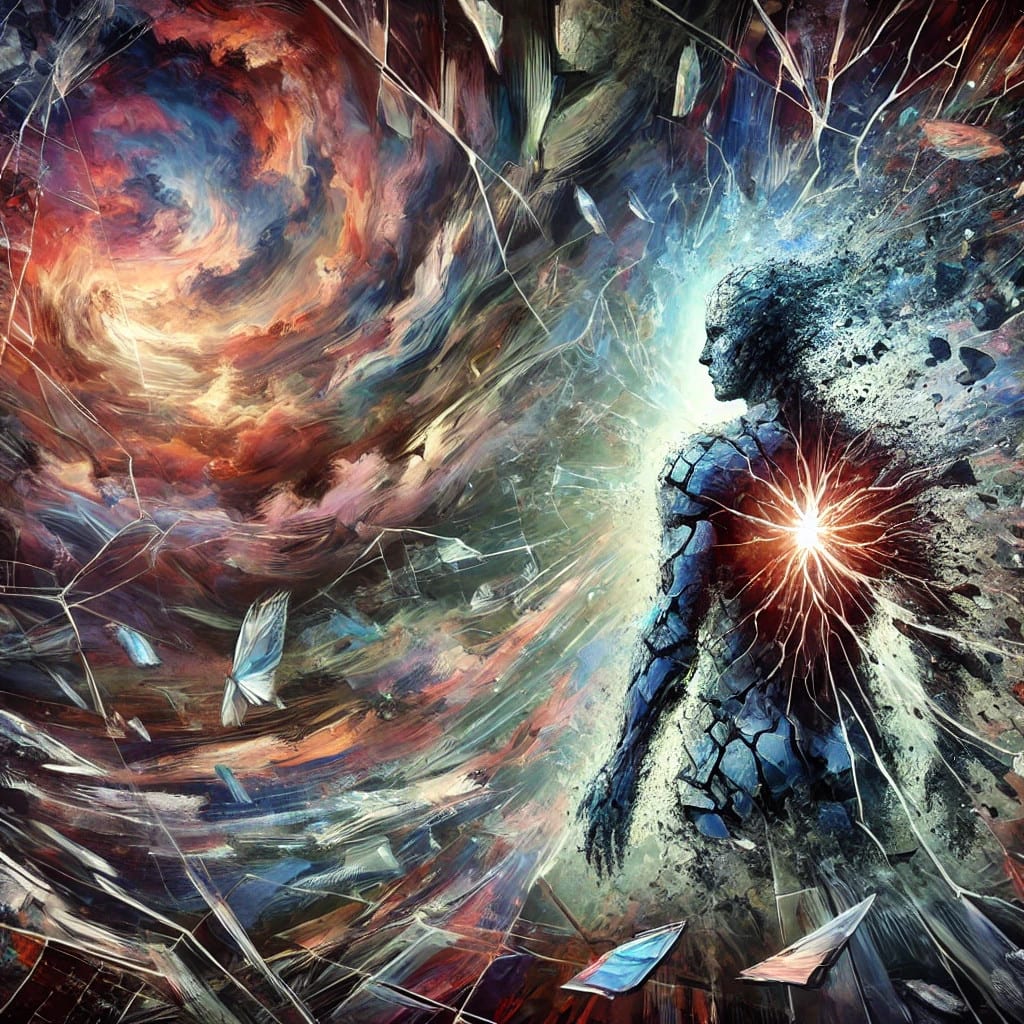
The Moment Everything Shattered
Have you ever felt your mind crack like a windshield hit by a stray pebble? One moment, you’re coasting through life, and the next, you're watching the fractures spread in all directions, like delicate spiderwebs reaching their way across the glass. That was me, sitting alone in my apartment, staring at my reflection in a cold cup of coffee, realizing that something had shifted irreversibly inside me. There was no dramatic event, no warning bells—just the quiet recognition that everything I had once taken for granted was slowly, steadily, breaking apart.
This wasn’t just a bad day or a rough patch—it was a full-blown existential landslide. The kind where reality unravels like a sweater with a single loose thread, and you’re left wondering whether you’re breaking down or breaking through. Spoiler: it turned out to be both. But in the middle of that wreckage, I found something unexpected—clarity, resilience, and a bizarre appreciation for the chaos that got me there.
In this piece, I’ll take you through that transformative journey—step by disorienting step—showing how despair and enlightenment often dance uncomfortably close together, like two opposites that can’t exist without each other.
The Descent – When Rock Bottom Feels Like a Free Fall
Hitting rock bottom is not a gentle landing. It’s a high-speed collision with yourself, one that doesn’t just shake you but shatters the very foundation of who you thought you were. For me, it started with subtle signs: a creeping exhaustion that no amount of sleep could fix, a growing detachment from things I once loved, and an anxiety that felt like static buzzing in my veins, an electric hum in the background of everything. But the real breaking point? That was quieter—a subtle, eerie calm before the storm.
I remember standing in my kitchen one morning, overwhelmed by the simple act of choosing between tea and coffee, my hands trembling slightly as I stared at the two options. And in that seemingly mundane moment, the weight of years of ignored emotions pressed down on me all at once. It felt as though my brain had decided, "Okay, that’s enough. We’re shutting down for maintenance." But there was no maintenance crew to be found, no one to come in and fix the malfunction.
Psychologists often refer to this as the “dark night of the soul,” a state where your sense of self completely dissolves. It’s not just an emotional breakdown, it’s a profound sense of disintegration. Research suggests that people experiencing major emotional upheavals often report feelings of dissociation, identity confusion, and an inability to see a future beyond their pain. For me, it felt like staring into a void—and having the void stare back at me. There was no escaping it, no denying it. All of a sudden, I was confronted with the stark truth: I didn’t know who I was anymore.
I clung to distractions. I binge-watched mindless TV shows, doom-scrolled on my phone, anything to avoid confronting the inevitable. But avoidance only deepened the abyss. It was only when I stopped running—when I stopped trying to distract myself—that I realized rock bottom wasn’t the end of the road. It was the foundation upon which something new could be built.
Hitting rock bottom isn’t the end—it’s where the foundation for change is laid.
The Chaos – Navigating the Mental Tornado
Once the initial breakdown settled in, my mind turned into a battleground of conflicting thoughts. I was both hyper-aware and completely numb, questioning everything that once made sense to me. Who was I beneath the expectations, the coping mechanisms, the carefully curated image I presented to the world?
Surreal moments became the norm. I found myself laughing uncontrollably at my own misery, then crying over an ad for cat food. Everything felt significant, yet completely meaningless. I’d wake up with an overwhelming sense of dread for no reason at all, only to be consumed by the slightest thing—a passing comment, a forgotten errand, the abrupt quiet of my apartment. It was like my mind was an open sky, constantly shifting and clouded, and I couldn’t find a place to land.
At first, I fought against it. I read self-help books, journaled obsessively, tried every meditation app available—anything to “fix” myself. But the more I resisted, the worse it got. Then, something strange happened: I stopped fighting. I let the chaos exist without trying to control it. I began to understand that my mind wasn’t broken—it was simply untangling itself from the outdated stories I had been telling myself. And that’s when the real transformation began.
Research in cognitive behavioral therapy (CBT) suggests that radical acceptance—fully acknowledging one’s thoughts and emotions without judgment—can be a powerful tool in emotional healing. When I stopped trying to label my breakdown as “bad” or “wrong,” I started seeing it as a necessary process of dismantling outdated beliefs and patterns. It wasn’t about fixing something that was broken. It was about rebuilding a structure that had outlived its purpose.
One night, I wrote down everything I was afraid of on scraps of paper and burned them in my sink. The symbolism felt dramatic, almost theatrical, but it gave me a sense of release. The act of physically letting go mirrored the emotional release I was starting to experience. That was the first step toward reclaiming my mind, my life, and my autonomy.
In this stage, I also started noticing patterns in my thinking. I was prone to catastrophizing—imagining worst-case scenarios at every turn. I’d convince myself that a small mistake would spiral into something disastrous, that an innocent comment could derail my entire day. Learning to challenge these thoughts, to ask myself, "Is this really true?" or "What evidence do I have for this belief?" helped me regain control. Slowly, my mind became a place I could navigate instead of a battlefield I was trapped in.
Sometimes, the only way through chaos is to surrender to it.
The Awakening – Finding Meaning in the Mess
The turning point didn’t arrive with fireworks or profound revelations. It came in the form of a single, simple question: "What if this isn’t a breakdown, but a breakthrough?"
That shift in perspective changed everything. Instead of fearing the unknown, I got curious. I started to embrace the discomfort, treating it like an invitation rather than a threat. It felt like a personal challenge—like I had been handed an opportunity to rediscover myself and make choices I’d never considered before. I started experimenting with new ways of thinking, breaking old patterns, and allowing myself to feel everything—no numbing, no avoidance, just raw experience. The world started to shift around me, and for the first time in a long time, I didn’t feel like I was just surviving. I felt like I was finally living.
Neuroscientists have found that the brain is remarkably adaptable. The process of neuroplasticity—the brain’s ability to rewire itself—means that even after trauma, we can create new pathways for resilience and growth. This realization gave me hope: if my mind could break itself down, it could also rebuild itself stronger. And maybe—just maybe—that’s what I was being given the chance to do.
I started small: mindful walks without my phone, reconnecting with friends I had isolated myself from, practicing gratitude for even the tiniest things. Slowly but surely, the world began to regain its color. The sharp edges of anxiety began to soften, and the constant hum of dread turned into something quieter, more manageable.
Another crucial step was learning to detach from old narratives about myself. The person I was before the breakdown—driven by external validation, burdened by perfectionism—wasn’t the person I wanted to be anymore. I allowed myself to redefine success, happiness, and purpose on my own terms. I realized that I didn’t have to prove anything to anyone—I just had to be true to myself. This was my journey, and only I could define its destination.
Enlightenment doesn’t arrive fully formed—it emerges from the rubble of what no longer serves you.
The Integration – Living With the New Self
Real transformation isn’t about erasing the past—it’s about integrating it. The old wounds, the shattered illusions, the hard-earned lessons—they don’t disappear. Instead, they become part of your foundation, making you stronger, wiser, and more authentic. The past doesn’t haunt you anymore. It becomes part of your story—a story that no longer controls you, but informs you.
I started rebuilding, piece by piece. I set boundaries where I once bent over backward. I prioritized self-care, not as a luxury, but as a necessity. I learned that rest wasn’t a sign of weakness, and nurturing myself wasn’t selfish—it was essential. I let go of the need to be "fixed" and embraced the fact that being a work in progress is a lifelong journey. There’s no finish line, no perfect version of myself waiting at the end of the race. The journey is the point.
One of the most profound shifts came from realizing that happiness isn’t a destination—it’s a byproduct of alignment. When you live in accordance with your values and listen to your intuition, joy follows naturally. It’s not something you chase. It’s something you cultivate. And for the first time in years, I felt at home in myself, at peace with the person I was becoming.
I also learned the value of community. Healing isn’t meant to be done in isolation. Sharing my story, listening to others, and allowing myself to be seen in my vulnerability created deeper connections than I had ever known before. We are not meant to heal alone. Connection is part of the cure.
True healing isn’t about becoming someone else—it’s about finally becoming yourself.
Conclusion : From Breakdown to Breakthrough
So, what did I get from my mental and emotional unraveling? A profound respect for the unpredictable, a willingness to embrace discomfort, and an understanding that even the darkest moments carry the seeds of transformation. The mess wasn’t something to fear—it was something to learn from.
If you find yourself on the edge of your own abyss, know this: it’s not the end. It’s a beginning—a messy, painful, beautiful beginning. The version of you that emerges on the other side? They’re worth the journey. It may not be easy, and it may not be quick, but it will be worth it.
And if nothing else, at least you’ll have one hell of a story to tell.
About the Creator
Alain SUPPINI
I’m Alain — a French critical care anesthesiologist who writes to keep memory alive. Between past and present, medicine and words, I search for what endures.
Keep reading
More stories from Alain SUPPINI and writers in Psyche and other communities.
Mastering French Without Losing Your Sanity: A Realistic Guide for Beginners
Learning French can feel like solving a Rubik’s Cube blindfolded. The tricky pronunciation, the never-ending grammar rules, and the surprising exceptions make it seem impossible. But don’t worry—equipping yourself with key expressions and effective strategies can turn frustration into fluency. Let’s simplify French and make learning enjoyable.
By Alain SUPPINIExclusive • 11 months ago



Comments
There are no comments for this story
Be the first to respond and start the conversation.