
Evolutionary Minds: Unraveling the Origins of Mental Health
How Our Past Shapes Present Well-Being
Lila always felt a pull toward the unknown, a sense that her mind was a labyrinth of mysteries waiting to be solved. Growing up in a bustling city, the chaos and constant buzz of modern life often left her feeling disconnected and overwhelmed. Yet, beneath the surface of her anxiety lay an inexplicable curiosity about the origins of her inner world—a curiosity that would lead her on an extraordinary journey into the depths of human evolution.
Lila’s quest began with a chance encounter at a local library. Hidden among dusty shelves, she discovered an old, leather-bound book titled The Ancestral Mind: A Journey Through Time and Thought. The book promised to unravel how the intricate tapestry of human mental health was woven from threads spun in the distant past. Enthralled by the idea that the seeds of modern mental challenges might be rooted in ancient survival mechanisms, she embarked on a mission to trace the evolutionary origins of her own mind.
The narrative of the book transported Lila to prehistoric times, where early humans faced a relentless struggle for survival. In these primitive landscapes, every day was a battle against hunger, predators, and the unforgiving elements. It was in these harsh environments that the human brain evolved, developing complex mechanisms to detect threats and form social bonds. The heightened anxiety that helped alert early humans to dangers became an essential tool for survival, though in the modern world, it often transformed into an overwhelming burden.
As Lila delved deeper, she encountered the story of a young hunter-gatherer named Eko—a fictional character crafted by the ancient storyteller behind the book. Eko’s journey through the wilderness mirrored the inner battles fought by millions of modern humans. He was a vigilant scout whose acute senses and rapid response to danger ensured the survival of his small band. Yet, the very traits that kept his tribe safe also isolated him, setting him apart from others with an unyielding wariness that made it difficult to trust even his closest companions.
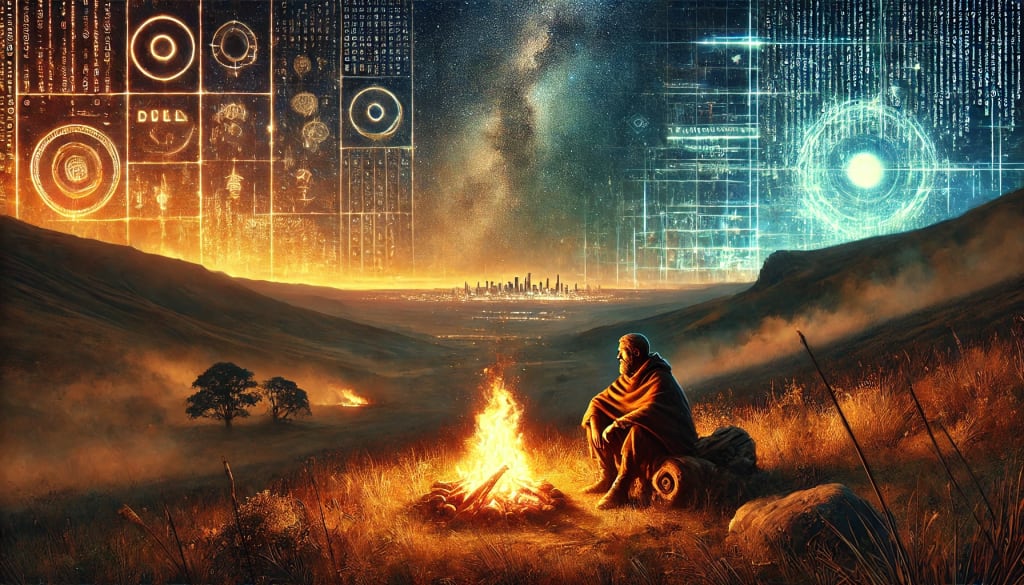
Lila found herself drawn to Eko’s struggles. In the flickering light of a campfire, as Eko wrestled with the dual nature of his instincts—the need for connection versus the imperative to remain alert—Lila saw a reflection of her own internal conflicts. The evolutionary gift of anxiety, which once served as a guardian in the wild, had transformed into a source of modern distress. She began to understand that her racing thoughts and deep-seated worries were not mere personal failings, but echoes of a distant past when vigilance was a matter of life and death.
Inspired by Eko’s story, Lila decided to visit a renowned university where evolutionary psychology was a subject of active research. There, she met Dr. Marcus Hayes, a brilliant scientist who dedicated his career to uncovering how ancient survival strategies shaped contemporary mental health. In his cluttered office, surrounded by books and artifacts, Dr. Hayes explained how our ancestors’ brains had developed an acute sensitivity to environmental stressors. This sensitivity, once advantageous in a hostile world, now contributed to anxiety, depression, and other mental health challenges in the safe but overstimulating context of modern society.
Dr. Hayes recounted how the “fight or flight” response, a mechanism that helped our ancestors react to immediate threats, often misfired in the urban jungle. Instead of responding to a lion’s roar, modern brains reacted to abstract stresses like looming deadlines or the constant buzz of smartphones. Lila listened intently as he described studies where individuals with a robust stress response performed better in ancient environments but struggled with chronic stress in today’s world.
Armed with this knowledge, Lila felt empowered to reframe her own struggles. She began to see her anxiety not as a defect, but as a relic of a time when every heartbeat counted. Yet, the question remained: How could one harness the strengths of this evolutionary legacy while mitigating its burdens in a world far removed from the wild plains of yesteryear?
Determined to find an answer, Lila embarked on a personal experiment. She decided to immerse herself in nature, away from the constant stimuli of city life. Over several weeks, she hiked through remote forests and camped under starlit skies, allowing herself to experience the ancient rhythms of the natural world. In the serene solitude of nature, her racing thoughts began to settle. She noticed that the natural environment, with its gradual pace and predictable cycles, allowed her brain to recalibrate. The heightened alertness she once considered a curse slowly revealed itself as an asset—one that could be managed rather than suppressed.
During her solitary adventures, Lila met an indigenous elder named Toma, who had spent decades living in harmony with the land. Toma shared with her traditional practices passed down through generations—a blend of meditation, storytelling, and communal rituals that helped balance the mind and spirit. His wisdom resonated deeply with Lila, affirming that ancient cultures had long recognized the dual-edged nature of the human mind. They had learned to harness their innate alertness through practices that fostered connection, mindfulness, and respect for the natural order.
Returning to the city with renewed insight, Lila decided to document her experiences in a series of essays. In her writings, she wove together the scientific insights of Dr. Hayes, the ancient narratives of The Ancestral Mind, and the practical wisdom of Toma. Her essays, rich with personal reflection and backed by evolutionary theory, struck a chord with readers who too felt the weight of modern pressures. They resonated with those who saw in Lila’s journey a bridge between the instincts of the past and the challenges of the present.
As Lila’s stories gained traction, she became a voice for many who longed to understand their own inner workings. She explained that the mind, with all its quirks and vulnerabilities, was not broken but beautifully complex—a product of millions of years of evolution. Every anxious thought, every surge of adrenaline was a reminder of the resilience and adaptability that had allowed humanity to thrive against all odds.
In her final essay of the series, Lila reflected on the journey from Eko’s ancient campfires to the bustling streets of modern cities. She realized that while the context had changed, the fundamental human experience remained the same. The key to thriving in today’s world lay in embracing our evolutionary heritage—acknowledging our innate responses and learning to channel them in ways that served our well-being.
Lila’s journey was a testament to the enduring interplay between our ancestral past and our modern existence. By understanding the evolutionary roots of mental health, she and her readers discovered not only the origins of their struggles but also the pathways to healing. In embracing both the strengths and challenges inherited from our ancestors, they found the courage to shape a future where the mind could flourish, free from the shackles of misunderstood history.
In the end, Lila’s exploration of the evolutionary mind became more than just a quest for knowledge—it transformed into a celebration of human resilience. Her story invited others to reframe their own narratives, to see every anxious heartbeat as a legacy of survival and every mindful moment as a step toward reclaiming the balance between past and present. Through her words, Lila kindled a renewed appreciation for the intricate dance between our ancient instincts and our modern lives, inspiring readers to navigate their mental landscapes with curiosity, compassion, and hope.
About the Creator
OWOYELE JEREMIAH
I am passionate about writing stories and information that will enhance vast enlightenment and literal entertainment. Please subscribe to my page. GOD BLESS YOU AND I LOVE YOU ALL
Keep reading
More stories from OWOYELE JEREMIAH and writers in Psyche and other communities.
Mind in the Machine
Alex never imagined that his life would be defined by the digital world—a swirling labyrinth of likes, shares, and endless notifications. Growing up, he was captivated by technology’s promise of connection, but as years passed, the glow of the screen began to blur the boundaries between reality and the virtual realm.
By OWOYELE JEREMIAH10 months ago in Psyche
Christmas is Not Always “Beer and Skittles”
If you find the holiday season challenging, you’re not alone. I have never been a big fan of Christmas. I have always found it a bit pretentious. It is a time for kids, really. I have not had kids in my life, so the "children's influence" around this time of year doesn’t occur.
By Calvin London20 days ago in Psyche


Comments (2)
Hey, just wanna let you know that this is more suitable to be posted in the Fiction community 😊
Mental health is a good problem to get help for! Good work