
Drug Policies and Addiction Treatment
The Impact and Implications of Today


In today’s society, drug policies and modifications to drug policies in the United States and the world have been the focus of a lot of political movements and social issues recently. The legalization of marijuana in certain places has given people a platform to talk about drug issues as well as the issues with drug policies, and how those policies may impact individuals and society as whole. In this article, I will discuss some of the basics about drug policies in the United States specifically, and how this system has a direct impact on the availability and types of addiction treatment programs that are offered in the United States. Lastly, I will discuss what these policies and the direction of our policies and social issues related to drug abuse should be in order to make drug addiction treatment more effective.
Substance abuse, addiction, and drug policies have a long history in the United States and the world. From the Prohibition era to the experimental atmosphere of the 60s, to today, we have seen many changes in viewpoints and policies on drugs and drug addiction treatment. The initial idea and purpose of drug policies is to look out for public health and safety, but many individuals are often put at more risk and even more dangerous situations because of the way politics and social issues tend to control viewpoints about substance abuse and drugs. To give you an example of some of the often-flawed thinking in relation to addiction, I want to tell you about a particular period in history that I find interesting when we think about drug policies.
Back in the 1800s, the healthcare “system” was much freer. Self-proclaimed “doctors” would walk the streets, with a “miracle elixir” that promised to bring patients back to health in no time at all. These elixirs and medications were not regulated by the government and mostly experimental. Many people thought, and discovered, that these “miracle cures" were mostly hoaxes. Some of these medicines contained highly addictive substances, such as cocaine and opium/morphine. Eventually, they started regulating these medications as well as controlling doctors’ ability to prescribe these medicines. However, the 1800s brought a time where there was a lot of drug abuse happening, more specifically, the opium craze.
It is well known that many women were prescribed opium by their doctors to help women be more "obedient" in the home. Men and doctors at the time basically thought that if women weren’t being obedient and taking care of the children and house, if they weren’t behaving the way they thought a woman should (i.e. always happy and taking care of the home), that they needed opium to basically “take the edge” off and make women more compliant. It is no surprise that back in this time, many women were sent to mental institutions if they dared behave outside of the “norm”. This directly impacted society as a whole in the decades and years to come.
It wasn’t just women taking opium medicinally, but also prostitutes on the streets, men smoking opium after learning about the opium pipe and popularity of it with Chinese men. All of these things contributed majorly to the early opioid crisis. What I always find fascinating about this story, though, is that once they discovered the powerful addictive properties of opium, it was seen as a health crisis, and most people felt bad for those afflicted with it. Doctors tried their best to help people manage withdrawal symptoms by prescribing it willingly. Drug use, especially medicinally and socially, was more acceptable and “normal” in these times.
The plight of the addict in this time, was seen as a normal part of society, and people were not ostracized to the extent they are today for having the disease of addiction. Looking at today’s society, we have come a long way, adding stricter policies for medications, health care, doctors, and drugs. We look down upon those that have the disease of addiction and often paint a negative picture of who they are, feeding into stereotypes that are terribly inaccurate.
Are Drug Policies a Detriment to Society?
In hearing the story about early opium and heroin addiction in the United States, you can see how drug policies can be negative for those struggling with addiction. As time went on, policies became even tighter, which eventually led to the Prohibition era in America. People were sneaking around, going to speakeasies to drink and get their fix. Use of other drugs went up when alcohol was illegal, as well as people making dangerous “moonshine” that actually killed people because of the potency of the alcohol content.
People were making alcohol in bathtubs because they didn’t have access to properly made alcohol. You can see how current drug policies then match up with those same types of behaviors. Many drugs nowadays are illegal, and consumers will either find “legal” synthetic drugs to replace their fix with (which actually might be more dangerous than the real thing, in some cases), or seek out the use of these drugs in some not so savory places that often do not take personal health and safety into account when "manufacturing" these drugs. A dealer will put in more and more filler substance to extend the length of their investment, optimizing their sales for their own personal gain, and with a complete disregard for the lives of the many people they impact. This is just one issue with drug policy, but it is often an argument many people make that are against the use of drug policies.
Implications of Decriminalization
Advocates for the decriminalization of drugs argue that making all drugs legal and accessible to consumers would actually cause drug abuse and drug consumption to go down. In addition, the argument is that the drugs would be much safer, regulated potentially, and less harmful overall to consumers. To give you a global example, in Spain, drugs are legal for personal use, and they have some of the lowest numbers in terms of overdoses and abuse. So why haven’t we decided to change the legality of drugs in the United States? It all comes down to politics, the economy, and social issues. This is a very controversial topic. Those that argue against decriminalization make the point that giving access to drugs to everyone legally could potentially cause pandemonium. However, it hasn’t been tested out. We can’t really know what will happen until it is tried.
In the United States it seems, there have been some positive strides in relation to the decriminalization of marijuana. There are states and places where policies have become less severe. With new science and experimentation into cannabis and marijuana, we have learned that this drug in particular is not as harmful as society may have thought in the past. “Reefer Madness” was an exaggeration of the experience of marijuana altogether. More hardcore drugs, however, we know to be very dangerous. Those that argue against decriminalization of those drugs are concerned about overdose deaths rising and more people being exposed to the drugs than otherwise would. That may be true, but there is also good evidence to support better addiction treatment programs in a society where drugs are decriminalized.
Imagine a society where instead of getting arrested for having a disease, you got to a safe facility that will help you taper off the drugs... Wouldn’t that be a much more positive outlook for everyone? The bottom line is, our society is advancing, and we are learning new things everyday about addiction and about drugs. We may or may not see such stark changes in policy in our lifetime, but it’s important to know all the advantages and disadvantages of both. Whatever side you take on this issue, know the importance, the goal, in all of this, is to help others. Maybe one day we can figure out a more reasonable way to fix the issue that has been a crisis in this nation for many decades, and drug addiction will become a thing of the past, but who knows? Only time will tell.
About the Creator
Slgtlyscatt3red
Slightly scattered. Just a woman with autism and ADHD that loves to write poetry, create art, and sing.
Keep reading
More stories from Slgtlyscatt3red and writers in Psyche and other communities.
It's Called Being Neurodivergent...
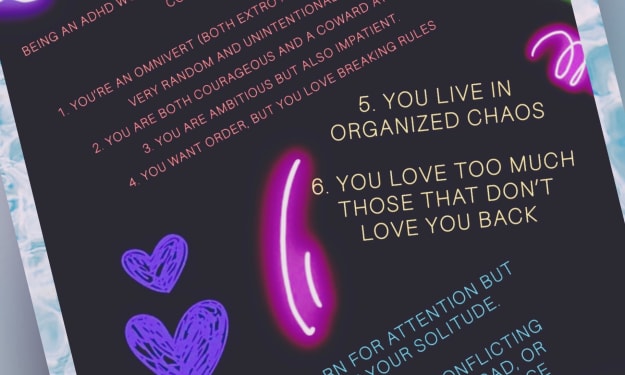
Last night, as I was scrolling my phone, I thought about how many times I've contradicted myself in my life, and honestly, it's a lot. Having both autism and ADHD, although similar, makes things a bit challenging for me sometimes. In fact, I was so taken by my thoughts that I created the images you see above and posted them online last night, a small echo of my soul reaching out for those other kindred spirits that understand the complexities of being who we are. I like being creative and expressing that, too. Sometimes I like to create collages with quotes on them or things I have said. I always love for it to reflect kind of how I am feeling in the moment. The picture is organized, but also chaotic, just like my wild, wonderful, beautiful, neurodivergent brain. A perfectly imperfect human mind...
By Slgtlyscatt3redabout a year ago in Psyche
Top tipple tricks
Been thinking a lot about drinking, lately. Not least because of a recent episode of over-indulgence and the inevitable after effects. Some readers may recall the earlier articles I wrote about beating the booze. Here I set out an experiment in techniques for cutting down on my alcohol intake. The experiment was successful, the techniques worked, and I have armed myself with an arsenal of weapons in the war against the demon drink. I have yet to fire the first round however. It's all a question of timing (perhaps procrastination).
By Raymond G. Taylor3 days ago in Psyche
The 6 Hardest Life Truths You Already Know But Refuse to Face
Life has a strange way of teaching lessons we wish were not true. Deep down, most people already know some uncomfortable truths about life. Yet, instead of facing them directly, we distract ourselves with routines, entertainment, or false hopes. These truths are not meant to discourage you. In fact, accepting them can be incredibly freeing. When you stop denying reality, you gain clarity, resilience, and control over your life. Here are six of the hardest life truths most people already know—but often refuse to face.
By Shahid Zaman4 days ago in Psyche
From ad men to mad men
It's after 2am in the morning when a local police patrol vehicle in Northern New Jersey spots a figure costumed as Quasimodo, The Hunchback of Notre Dame, proceeding southbound on the sidewalk along Lydecker Street. Though the hunchback’s costume stuffing offers added insulation, it's January, and friggin’ freezing. Carefully, the officers slow down, gently question the subject, and offer him a ride home.
By David W. Maury7 days ago in Humor


Comments (1)
This is a great look at this side of the argument for decriminalization. Addiction is such a complex disease for the sufferer and the people who love them. I worked in the cannabis industry in Ontario for two years and it's been interesting to experience the changes since cannabis became legal in Canada in 2018. Many times, people have ended up sharing their struggles with me at the dispensary while they look for something more organic while weening off the harder stuff. It's all so tricky and there is no real straight-forward solution. Kindness always helps, though. Thank you for writing about this, Anne Marie. This is a very well-researched and thoughtfully presented piece.