
Car Number 121
How a simple acronym can help drivers in trying situations


Imagine a nice, mild wintery day on a country road. There's some snow on the wide, open fields, but not too much. It's cool as opposed to cold, so a nice, warm jacket will do. There are no leaves on any trees; no shrubs or tall grass. And it's sunny because there are very few clouds in the sky.
While country roads are not that busy, one of my dear friends (who has decided to remain unidentified), found himself on a country road one day that was surprisingly popular. During a period of about an hour-and-a-half, he counted approximately 120 vehicles - mostly trucks, but some cars and two tractors - pass on by.
What I found odd upon hearing his story was what he was doing. In those outskirts, if you saw a vehicle parked at the side of the road with nothing odd about the vehicle itself (and there wasn't with his), that meant people were going for a walk, cycling (although not at that time of year), or blueberry picking (although not that time of year). For that one-and-a-half hours, my friend was neither cycling, nor going for a walk, nor picking berries. He was right next to the road in the very shallow ditch - not two feet deep - surrounded in white snow, wearing dark winter clothes.
The act of choice was a quiet method of suicide. From what he gathered from his point of view, the people in the front seats of about 60% of the vehicles that passed by were in a position to see him. None of those 120 vehicles stopped. None of those 120 vehicles called emergency services. Fortunately, just before exiting his car, he had messaged family where to find the vehicle. It was they who called emergency services once they had eventually checked their email.
My dear friend is still alive in spite of his mal-intentioned efforts and is recovering well. This is where my own story - and this article - takes a sharp turn. Over the years I had thought that both family and strangers were people from whom I could take responses personally. My friend's story shook my view of the latter into a much healthier viewpoint: expectations of strangers speak only to community, nothing personal.
In other words, what you can expect from strangers defines elements of a community, not yourself. It's a reason why people have the (otherwise odd) preference of sharing a belief system or ethnicity - you know what you can count on and one of those very general expectations is safety.
Given what didn't happen to my dear friend, I want to remove one of the barriers required to build a stronger community, one independent of faith and ethnicity. The point of this article is this: when you encounter a shocking situation when someone is in need of assistance, call emergency services and then, if you can,
apply GOBS H2O. It's really simple!
I am not going to lie, I would not have known what to do if I saw someone on the side of the road lying down or kneeling, surrounded by red snow. I do now and I will share it with you. The only absolute necessity is to call emergency services (911 in my country and region). Provide the location and what you see. No need to even get out of your own car.
If you are confident in approaching the scene to try to talk the person out of it (or delay things long enough for emergency services to arrive), apply GOBS H2O first. The symbol of this is in the image below. (Note: I am not providing advice to approach. You must use your own judgment and make your own choice. If you have made the choice to approach, then I advise applying GOBS H2O.)
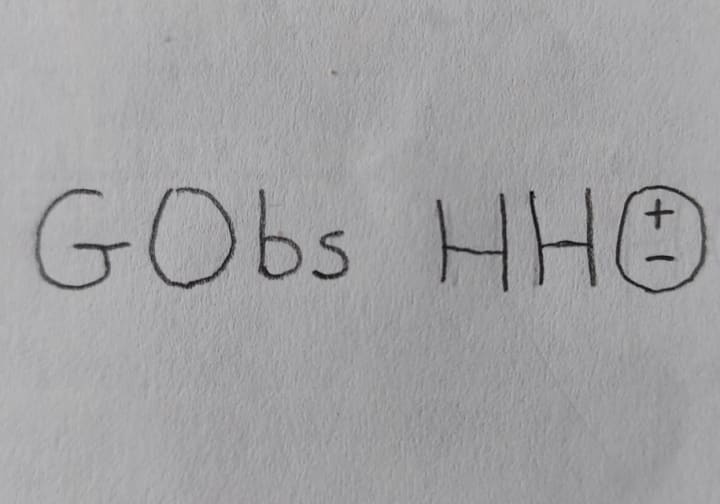
GOBS H2O has to do with scanning the scene - but for what? Well, in keeping yourself safe, start with looking for any projectiles. Guns or bullets? Objects that are Blunt (e.g. rocks) or Sharp (not only knives)? Any of those could come your way and it's entirely pointless to try to intervene only for you to end up dead, too!
The second group of items to look for are environmental factors, the H2O. The two H's are water (hydro) and heights/elevations. The O part is based on the symbol for voltage or in other words, open sources of electricity. (I remember doing a first aid course a long time ago and one scenario was a dark room and anyone who turned on the light or walked more than two steps in had to lie down on the spot to symbolize that they had been rendered unconscious due to a electric shock and were now also in need of assistance! Yes, I was the first one in and the second person lying down. Fortunately, the other trainees learned quickly and resuscitated both myself and the other person. But I digress.)
If water, heights, and electricity do not pose a threat, or if they do and you can easily mitigate them to stay safe, then approach at your own risk - although maintain caution. (Note: I am not providing advice to approach. You must use your own judgment and make your own choice.)
For any conversation you are able to strike up with the person in distress, I would advise to keep it very simple. My own federal government has a few key points mentioned here, or perhaps one scene in particular in the movie Pay it Forward inspired you. Whatever your motivation, keep the conversation very simple.
Another thing I have learned in the many times I have taken first aid training over the years is the helper. Assess the impact the situation had on you. Yes you, the person who was not in distress before arriving on the scene. It could be with family or friends, or even a quick assessment from a mental health professional. Those kinds of situations are trying on anyone, so do NOT dismiss this step!
I hope that helps you become car 121, the one that at least calls emergency services. (If you want to start a hashtag of #car121 for responses to such incidents, then feel free.) The only other impact of my dear friend's story had on me is the fact that in the next few years, I will not consider moving anywhere near the area in which this upsettingly true story took place!
As I seek to uplift, subscribe for free below to become notified right when I publish more thought-inspiring articles of things that in life that strike me as interesting. Alternatively, you can always bookmark this page where you will find all articles I have published here on Vocal Media.
About the Creator
Richard Soulliere
Bursting with ideas, honing them to peek your interest.
Enjoyes blending non-fiction into whatever I am writing.
Keep reading
More stories from Richard Soulliere and writers in Psyche and other communities.
Stock Trading - Entry 28
For those wondering why I axed three non-performing shares recently without selling them, well, a few things. First, that is a small amount of my portfolio and I can afford to wait ten years for the off chance of an increase in the stock price. Second, I am considering them as total losses unless the first point comes to fruition. Third, I have been getting emails like this for almost a year now:
By Richard Soulliereabout a year ago in Trader
Why Smiling Can Feel Like the Hardest Thing
The Unbearable Weight of a Smile: When Your Face Refuses to Lie Anymore "Just smile," they said, as if my face were a light switch I could simply flip. As if the muscles required to curve my lips upward hadn't become so heavy that lifting them felt like deadlifting my own despair. As if smiling—the simplest, most automatic human expression—hadn't become the most exhausting performance of my entire day. I'm standing in line at the coffee shop, and the barista is making small talk. "How's your day going?" she asks, cheerful, genuine, expecting the standard response. My jaw tenses. My face feels like stone. I know what I'm supposed to do—smile, say "great, how about you?", participate in this basic social ritual that I've performed thousands of times without thinking. But I can't. My face won't cooperate. The muscles required to form a smile feel paralyzed, or more accurately, weighted down by something too heavy to lift. I force it anyway. The corners of my mouth move upward mechanically, but it doesn't reach my eyes. It doesn't feel genuine. It feels like I'm wearing a mask that doesn't quite fit. "Fine, thanks," I manage, and the barista's smile falters slightly. She can tell. Something's off. My smile is wrong somehow—too tight, too forced, too obviously fake. I take my coffee and leave quickly, exhausted by the thirty-second interaction. My face hurts from the effort of that brief, failed smile. And I still have an entire day of this ahead of me. When Your Face Becomes a Traitor I used to smile easily, automatically. It was a reflex, an unconscious response to humor, kindness, joy, social situations. I never thought about it, never had to try. Now every smile is manual labor. Every upward curve of my lips requires conscious effort, deliberate muscle activation, sustained energy I don't have. My face has become resistant, like it knows I'm lying and refuses to participate in the deception. In meetings at work, I'd notice other people smiling, laughing, their faces animated and expressive. And I'd try to match them, to mirror their expressions, to look like I was engaged and present. But my face wouldn't cooperate. It would freeze in this neutral, flat expression that read as either bored or angry, even though I wasn't trying to look either way. I just... couldn't make my face do what faces are supposed to do. "You look upset," my boss said after one meeting. "Is everything okay?" "I'm fine," I said, and tried to smile to prove it. But even I could feel how wrong it looked—this grimace that pretended to be a smile, this contortion that fooled no one. "If something's bothering you, you can talk to me," he pressed. Nothing was bothering me. At least, nothing specific. I wasn't angry or upset about work. I was just... unable to smile. Unable to make my face perform the basic signals that tell others I'm okay, I'm engaged, I'm a functioning human being having a normal interaction. The Exhaustion of Performance Every day became a marathon of forced facial expressions. Wake up. Try to smile at my partner over breakfast. Fail. See his concern. Force a smile to reassure him. Feel my face muscles strain with the effort. Get to work. Try to look pleasant and approachable. Feel my face settle into that blank, heavy expression despite my best efforts. Force periodic smiles during conversations. Feel exhausted by 10 AM from the sheer effort of manipulating my own face. Lunch with colleagues. They're laughing about something. I hear the joke, understand it's funny, know I should be laughing too. Try to make my face do the laughing expression. Produce something that's almost a smile but not quite right. See them notice. Feel them pull back slightly, unsure how to read me. By the end of each day, my face would actually ache. Not from overuse, but from the constant tension of trying to force expressions that wouldn't come naturally, of fighting against muscles that wanted to remain flat and unresponsive. I started avoiding situations that required me to smile. Stopped going to social gatherings where I'd have to perform happiness I didn't feel. Turned down invitations to celebrations, parties, events where smiling would be expected and my inability to do so would be conspicuous. My world shrank to environments where I didn't have to pretend—mostly my apartment, alone, where my face could rest in its natural state of heavy neutrality without judgment or concern. Understanding the Impossibility "Why can't I smile?" I asked my therapist, genuinely baffled by this loss of what seemed like the most basic human function. "I'm not trying to look miserable. I just... can't make my face do it anymore." She explained it in a way that finally made sense. "Depression doesn't just affect your mood—it affects your motor functions, including the facial muscles. The neurotransmitters that allow for spontaneous emotional expression are depleted. Your face isn't refusing to smile. Your brain isn't sending the signals that create smiling." She showed me research about something called "facial feedback"—the way our facial expressions both reflect and influence our emotional state. When you smile, your brain registers that feedback and generates corresponding positive emotions. It's a two-way street. But in depression, that street is blocked. Your brain can't generate the positive emotions that produce genuine smiles, and forcing smiles doesn't trick your brain into feeling better—it just exhausts you with the effort of manually operating machinery that's supposed to be automatic. "It's not laziness," she emphasized. "It's not attitude. It's a literal neurological impairment. Your brain has lost the ability to generate spontaneous positive facial expressions." Knowing this didn't make it easier, but it helped me understand why something so simple had become so impossibly hard. The Social Cost The inability to smile carries a staggering social cost that people who've never experienced it can't understand. Humans are wired to read faces. We make split-second judgments about people based on their expressions. A lack of smiling reads as unfriendly, unapproachable, angry, or unstable—even when that's not what you're feeling at all. My relationships deteriorated. Friends stopped reaching out because interactions with me felt flat, heavy, unrewarding. I wasn't fun to be around anymore. Not because I was actively negative, but because I couldn't reflect back the warmth and positive energy that social bonds require. My partner grew increasingly frustrated. "You never seem happy to see me," he said one night. "I come home and you just... look at me. No smile, no warmth, nothing." "I am happy to see you," I insisted. "I just can't make my face show it." "That doesn't make sense," he said, hurt and confused. "If you're happy, why can't you smile?" How could I explain that happiness and smiling had become disconnected? That I could feel some small sense of gladness that he was home, but that feeling couldn't translate into facial expression? That the pathway between emotion and face had been severed? I couldn't explain it in a way that made sense to him. And eventually, he stopped believing I was happy to see him at all. The Judgment and Misunderstanding The worst part was the constant judgment from people who didn't understand. "You should smile more!" Random strangers, usually men, felt entitled to offer this advice, as if my face existed for their viewing pleasure. "Cheer up, it might never happen!" People would joke, assuming my expression meant something bad had occurred, when really it just meant my face was resting in its default depressed state. "Why are you so angry?" I wasn't angry. I was just unable to smile. "You need to work on your attitude." My attitude was fine. My face just couldn't show it. People assumed my lack of smiling meant I was rude, unfriendly, hostile, or miserable. They couldn't see that I was simply exhausted from trying to operate machinery that had stopped working. Even well-meaning people hurt me with their attempts to help. "Just fake it till you make it!" they'd say. "Force yourself to smile and you'll feel better!" But forcing smiles didn't make me feel better. It made me feel like a fraud. It highlighted the gap between what my face was doing and what I was actually feeling. It made the depression more obvious, not less, because the smile never reached my eyes, never looked genuine, never fooled anyone including me. The Breaking Point The crisis came during my niece's birthday party. She was turning five, excited, adorable, having the time of her life. She ran up to me with a drawing she'd made, her face lit up with pure childhood joy. "Look what I made for you, Auntie!" I looked at the drawing—a colorful, enthusiastic rendering of the two of us holding hands. She'd drawn me with a big smile. And I couldn't smile back at her. I tried. God, I tried. This innocent child showing me something she'd made with love, and I couldn't produce even a small smile of acknowledgment. My face remained flat. Heavy. Unresponsive. Her face fell. "Don't you like it?" "I love it, sweetheart," I said, my voice breaking slightly. "It's beautiful." But she'd already seen my expression—or lack of it. She walked away, confused and a little hurt, and I stood there holding her drawing, hating myself for not being able to give this child the one simple thing she wanted: a smile. That night, I called my psychiatrist. "Something's really wrong," I said. "I can't even smile at a five-year-old. What's happening to me?" The Medical Reality My psychiatrist adjusted my medication and explained what was happening. "What you're experiencing is called 'psychomotor retardation'—a slowing down of physical and emotional responses. It's a core symptom of major depression. Your facial muscles aren't responding normally because the neural pathways that control spontaneous expression aren't functioning properly." She also mentioned something called "anhedonia"—the inability to feel pleasure—which often comes with an inability to express pleasure, even when you're trying. "The medication we're adjusting should help," she said. "But it takes time. Six to eight weeks, possibly longer, before you notice a difference." She also recommended something unexpected: facial exercises. "Research shows that deliberately practicing facial movements—even without the corresponding emotion—can help retrain the neural pathways. It won't cure the depression, but it might make the physical expressions easier." So I started doing these bizarre exercises. Standing in front of the mirror, manually moving my face through expressions. Lifting the corners of my mouth with my fingers to simulate a smile. Holding it. Releasing. Repeating. It felt ridiculous. I felt ridiculous. But I was desperate enough to try anything. The Slow Return The medication took seven weeks to start working. Seven weeks of forced smiles, exhausted facial muscles, and social situations I couldn't navigate properly. Then one morning, my partner said something funny at breakfast and I felt it—a real smile, spontaneous and genuine, breaking across my face without effort. It lasted maybe three seconds before fading. But it was real. It was mine. It happened without me having to manually operate my face. I started crying, which alarmed my partner until I explained: "I just smiled. A real smile. I didn't have to force it." He looked at me with such relief and sadness. "I didn't realize how hard it's been for you," he said quietly. After that, smiles came more frequently. Not all the time—I still had days where my face felt weighted and unresponsive. But the genuine smiles started outnumbering the forced ones. The effort required diminished. My face started cooperating again. Living With the Memory A year later, I can smile relatively easily again. Not effortlessly like I used to, and not constantly. But the heavy impossibility has lifted. My face has mostly remembered how to express what I'm feeling without requiring manual operation. But I haven't forgotten what it was like. That period when smiling felt harder than anything else, when my face betrayed me every day, when the simplest human expression became impossible. I'm gentler with people now. When I see someone with a flat expression, with a face that doesn't smile easily, I don't assume they're unfriendly or angry or rude. I wonder if maybe they're fighting this same battle. If maybe their face is as heavy as mine once was. I also don't take smiling for granted anymore. Every genuine smile feels like a gift, like evidence that my brain is working properly again, that the neural pathways are transmitting signals the way they should. The Truth That Needs Telling If you can't smile right now—if your face feels like dead weight, if forcing expressions exhausts you, if people keep telling you to cheer up and you want to scream that you're trying but your face won't cooperate—please know this: You're not broken. Your face isn't defective. This is a symptom of depression as real and valid as any other symptom. Your brain's ability to generate spontaneous positive expressions has been impaired by depleted neurotransmitters and disrupted neural pathways. This isn't attitude. This isn't choice. This is neurology. And it's treatable. With the right medication, therapy, and time, your face can remember how to smile again. The heaviness can lift. The effort can diminish. The genuine smiles can return. Don't let people shame you for something you literally cannot control. Don't let them tell you to "just smile" as if you haven't been trying. Don't let them mistake your depression for rudeness or hostility. Your face will cooperate again. The pathways will reconnect. The expressions will come naturally once more. Until then, be patient with yourself. You're not failing at something easy. You're managing something impossibly hard. And you're doing better than you think. When smiling becomes the hardest thing, it's not because you're ungrateful or negative or refusing to see the bright side—it's because depression has literally disconnected the neural pathways between emotion and facial expression. Your face isn't betraying you out of spite. It's malfunctioning because your brain chemistry is disrupted. The effort it takes you to produce a smile is the same effort it would take someone else to deadlift a car. You're not being difficult. You're being incredibly strong, showing up to social situations and manually operating facial machinery that's supposed to be automatic. The heaviness will lift. Your face will remember. Until then, please stop judging yourself for not being able to do something your broken neurology has made nearly impossible. --------------------------------------------- Thanks for Reading!
By Ameer Moavia6 days ago in Psyche


Comments