
Can Social Media Posts be Used to Predict Depression?
We'll discuss how language shapes our thoughts and emotions, specifically sadness.


Here’s a thought experiment:
Imagine that the color blue was imperceptible to humans. What would we say instead of “I’m feeling blue”? Or if humans didn’t have words for different directions, would we have come up with the phrase “I’m feeling down”?
Figurative language can be confusing if you don't know the context surrounding it. If taken literally in a conversation, these phrases wouldn't make any sense. After all, what does it mean to "feel" like a color? Colors can be ascribed to things, like how a sky can be blue, but it doesn't make as much sense to say that "Blue is the sky." Yet, English-speakers made an arbitrary connection between a random color and an emotion that works because sadness is a definition of blue that we can more-or-less all agree on.
It may sound self-evident, but it’s interesting to think about how our thoughts are rooted in our language, and vice versa.

A study found that individuals with mood disorders such as depression and anxiety tended to use more words related to sadness during cognitive behavioral therapy.
- Cognitive behavioral therapy is a form of therapy that focuses on restructuring an individual’s negative thought patterns while also attempting to change their behaviors. A key aspect of CBT that is not often considered is the language of the therapist.
- Considering the results of the previously mentioned study, this might be surprising. Reshaping negative thought patterns could involve targeting an individual’s usage of sadness-related words and encouraging them to stray towards more neutral or positive words. This could work on a subconscious level to steer a patient away from reinforcing their negative thinking by repeating instances of negative verbal utterances.
- Priming experiments have shown that flashing a semantically or phonologically similar word can facilitate the mental retrieval of a target word. This could potentially mean that exposing depressed patients to sadness-related words might make them more inclined to free-associate with ideas of sadness.
These findings actually extend beyond the clinical/therapeutic setting.
Did you know that an increased usage of sadness-related language can potentially even predict onset of Major Depression?
Another study investigated Facebook users who tended to post content with language related to depressive disorder symptoms such as sadness, loneliness, etc. After checking their medical records later on, the researchers found that these users actually did have a depressive episode later on in life.
These results also support the idea that depressive symptoms can sometimes manifest in our language output. It can be speculated that we tend to use emotionally-charged words that are more similar to our emotional state whether we are consciously aware of it or not. An interesting concept that illustrates this phenomenon is called a “Freudian Slip”, in which a person may accidentally say something that they didn’t mean to which demonstrates an unsaid desire of theirs.
This reinforces the idea that our thoughts and feelings may be more intertwined than we might have previously thought.
So far, we’ve examined how our emotions can affect our language output. But how does our language affect our emotional processing?
Some researchers have posited that our emotions are actively created through our internal language, A.K.A. our thoughts. There’s actually neuroimaging evidence that supports this idea by showing that emotion words such as “anger” are important to emotional perception. Patients with lesions in language-related areas of the brain had difficulties with emotional perception, although more research may be needed to confirm these findings since brain areas often have overlapping functions.
Other than neuroimaging studies, researchers investigated how semantic aphasia can actually impair emotional processing as well. This could suggest that the meaning behind words is key to the recognition of emotions.
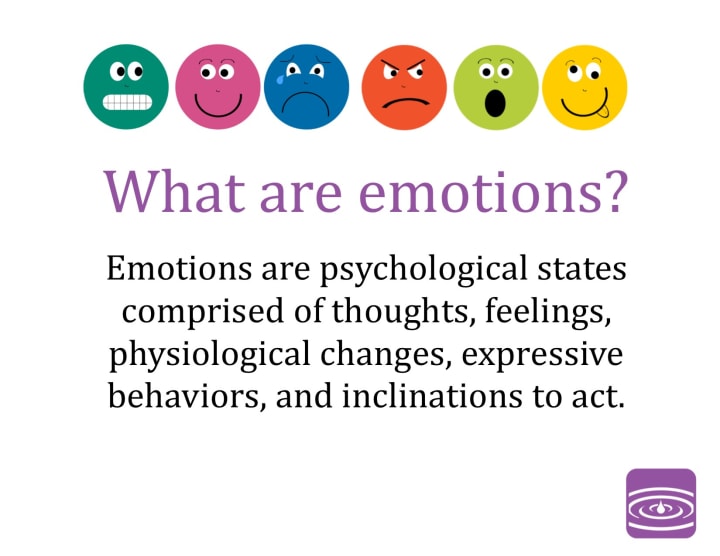
It is clear that there is a direct relationship between our language production and emotional processing. But what does this mean for our current mental health practices?
Let’s revisit the previously mentioned expression: “I’m feeling blue.” If an individual does not have a semantic understanding of the word “blue” as meaning “sad”, then they might have a hard time answering this question in a depression screening test. Similarly, a person whose native language isn’t English may not understand the expression altogether, or may even perceive the color “blue” as a “happy” color instead.
- This could highlight the importance of writing screening tests that are not semantically ambiguous, so that they can be as accurate as possible.
- The color "blue" in other cultures may also be associated with other feelings. For example, in Dutch it might be used to refer to someone as shy. This means that a native Dutch speaker could misinterpret the "I often feel blue" inventory on a screening test as "I often feel shy."
Even in our day to day life, we can benefit from the knowledge that our language and emotions are intertwined. A multitude of research studies have shown that emotions are contagious, which makes sense since our brains are wired with mirror neurons that prime us for emotional processes such as empathy.
With this in mind, it might be worth considering putting more thought into how we speak to one another on a daily basis. Using more words associated with sadness may not only make others feel more prone to sadness, but can also affect your own happiness. Sometimes, the best way to spread positivity is to maintain your own positivity.
About the Creator
Amy Hong
Hi there! Just a college student looking to practice my writing skills.
Keep reading
More stories from writers in Psyche and other communities.
The BAFTA Awards
By now, in a stunning departure from recent years, most of the world is aware of what happened at the BAFTA film awards. Social Media Headlines will tell you the bare bones: that John Davidson, a Tourette's Syndrome advocate, shouted a racial slur at two Actors of Colour, Michael B Jordan and Delroy Lindo.
By Natasja Rose6 days ago in Psyche


Comments
There are no comments for this story
Be the first to respond and start the conversation.