
Blame My Brain!
How Your Brain Is Enabling Your Addiction!

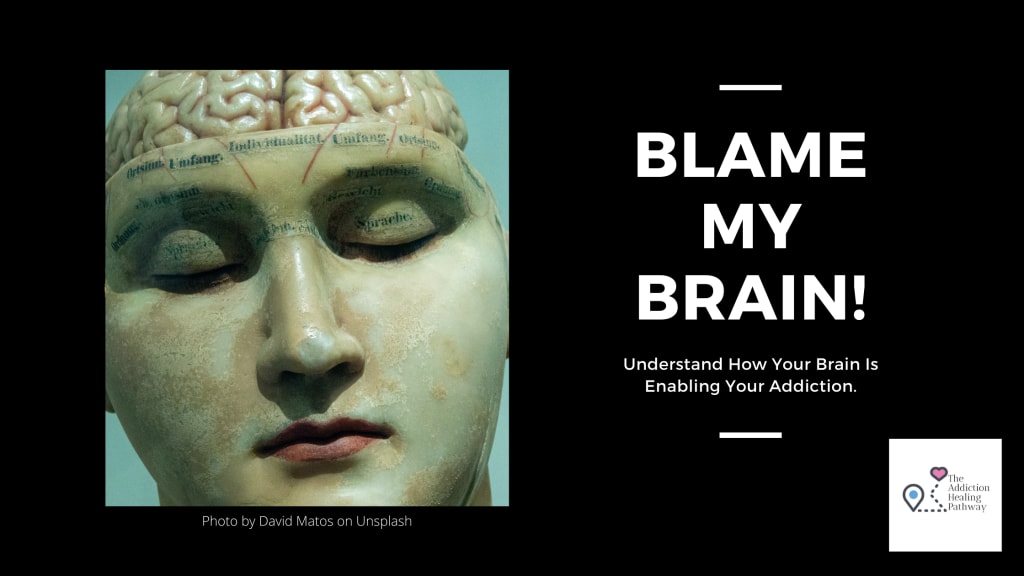
Even before you became addicted, your brain made you vulnerable to substance and activity dependency. This is because, at the very core, we have an animal brain. All it cares for is getting pleasure and avoiding pain. Neuroplasticity also enables any behaviour (helpful or harmful) to become ingrained and automatic. The reality is that our brains both encourage and support our addiction at a physical level.
It still breaks my heart when I think of how I treated my family when I was in the throes of addiction. I kept wondering what the hell was wrong with me when I would put getting a drink before caring for my kids. What kind of monster would think it was more important to be 'out of it than to be truly present for their children?
However, when I learnt about the brain's role in addiction, a great weight fell from my shoulders. I could finally understand why I was doing such terrible things, and I could put some space between me and the addiction. I could even begin to believe that I was not addicted. My brain was. In this way, I could stop associating myself with the addiction and begin treating its causes and effects. I was able to begin letting go of the idea that I was a failure and work on fixing the brain patterns that were keeping me stuck.
With knowledge comes power, so let's get familiar with how our brain contributes to our addiction. Because when we know how our brain works, we can use its power for good – for healing.
Old Brain v New Brain
The human brain is an incredibly sophisticated organ. However, at its core, it shares the same basic structures as our reptile and primate ancestors. Evolution has merely added layers on top to help humans deal with their more complex environments and tasks. The result is that there are two distinct sections of the human brain being the :
- Old brain – that we share with our reptile and primate ancestors. It is located in the core of the brain and includes the brain stem and limbic brain. It is also known as the Limbic System or Animal Brain and houses both the brain's pleasure centre and fear centres.
- New brain – that makes up the outer layers of the brain. It includes the two large cerebral hemispheres full of dense grey matter, also known as the neocortex. The neocortex is where we see an immense neuroplasticity ability and, therefore, the gift of almost infinite learning capacity.
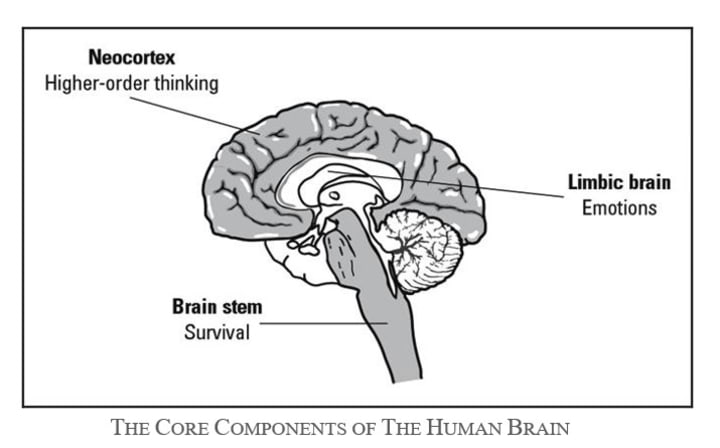
The problem is that every piece of information we receive into the brain passes first through the Old Brain. Thus, without awareness, thoughts and behaviours can be hijacked and driven towards harmful addictive behaviours. Let me show you how.
Our Animal Brain Can Work Against Us
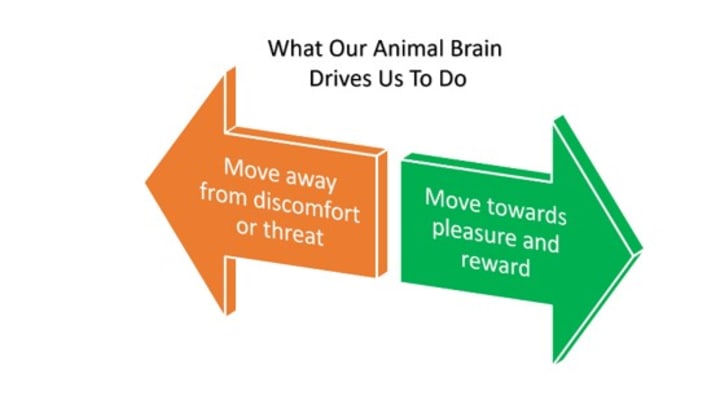
When our ancestors were animals, there was only one thing they cared about – survival. And this is exactly what the Animal Brain is set up for. It does this by:
- Seeking out pleasure and gaining reward. The release of the neurotransmitter dopamine motivates us to do 'feel good' survival activities such as eating, reproducing, and caring for offspring.
- Avoiding pain and escaping a threat. By releasing hormones such as cortisol and adrenaline, it prepares our bodies to fight, flight or freeze when we sense danger.
These two basic drivers, pleasure and pain, dictate most, if not all, of our actions.
"Nature has placed humankind under the governance of two sovereign masters, pain and pleasure. It is for them alone to point out what we ought to do, as well as to determine what we shall do." ~ Jeremy Benthem
Here's the kicker, though. We humans have become too smart for our simple animal brain. We have:
- invented substances and technologies that provide an even greater pleasure hit than the natural survival activities
- removed ourselves from the life and death threats of the jungle life, but still treat our daily encounters with the same seriousness.
Prioritising the Greatest Pleasure Hit
Our animal brain is pretty dumb. It operates from one simple rule - prioritise those activities that give the greatest pleasure response. It does not judge whether the substance or activity is healthy or deadly. It only evaluates its worth on the amount of dopamine released. It mistakenly believes that the more dopamine that is released, the more life-sustaining the substance or activity is. So, while eating, sex and being around loved ones does release dopamine (the 'feel-good neurotransmitter), illicit drugs can release between two and ten times the amount of dopamine that these natural activities can.
Moreover, they activate the dopamine even quicker and more consistently. A few years ago, research found that video games increase the brain's dopamine level by 100%, which is the same amount of pleasure gained during sex. However, the games have become increasingly more sophisticated. As a result, it is predicted that the pleasure gained from video games now exceeds physical intimacy.
Suppose the drug you take or activity you do gives you a bigger pleasure response than eating or being with loved ones. In that case, sadly, if you continue to expose yourself to the substance or activity, it may inevitably get put before food or spending time with family and friends. That, dear friends, is just how our animal brain works.
When Everything Is A Threat
Just like our animal brains don't distinguish between healthy and harmful pleasures, our Animal Brain does not distinguish between real threats to our survival and mere threats to the ego. Most of us don't live in jungles anymore and certainly don't come across lions on our way to the office. But all it takes is for us to think about being chased by a lion and the same chemical responses occur in the brain.

So, when we interpret an everyday challenge as a crisis or when we worry about things that have not happened, our Limbic System kicks in and gets us ready to fight, flight or freeze.
How does this relate to addiction? Well, as we have heard, our Animal Brain will help us avoid pain. Drugs, alcohol and internet gaming provide pleasure and a convenient escape from a difficult situation. Suppose we cannot manage the stressors around us or are unwilling to deal constructively with pain or fear. In that case, we set ourselves up to be attracted to those things that will help us run away and numb out from the discomfort.
The Pros and Cons of Neuroplasticity
Our brain has the amazing ability to change itself, and this is known as neuroplasticity. Neuroplasticity is exciting because it gives us the ability to heal the brain from the ravages caused by addiction. However, we first need to understand two changes that have already occurred in your brain that may be keeping you stuck in addiction. There are:
- Tolerance; and
- Automaticity.
Tolerance Turns Down The Volume
We have heard how drugs, alcohol, and the internet flood the brain with dopamine and, for a time, deliver pleasure and reduce pain. But there is a cruel twist to this plot. Just when your brain has you sucked into the pleasure response, it turns down the volume. You see, the brain actually can't handle the continual onslaught of excessive dopamine. So it will change to protect itself. In the act of self-preservation, it will begin to release less dopamine, or it will close down some dopamine receptors to lessen the hit.
This adaption means that over time the amount of pleasure you get from the substance or activity decreases. But you know how much satisfaction is possible, so the natural response is to begin consuming more to get the same hit as before. Tolerance is neuroplasticity in action. Unfortunately, though this change in the brain only works to escalate the addiction.

Automaticity Destroys Awareness
Every time you take the substance or do an addictive activity, you build a habit. If you repeat this activity enough times, you make it an automatic behaviour. Think about reading. When you first learnt how to read, it was cumbersome. But after months and years of practising it, all just fell into place. You could then read a book without thinking about each word.
It is just the same with your addiction. Every time you reach for a drink when you are stressed. Every time you start an online game to avoid conflict. Every time you pop a pill to escape a struggle – you are 'practising' an addiction. The longer you practice, the more automatic the behaviour will become, and the less space there is between the stimulus and your response. You lose your awareness, and as a result, the power to choose your actions.
What This Means For Healing From Addiction
Alas, there is no treatment available to get an addictive habit burnt or shocked out of the brain. I know because in my desperation for a 'cure', I have asked! The fact is we have put in the repetitive work to build the addiction. Now, the only way is to put the work into replacing it with habits that help us sustain our spirit and thrive. The more hardwired the addiction behaviour is in your brain, the more time it will take to replace this behaviour with a healthier means to the same end. The only thing you can rely on to heal ingrained addictive behaviours are time, patience and compassion.
The knowledge about our pleasure-seeking behaviours also reinforces the role of the spirit in healing from addiction. According to Wayne Dyer:
"Strong emotions such as passion and bliss are indications that you're connected to Spirit, or inspired,' if you will."
I believe that the pleasure found from working true to your spirit is the only thing that can rival the harmful substances we take or activities we do to feel good. When you touch the spirit and find a way to bring it into your everyday life, then you get bliss. But this bliss comes from a source that is already within you.

Photo by Darius Bashar on Unsplash
How does the knowledge about our threat avoidance behaviour help our healing? Well, I believe when we are not living authentically, we are in conflict with our own spirit. There is an internal war, and there is fear that we seek to escape from. Maybe we are afraid about being 'found out' or being rejected if we reveal our true selves. Maybe we believe our real self is 'faulty' and act aggressively towards our body, mind and spirit. Either way, there is a war raging between the life you live and the spirit that sustains it. Our brains will drive us to escape the conflict. If we are unwilling to live authentically, then the only other option is to numb out and seek pleasure in external substances and activities. If we choose to deny and attempt to destroy our spirit, we create an ongoing vulnerability to addiction.
Blame v Responsibility
It would be so great just to be able to blame our brains for our addiction. After all, this article shows how our animal brains encourage, escalate and keep us trapped in addiction. But with knowledge comes responsibility. You now have the responsibility to use the power of the brain to heal from addiction. Understanding the role of our brain in addiction is an incredible first step on the healing journey. But to bring ultimate peace, you must take responsibility for your future, build courage and go much, much deeper. Find out more at The Addiction Healing Pathway.
May you come to understand the incredible power of your brain and harness this power to live your life to the fullest.
About the Creator
Belinda Tobin
Author. Series Executive Producer for the award-winning Future Sex Love Art Projekt. Founder of The 3rd-Edge The Addiction Healing Pathway.
Keep reading
More stories from Belinda Tobin and writers in Psyche and other communities.
Who is your "Person"?
It's important to recognize that you cannot go through life as easily on your own. My name is Elizabeth and I'm a survivor of child abuse and horrific trauma. Healing from trauma is not a quick fix and recognizing that it will take time, is part of the struggle.
By Elizabeth Woods4 days ago in Psyche
Review of 'Man on the Run'
My wife and I saw Man on the Run, a nearly 2-hour documentary on Amazon Prime, about Wings, Paul McCartney's group that flew around the world from shortly after The Beatles broke up in early 1970 to shortly after John Lennon was murdered at the end of 1980, making a Beatles reunion forever impossible.
By Paul Levinson6 days ago in Beat


Comments
There are no comments for this story
Be the first to respond and start the conversation.