
Apollo 11: A Forensic Approach to Photographic Consistency
Examining Light and the Integrity of Photographic Evidence

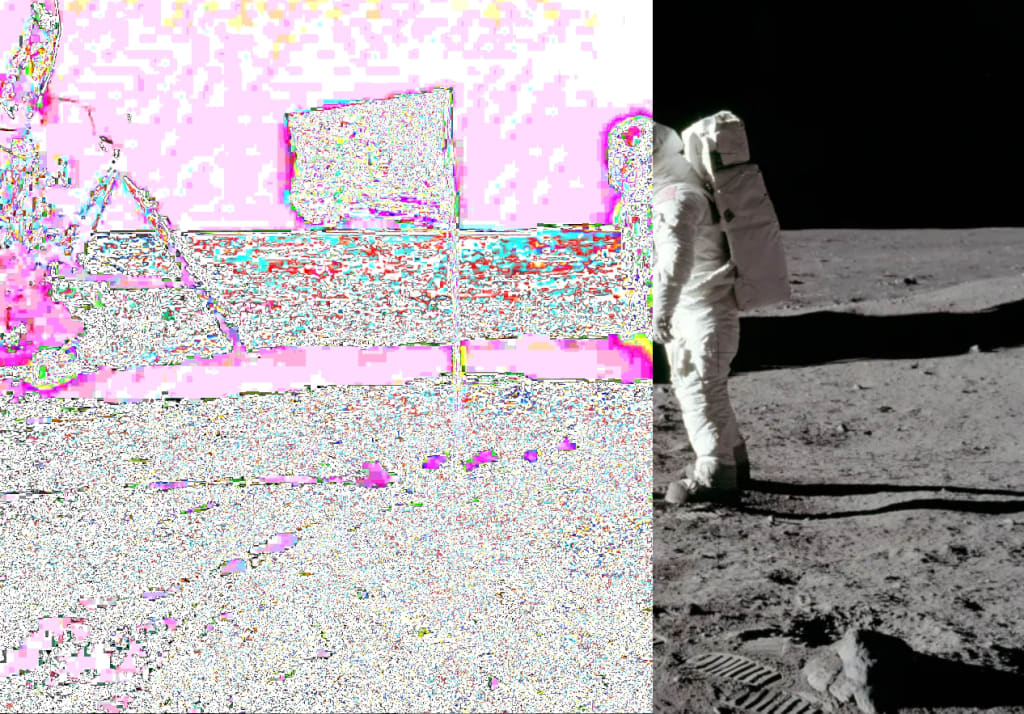
Note: This process began in 2021 and is now concluding
There is a quiet, unrelenting pain in recognizing that the truth—the hard, unvarnished truth—often holds no power in the face of perception. I have spent years deliberately training myself to acknowledge my own errors, embracing the discomfort of self-examination. And yet, the more I correct myself, the more the world accuses me of an inability to concede. The irony is a bitter one.
We live in a society where error is punished rather than seen as a catalyst for growth. The acknowledgment of a mistake is met not with admiration but with scorn, as though to admit fault is to surrender a piece of oneself. But what does self-deception achieve? What purpose does it serve to weave a comforting lie over an uncomfortable reality?
It achieves nothing but misery. I have long believed that deception—especially self-deception—wreaks havoc on the mind itself. The neurons responsible for integrating truth are disrupted, forced to construct an increasingly tangled web of conflicting information. Over time, this breeds a peculiar blindness: the inability to reconcile past contradictions, the slow erosion of self-awareness. Motivated forgetting, as it is called, is not simply a passive defense mechanism—it is a deliberate act of self-sabotage.
The Relentless Pursuit of Truth: A Journey Through Cognition, Bias, and Image Forensics
For over a decade, I have immersed myself in the study of cognition, probing the depths of mind-stimulating activities such as mathematics, philosophy, language construction, and history. My approach has always been interdisciplinary, driven by an insatiable curiosity that compels me to answer the questions that arise from each exploration. In this journey, I have developed new cognitive models, such as the theory of cognitive impasse, and refined our understanding of cognitive dissonance by challenging my own biases. What I once believed to be true often crumbled under scrutiny, leaving me with the humbling realization that the greatest teacher of all is failure itself.
Failure sharpens perception. It forces refinement. Each mistake becomes a lesson in navigating reality—a reality littered with misleading narratives and unverified claims masquerading as truth. This became especially evident when I ventured into the field of forensic image analysis, an area I had not initially set out to explore but was drawn into through personal experience.
A Window into the Invisible: Perceiving Electromagnetic Waves
An unexpected eye injury became a pivotal moment in my research, leading to an unusual perceptual anomaly—I began seeing faint shadows of what I soon discovered to be electromagnetic waves. Though, it was not a fully pleasant experience. While many would dismiss this as an illusion, I saw it as an opportunity of study. I also challenge the notion that electromagnetic waves are entirely invisible. See paper here.
And though my eye injury revelations did not directly contribute to forensic techniques, they set me on a path of inspiration. This led me to develop an advanced but simple forensic image analysis technique, one that was found to have the neighboring principles of Error Level Analysis (ELA) but as an extreme version so to say which caused—not a greater accuracy, but different one with greater consistency.
Unlike traditional ELA, which detects digital manipulation by highlighting compression artifacts, my method—Image Degradation Analysis (IDA)—examines the electromagnetic leaking of the color spectrum. I will show an example of this with the sun below.
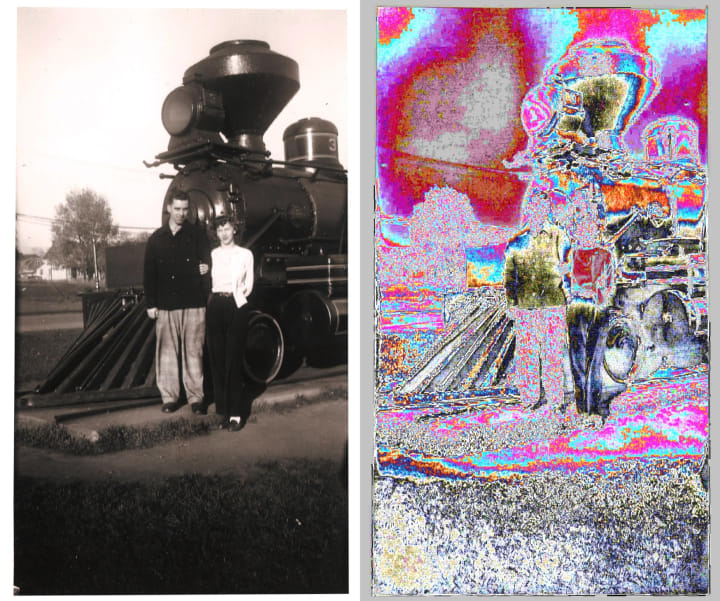
The difference between Image Degradation Analysis (IDA), above and Error Level Analysis (ELA) below.

The Image Forensic Technique
The differences between ELA and IDA are apparent. Where ELA identifies broad discrepancies in image structure, IDA delves into the physics of light interaction. The results are remarkably consistent, making it a powerful tool for evaluating historical, present, and digital imagery.
As I honed this technique, I tested it across various applications—from verifying the authenticity of historical photographs to scrutinizing celestial photography. And then, my attention turned to a subject that had long been mired in controversy: the Apollo moon landing photographs.
The Scrutiny of a Skeptic
Like many, I had always dismissed moon landing conspiracies as absurd. The overwhelming consensus among scientists supported the Apollo missions as historical fact, and I saw no reason to question it. My forensic technique, I believed, could finally put an end to the speculation by verifying the integrity of the images once and for all.
I approached the analysis with excitement, eager to debunk the conspiracy theories. My method was simple—apply the forensic technique to Apollo photos and compare them to known authentic images by comparison. If the results aligned, it would serve as yet another piece of evidence supporting the Apollo landings.
However, as I progressed, my initial enthusiasm began to wane. The images from the International Space Station, and all images in orbit passed these tests with flying colors. However, the inconsistencies I found were not minor anomalies that could be dismissed as photographic artifacts—they were fundamental failures in the physical properties of light.
The Sun Consistency Test
A single question dominated my thoughts: if the Apollo photographs were real, the sun would behave consistently within them. Now, I was off to find photos of the sun, still clinging to the hope that they were authentic in some way.
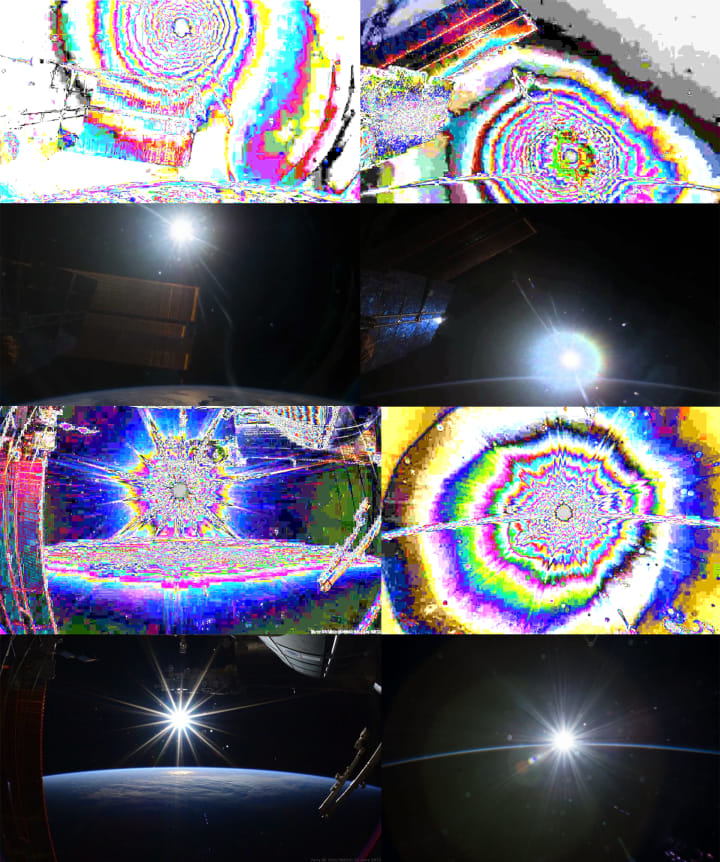
The sun, as observed from Earth and space, maintains a consistent signature under varying imaging conditions. Regardless of whether viewed from orbit, from Earth’s surface, or from interplanetary space, its radiance remains within a predictable range. The atmosphere influences its appearance near the horizon but does not alter its core characteristics when observed directly above.
What did alter it were edited photos, and varying degrees of compression, but still, the normal characteristics shone through.

The Apollo footage provided an ideal test case. Within the same film canister, there were images of the sun as seen from Earth orbit (second photo from the right above) and images of the sun from the moon’s surface. The same camera, the same conditions—yet, inexplicably, the lunar sun lacked any of the distinct characteristics seen in every other instance.
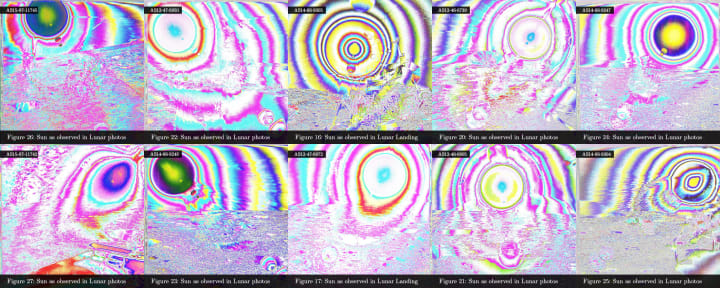
Lehti, Andrew (2025). Degradation Analysis of Lunar Landing Photos: Evaluating Authenticity of Light Sources. figshare. Media. https://doi.org/10.6084/m9.figshare.28225073
My forensic process verified that:
- The sun in orbit and from Earth displayed consistent optical properties.
- The sun in the Apollo lunar photos in orbit matched known images of the sun, including those taken in space throughout the years.
- The "sun" in Apollo photographs exhibited no characteristics, and no spectral consistency across different lunar images with known and established forensic imagery of the sun.
This was not a minor anomaly. It was a systemic failure of consistency, something that should not happen if the images were authentic.
Confronting the Implications
As a scientist, my approach is not to confirm what I want to believe but to disprove my own assumptions. This method has led me to challenge many of my own deeply held views, forcing me to acknowledge where I was wrong. It is not a comfortable process—it is often frustrating, sometimes painful—but it is the only path to truth.
The implications of my findings do not automatically lead to any definitive conclusion about the Apollo missions themselves, but they do raise serious concerns about the photographic evidence presented as proof. The sun’s inconsistency cannot be explained by camera settings, exposure levels, or film degradation—it is a fundamental issue of physics. Yet, they pass these as if they were factual. That is the issue I have. The perversion of science.
This journey into forensic analysis began with an injury, an unintended perception, and a curiosity that would not be ignored. It led me to develop a technique that has proven itself in various applications, only to confront me with a question far more unsettling than I ever anticipated: what do we do when the evidence does not align with what we have been told?
Science demands scrutiny. If we are to hold our knowledge to the highest standard, then no claim should be beyond verification—not even the ones we have taken for granted as historical fact.
About the Creator
Andrew Lehti
Andrew Lehti, a researcher, delves into human cognition through cognitive psychology, science (maths,) and linguistics, interwoven with their histories and philosophies—his 30,000+ hours of dedicated study stand in place of entertainment.
Keep reading
More stories from Andrew Lehti and writers in Psyche and other communities.
Why We Fear Being Wrong: The Psychology of Rigid Thinking
Introduction: The Illusion of Learning Education is often framed as the pathway to knowledge, critical thinking, and personal growth. Yet, if that were true, why do so many individuals leave school with rigid thinking patterns, an inability to question authority, and a deep fear of being wrong? Why does intellectual stagnation persist despite increasing access to information?
By Andrew Lehti12 months ago in Journal
The 6 Hardest Life Truths You Already Know But Refuse to Face
Life has a strange way of teaching lessons we wish were not true. Deep down, most people already know some uncomfortable truths about life. Yet, instead of facing them directly, we distract ourselves with routines, entertainment, or false hopes. These truths are not meant to discourage you. In fact, accepting them can be incredibly freeing. When you stop denying reality, you gain clarity, resilience, and control over your life. Here are six of the hardest life truths most people already know—but often refuse to face.
By Shahid Zamana day ago in Psyche


Comments
There are no comments for this story
Be the first to respond and start the conversation.